

Ashok Ogra
ashokogra@gmail.com
When news came of Dharmendra’s death, many of us returned, almost instinctively, to Sholay. Among its most remembered moments is Basanti (Hema Malini), reins in hand, urging Veeru (Dharmendra) forward as her Tonga rattles across the dusty roads of Ramanagara. The bells ring, the horse moves steadily, and Basanti’s chatter fills the air. The scene stays with us because the Tonga is not just a vehicle. It carries feeling, memory, and a sense of time.
Though Tonga has nearly vanished from Indian cities, it has not disappeared from our imagination.
There was a time when mornings in many Indian towns began not with horns and engines but with the soft rhythm of hooves on the road. Tongas carried schoolchildren, families returning from markets, elders who disliked rushing, and young couples quietly sharing space. Journeys were slow, but they allowed people to notice one another.
In Kashmir, long before modern highways, Tongas travelled the old Mughal Road linking Poonch and Rajouri with the Valley through the highest point on the historic Mughal Road ,Pir ki Gali mountain pass. The journey was scenic but demanding. Shepherds and traders had used the route for centuries. Before 1947, Tongas were also common between Amritsar and Lahore, connecting towns that later found themselves separated by borders.
In Srinagar, where I was born and grew up, Tonga survived well into the mid-1970s. Older Kashmiris still recall rides along the Jhelum, over wooden bridges, or through the old city, Rainawari, and Fateh Kadal. Before minibuses and matadors arrived, Tonga set the city’s rhythm. Though absent from the roads today, it lives on in shared memory as a reminder of a gentler Srinagar.
The Tonga did not originate in India, though it found a lasting home here. Horse-drawn carriages of similar design existed across Europe and West Asia for centuries. The word “Tonga” is believed to have Central Asian roots and entered Indian usage during the colonial period. Under British rule, the vehicle was standardised-light, two-wheeled, affordable-and spread quickly across Indian towns.
Elsewhere, it existed under different names. In Britain, a type of horse-drawn carriage locally known as hansom cabs that was designed by British architect Joseph Hansom in 1832 dominated city streets in the 19th and early 20th century. In France, Fiacres were horse-drawn carriages used for public hire. In Russia and Eastern Europe, small horse carriages moved people through narrow lanes. In parts of Southeast Asia, horse carts remained common well into the twentieth century.
India adopted the Tonga not as a luxury carriage, but as a people’s vehicle-cheap to run, easy to maintain, and suited to crowded towns.
Delhi’s association with the Tonga stretches back to Mughal times and expanded under British rule. For decades, it was a key part of the city’s transport system. Even in the 1970s, Tongas were still allowed around Connaught Place during fixed hours. A complete ban in 2011 finally ended their presence on Delhi’s roads.
Some cities held on longer. Pune once had proper Tonga stands at Swargate, Ghorpadi, and near the railway station. Fares were low and familiar. Even the name Swargate traces back to Sawar Gate-simply, the place where one took a ride.
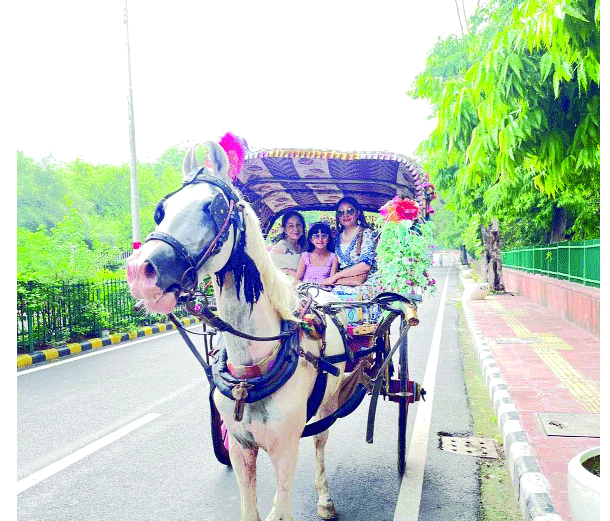
Today, Haridwar is among the few places where Tongas remain part of daily movement. Visitors hire them to travel between temples, markets, and ghats. The experience is simple-four passengers at most, a calm horse, and a rider who knows every turn of the town.
In Lucknow, a Tonga ride through the old city to the Imambara still feels natural. Narrow lanes and dense neighbourhoods seem suited to slow travel.
As for transport, Tonga has mostly lost the race. As emotion, it has not. For Tonga riders, the cart is not nostalgia-it is survival.
Sociologist Ashis Nandy has often noted India’s habit of equating speed with progress. Older systems are discarded with little thought to what they once sustained-skills, livelihoods, and dignity. The disappearance of the Tonga fits that pattern.
Most riders inherit the trade. The horse, the route, and even the customers are often passed down through generations. A typical day begins before sunrise, with feeding, grooming, and checking the cart. Earnings depend on weather, footfall, and festivals. On a good day, a rider may make enough to cover fodder, basic expenses, and little else.
Rising costs have made life harder. Fodder prices have increased, veterinary care is expensive, and space to stable horses is shrinking. Competition from motor vehicles has reduced daily rides. Many riders admit that their children do not wish to continue the profession.
Yet most remain deeply attached to their work. The horse is treated as family. The rhythm of the road, the familiar faces, and the quiet pride of honest labour keep them going.
For them, the Tonga is not a heritage symbol or tourist attraction. It is dignity on wheels-slow, fragile, and increasingly rare.
Today it survives mainly in tourist spaces-heritage towns, temple circuits, old neighbourhoods-more for feeling than for need. Traditional two-wheeled Tongas are now rare, replaced by horse-drawn four-wheeled carriages known as Sarots.
Heritage Tonga rides are organised in Kolkata, while in Mysuru they appear during Dasara celebrations. Anthropologist Nita Kumar, writing on north Indian towns, describes such practices as part of a city’s “intimate life”-ways of moving that allow people to engage with a place rather than rush through it.
In Agra, Tongas ferry tourists from parking areas to the Taj Mahal gates-a small but telling reminder of an older time.
In Jaipur, the Pink City seems made for slow travel. A Tonga ride past Albert Hall or through old bazaars lets the city unfold gradually. In Mumbai, the experience becomes almost romantic: night rides along Marine Drive ending at the Gateway of India reveal a softer city. Seen from a Tonga, even Mumbai appears willing to pause.
Writer Sushmita Mahanta notes that the sight of a Tonga-the bells, the colours, the sudden movement of the horse-can instantly bring back childhood. Perhaps this is why Tonga rides are quietly returning, not as transport but as memory.
If real life pushed the Tonga aside, Hindi cinema did the opposite. Films turned it into a space for romance, mischief, and song.
The famous “ghoda-gaadi songs” of the 1950s and 1960s remain favourites, especially those by O. P. Nayyar, who used hoofbeats almost like percussion. Shammi Kapoor’s energy in Yoon toh humne lakh haseen (Tumsa Nahin Dekha, 1957) remains unmatched. Madhubala’s Yeh kya kar daala tune (Howrah Bridge, 1958) turned a simple Tonga ride into magic.
Long before Nayyar, Naushad had already matched music to hoofbeats in Aan and Udan Khatola. Film scholar Rachel Dwyer has observed that such scenes turned ordinary objects into emotional symbols, making the Tonga a metaphor for closeness and shared space.
What keeps the Tonga alive is the many worlds it connects.
i. It belongs to history, reminding us of cities that once moved at human pace.
ii. It belongs to cinema, where it carries unforgettable romances.
iii. It belongs to tourism, reborn as experience rather than necessity.
iv. And it belongs to riders who still depend on it to earn a living.
Cities are growing faster than hooves can carry us. Roads widen, traffic hardens. Yet the affection people feel for Tonga-shaped by childhood, travel, and cinema-suggests it may not disappear completely. It may grow rarer, but also more cherished.
As long as a child points and asks, “Can we take that ride?”, the Tonga will survive-not just on a few streets, but in memory.
Its wheels may turn slowly, but like many things that refuse to fade, the Tonga keeps moving.
(The author works for reputed Apeejay Education, New Delhi)
 Follow our WhatsApp channel
