

Satish Singh Manhas
manhas444@gmail.com
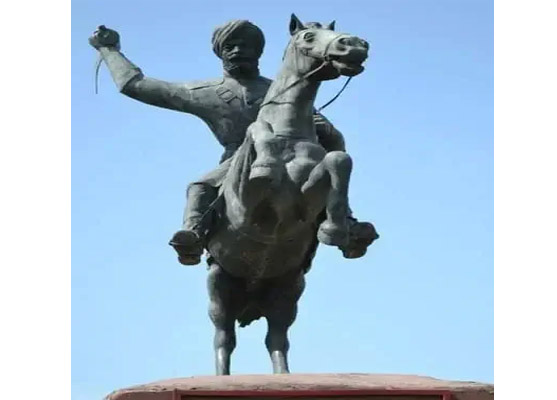
History records only a few generals whose name echos across mountains and frontiers for centuries. Among them stands General Zorawar Singh, the legendary Dogra military commander whose courage, strategic brilliance, and unmatched grit earned him the title “Napoleon of India.” His campaigns across Ladakh, Baltistan, Gilgit, and even the treacherous terrains of Tibet remain some of the most daring military expeditions ever undertaken in the Himalayas and high peaks world over. At a time when expanding territory across such perilous landscapes was considered nearly impossible, General Zorawar Singh achieved what few leaders in world history ever could-he expanded frontiers through sheer courage, sharp strategy, and invincible leadership, becoming one of only a handful of generals globally recognized for pushing boundaries into new realms.
Early Life and Rise of a Commander
Born in 1786 in a humble Rajput family in Kahlur (Bilaspur), Zorawar Singh’s journey to military greatness was forged in hardship. His early life was marked by discipline, resilience, and an unyielding spirit-qualities that would later define his military career. His destiny changed when he joined the service of MahaRaja Gulab Singh of Jammu and Kashmir, whose trust he soon earned through extraordinary displays of loyalty, organizational skills, and battlefield brilliance. Within a short span, Zorawar Singh rose from the ranks to become the chief military general of the Dogra forces, responsible for conducting some of the most ambitious military campaigns ever attempted in the Himalayas and in world military history.
Architect of a Unified Himalayan Frontier
General Zorawar Singh’s legacy is distinguished not just by victories but by the scale and difficult level of his operations. His campaigns were not fought in plains or temperate climates-they were conducted in some of the world’s harshest, coldest, least accessible terrains, including glaciated passes, plateaus above 14,000 feet, and deserts of snow where survival itself is a challenge.
Conquest of Ladakh
Before Zorawar Singh’s arrival, Ladakh was independent and geographically isolated. His 1834 campaign changed that forever. With unmatched logistical planning-transporting weapons, supplies, and troops across Himalayan ridges-he led the Dogra army into Ladakh and achieved decisive victories. The successful annexation integrated Ladakh with Jammu and Kashmir, laying the foundation for the 19th century political map of northern India in particular and Bharat in general.
Victories in Baltistan
In 1840, Zorawar Singh led another audacious campaign into Baltistan. Fighting sub-zero temperatures and rugged glacial pathways, he captured Skardu after a prolonged siege. His victory expanded the Jammu and Kashmir empire’s reach and brought stability to the region. Few generals in world history have succeeded in conquering such difficult high-altitude kingdoms consecutively.
The March into Western Tibet
It was a Feat comparable to World Military Legends. In 1841, Zorawar Singh launched what is considered his most extraordinary expedition-the invasion of western Tibet, making him one of the only generals in universal military history to expand a kingdom’s borders deep into another sovereign territory across one of the most inhospitable terrains on Earth. His forces crossed the Mansarovar-Kailash region, fought on frozen plateaus, and secured victories at several Tibetan outposts. His tents fluttered near Taklakot and other Tibetan fortifications, astonishing even Tibetan chroniclers with the precision and confidence of his military operation.
Valor and Sacrifice
Every great military life meets its defining moment, and for Zorawar Singh, that came in the winter of 1841. Surrounded by fierce resistance near Taklakot, with temperatures dropping to lethal levels and snowstorms flooding the valley, he refused to retreat. Leading from the front, sword in hand, he fought fearlessly until he fell on 12 December 1841, achieving martyrdom in battle-an end befitting a warrior of his stature. Tibetan historians themselves recorded his bravery, acknowledging that he died like a lion, on the battlefield, facing his enemies head-on.
A Legacy Larger Than Time and generation’s
General Zorawar Singh’s name continues to inspire soldiers, mountaineers, and patriots. His campaigns reshaped geopolitics across the Himalayas. His courage brought vast regions-Ladakh, Baltistan, and Gilgit-under Indian influence, contributing significantly to the modern northern borders. Military historians rank him alongside some of the world’s most audacious military commanders because no other general in Indian history has successfully conducted multi-front high-altitude expansions over thousands of kilometers of treacherous terrain. His logistical genius, adaptability, and icy-terrain combat mastery remains part of military studies even today.
Honoring a National Hero
This is an urgent call to the Government of India: Given his unparalleled contribution to India’s territorial integrity and military history, it is fitting to honor General Zorawar Singh in ways that match the scale of his legacy.
Naming the Ladakh Tunnel/Zojila tunnel after General Zorawar Singh
The new Ladakh tunnel-an engineering marvel aimed at improving connectivity between the region he helped bring under Indian control-should rightfully bear his name. Naming the tunnel “General Zorawar Singh Tunnel” would pay homage to the man who secured Ladakh through courage and strategy. It would educate future generations about his bravery and sacrifices. Remain an eternal reminder to symbolize the unity he forged across Himalayan regions. It would reflect India’s pride in its military heritage. Just as roads, bridges, and passes in other nations honor their greatest military heroes, India too must honor one of its bravest sons.
Military Honor Posthumously
Many nations award their highest military decorations retrospectively to warriors whose valour shaped national history. General Zorawar Singh stands tallest among the tall for such honor. His battlefield courage, strategic brilliance, and ultimate sacrifice fully embody the spirit of the Param Vir Chakra-gallantry “beyond the call of duty.” Posthumously awarding him India’s highest military honor would acknowledge his decades of service, recognize his unmatched role in securing India’s northern frontiers, Correct a historical oversight and finally inspire every Indian soldier to emulate his courage. This recognition is not merely symbolic-it is a tribute that history owes him.
(The writer is Assistant Director Forest Department)
 Follow our WhatsApp channel
