

B S Dara
bsdara@gmail.com
What began as a United States-Israeli strike on Iranian targets has rapidly evolved into a wider regional confrontation. Missile exchanges across the Gulf, disruptions to the Strait of Hormuz, and attacks on strategic infrastructure now threaten global energy security and regional stability.
The military confrontation involving the United States, Israel, and Iran is entering a dangerous and uncertain phase as missile exchanges, retaliatory strikes, and strategic disruptions continue across the Gulf region. What began as a targeted military offensive has now expanded into a wider conflict affecting multiple states across the Gulf Cooperation Council, with direct implications for global energy security, regional stability, and international diplomacy.
The conflict began on 28 February 2026 when the United States and Israel launched coordinated strikes against Iranian targets. The operation initially targeted military installations and strategic facilities across Iran. Soon after, the strikes resulted in the death of Iran’s Supreme Leader, Ayatollah Ali Khamenei. The incident transformed what may have been intended as a limited military action into a conflict of far broader political and strategic consequence. Iran responded with a series of retaliatory operations directed not only at Israeli territory but also at installations across the Gulf region associated with United States military deployments. As on 4 March 2026, missile and drone strikes are still occurring against strategic facilities across several Gulf Cooperation Council states, including Qatar, Saudi Arabia, the United Arab Emirates, Bahrain, Kuwait, and Oman. Major attacks are targeting locations hosting United States military infrastructure, including installations connected to United States Central Command (CENTCOM). Energy infrastructure and logistics installations across the region remain under repeated threat.
What began as a targeted military strike has now evolved into a regional conflict with direct consequences for global energy security and maritime stability. Missile exchanges across the Gulf are placing one of the world’s most concentrated clusters of energy infrastructure under sustained threat.
The widening scope of the conflict reflects the dense strategic geography of the Gulf. Military installations, shipping routes, and energy infrastructure are closely concentrated across the region. When retaliation expands beyond the immediate battlefield, the resulting impact spreads quickly across multiple states that host allied security infrastructure. The Strait of Hormuz has emerged as a central theatre in the confrontation. Iranian authorities have announced restrictions on maritime traffic through the strait, one of the world’s most important oil transit corridors. Approximately one-fifth of globally traded oil normally moves through this narrow passage connecting the Persian Gulf to international shipping routes. Any disruption to shipping through this corridor carries immediate implications for energy markets and global supply chains.
Shipping industry sources indicate that tanker traffic through the strait has declined significantly following the escalation. Insurance costs for vessels operating in the Gulf have increased sharply, reflecting the elevated risk environment. Several commercial shipping operators have temporarily suspended transit through the corridor while assessing operational safety. These developments have placed immediate pressure on global energy markets.
Regional airspace closures have compounded these disruptions. Several Gulf states have restricted or suspended civilian aviation routes due to missile and drone activity in the region. Airlines have diverted flights to alternative corridors, leading to longer routes, logistical complications, and delays across international travel networks. Airports across the region are experiencing operational strain as airlines adjust schedules and manage stranded passengers.
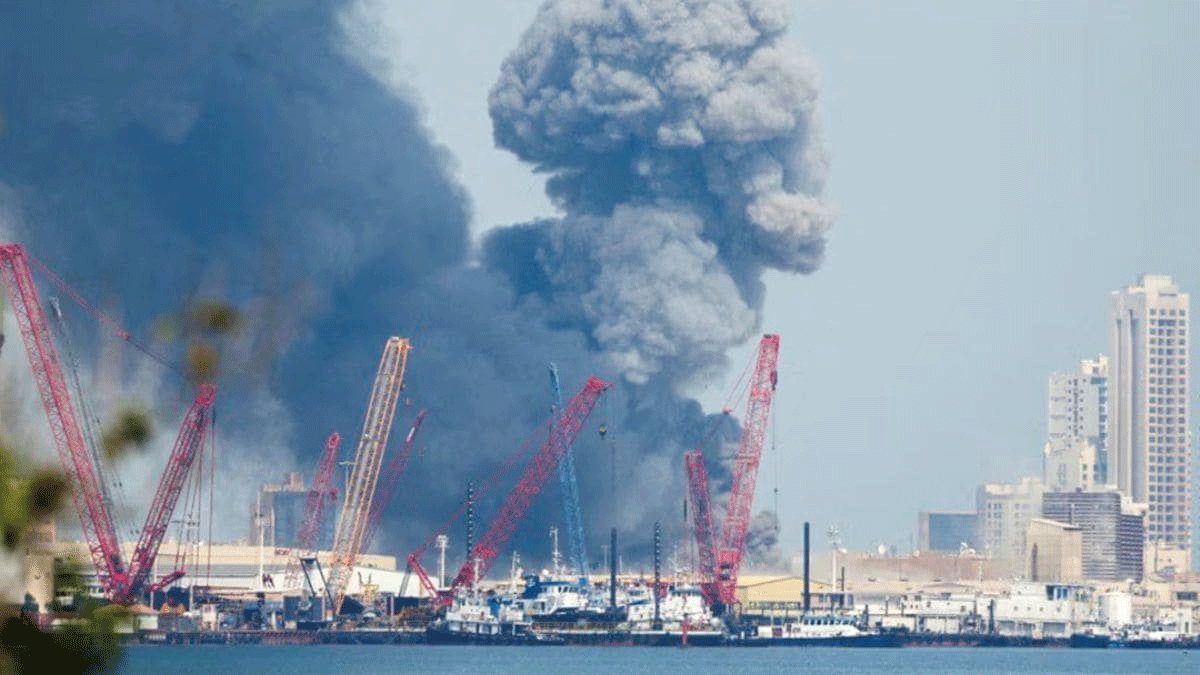
Energy infrastructure across the GCC has also faced heightened risk. Saudi oil refining facilities have experienced operational disruptions following reported missile strikes. Liquefied natural gas facilities in Qatar have been placed under enhanced security protocols as drone incursions and missile alerts continue across the region. Governments across the Gulf have activated defensive measures to protect export terminals, power stations, desalination plants, and industrial zones linked to national energy production.
Within Iran, casualty figures continue to rise as strikes target facilities associated with the Islamic Revolutionary Guard Corps and other security structures. The Iranian Red Crescent Society reports that hundreds of individuals have been killed in United States-Israeli strikes across Iranian territory during the initial phase of the conflict. Independent verification remains limited due to the operational environment, but reports from several international outlets indicate widespread damage to military and strategic installations. International organizations have raised concern regarding the potential environmental consequences of attacks on nuclear-related infrastructure. The International Atomic Energy Agency has warned that strikes on nuclear facilities carry the risk of radiological contamination that could extend beyond Iran’s borders. Gulf states located in close proximity to Iranian nuclear installations could face environmental and humanitarian consequences in the event of a major incident.
The political justification for the military campaign remains contested. United States officials state that the operations aim to neutralize threats associated with Iran’s missile capabilities and its support for armed groups across the Middle East. Statements delivered by senior United States officials suggest that the duration of the military campaign may extend for several weeks depending on developments on the ground and Iran’s military responses.
Inside the United States, the conflict has triggered renewed debate over presidential war powers. Members of Congress have introduced legislation seeking to limit the executive branch’s ability to conduct extended military operations without congressional authorization. Legal analysts note that the United States Constitution assigns the authority to declare war to Congress, although modern military operations are frequently conducted without formal declarations.
Diplomatic reactions across Europe and the wider international community reflect growing concern about the risk of escalation. European governments have called for restraint while urging diplomatic engagement to prevent further expansion of the conflict. British officials have stated that Iran’s retaliatory actions pose a threat to allied interests and regional security.
The economic consequences of the confrontation are already visible beyond the Middle East. Global energy markets have reacted sharply to disruptions in Gulf shipping routes and concerns regarding supply continuity. Analysts warn that prolonged disruption in the Strait of Hormuz could affect energy imports for major economies in Asia and Europe that rely heavily on Gulf oil and gas exports.
Aviation networks across the region remain under pressure as airlines continue to divert flights away from conflict zones. The rerouting of long-distance flights increases operational costs and complicates logistics for international carriers. Travelers moving through Gulf transit hubs face significant delays as flight schedules are revised.
The conflict has also generated political consequences in states beyond the immediate war zone. Pakistan, which maintains diplomatic and security relationships across the Middle East, has experienced public unrest following the escalation. Demonstrations have taken place outside United States diplomatic facilities in several Pakistani cities. According to reporting by Reuters, demonstrators attempted to storm the United States consulate in Karachi during one of the protests. United States officials state that Marines stationed to protect the diplomatic compound opened fire after protesters breached the perimeter. Casualty figures vary across reports, but the incident has intensified domestic debate in Pakistan regarding the country’s foreign policy position amid the conflict. Pakistan’s leadership faces complex strategic pressures. The country maintains longstanding security ties with Saudi Arabia while also expressing diplomatic concern regarding military escalation against Iran. Public statements by political leaders reflect these competing considerations, with some officials condemning the attacks on Iran and others emphasizing the importance of regional stability and restraint.
The broader regional security environment remains uncertain. Sustained confrontation between the United States, Israel, and Iran carries the potential to reshape the strategic balance across the Middle East. The Gulf region hosts extensive military infrastructure associated with Western alliances, and these installations increase the likelihood that retaliatory operations extend beyond the immediate participants in the conflict. Governments across the GCC are strengthening defensive measures around critical infrastructure while monitoring developments in maritime security. Energy exporters are attempting to reassure international markets regarding supply stability, though the blockade of the Strait of Hormuz limits the effectiveness of these assurances.
Diplomatic efforts aimed at de-escalation remain limited. Iranian officials state that military action has undermined diplomatic negotiations, while Western governments argue that Iran’s missile capabilities and regional activities justify continued military pressure. These conflicting narratives complicate attempts to establish conditions for ceasefire discussions. Humanitarian agencies are also monitoring the situation closely. Prolonged conflict could generate population displacement, economic disruption, and environmental damage across several countries. Industrial infrastructure located near urban areas raises concerns regarding civilian safety should attacks intensify.
As of first week of March 2026, the conflict continues without clear signs of immediate resolution. Missile exchanges persist, maritime traffic through the Strait of Hormuz remains severely restricted, and regional governments maintain heightened security measures. Diplomatic engagement among major powers continues, but the prospects for rapid de-escalation remain uncertain.
The Gulf occupies a central position in global energy supply networks and international security arrangements. Developments in the current conflict therefore carry implications that extend far beyond the Middle East. The trajectory of the war will depend on military developments on the ground, diplomatic initiatives among major powers, and the capacity of regional states to manage escalation risks while safeguarding critical infrastructure and civilian populations.
(The author is an independent foreign affairs analyst. He is currently based between Qatar and the United States.)
 Follow our WhatsApp channel
