

Alaknanda Mahajan & Manvika Bamba
alakmahajan26@gmail.com
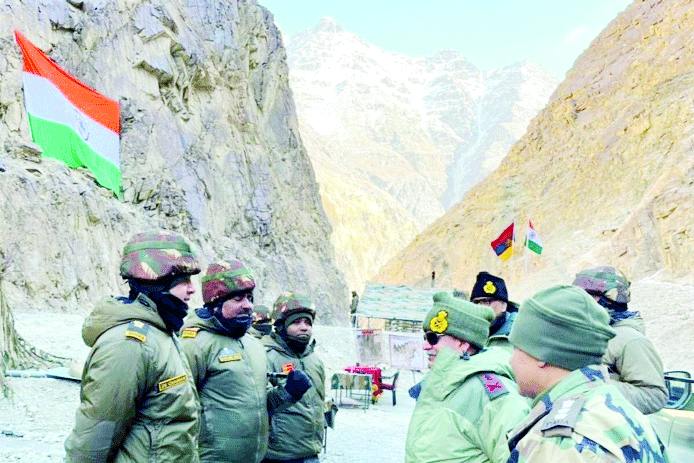
Bollywood superstar Salman Khan’s upcoming film now renamed as ‘Maatrubhumi: May War Rest in Peace’ is set to bring one of the most painful and defining episodes of contemporary Indian history to the big screen. The film is based on a series of violent skirmishes between Indian and Chinese troops in eastern Ladakh in June 2020. It revisits a moment that shook the nation, altered the dynamics of India-China relations, and permanently etched the name “Galwan” in public consciousness. For many Indians today, the Galwan clash signifies sacrifice, valour, and the harsh realities of an undefined and contested border between India and China.
Understanding the border:
 India shares a 3,488km long border with China that runs along the Union Territories of Jammu-Kashmir and Ladakh and States of Himachal Pradesh, Uttarakhand, Sikkim and Arunachal Pradesh. This boundary between India and China is trifurcated into – the Western Sector, the Middle Sector and the Eastern Sector. The Western Sector covers areas of the Ladakh region of Jammu and Kashmir along with the segment which is now Pakistan-occupied Kashmir. The Middle sector includes areas near Indian states of Uttarakhand and Himachal Pradesh sharing borders with Tibet. And the Eastern sector encompassesareas of Arunachal Pradesh.While the middle sector generally exhibits signs of peaceful coexistence the border conflicts in the Western and the Eastern sector still persists
Historical Context of the 1962 War:
At present the claims and counter-claims made by India and China concerning the conflicted areas cannot be understood in isolation from the prolonged and complex historical developments that shaped them. These contemporary tensions can be traced to the ambiguities of colonial-era frontiers, varied interpretations of the historical boundaries and competing strategic ambitions that culminated into the Indo-China War of 1962.
In the immediate aftermath of the Treaty of Amritsar (16th March 1846), the Colonial officials decided to address the problem ofundefined boundaries between Ladakh and Tibet.Accordingly, two boundary commissions wereappointed in 1846 and 1847 to demarcate the ‘exact limits’ of Maharaja’s territories. However, despite all efforts, the colonial government’s pursuit for an agreed frontier with China remainedinconclusive as the Chinese authorities repeatedly denied cooperation. Meanwhile,surveys of the frontier regions advanced at arapid pace.William H. Johnson, anofficer of Trigonometrical Survey of India in 1865 undertook surveys between Karakoram and Kuenlun ranges. He also traversed through the ‘deserted land of white stones-Aksai Chin’.Based on this survey, Johnson’s map showed entire Aksai Chin and a considerable area of land up to the crest of Kuenlun range as a part of Ladakh’s territories.In 1897, Major-General John Ardagh (Director ofMilitary Intelligence, Delhi) proposed some modifications to Johnson’s map. This demarcationthus, came to be known as the Johnson-Ardagh Line.Another solution to the boundary problem was the Macartney-MacDonald line (1899). Macartney suggested that Aksai Chin should be partitioned between both the countriesalong the Lak Tsang Range (North to China and South towards India). As far as the developments in the Eastern Sector are concerned; the British Government invited both Chinese and Tibetan delegates for the Delhi andShimla Conference of 1913-1914. Through these meetings, the British aimed at settling theboundary conundrum for Tibet. The Shimla Conference lasted for over six months and remains a landmark event in thehistory of Indo-China boundary making. It concluded with settlement of India’s North-EasternFrontiers in the form of MacMahon line. However, right from the outset China refused to recognize the MacMahon line.
Following India’s Independence, the responsibility of settling unresolved boundary conflicts with China was eventually inherited by the Indian Government, under Prime Minister Jawaharlal Nehru. Meanwhile, in China, theCommunist party under Mao Zedong came to power in 1949.The new Government continued to accept the Johnson-Ardagh line and MacMahon line as its official boundary with China. It was firmly asserted by the Indian leadership that China held no valid claims over Aksai Chin (Ladakh) and Tawang region (Arunachal Pradesh).The strained relationship between the two nations ultimately led to the War of October 1962. Even after the War, China continued to retain its control on Aksai Chin and a Line of Actual Control (LAC) was created which separates theareas controlled by India and China. But no official agreement could be concluded on its exactposition. This ambiguity is the major reason of the prevalent tensions between both the nations.
The Galwan Valley Clash (2020):
In the summer of 2020, as the entire world was reeling under the havoc caused by Covid-19 pandemic, a small and desolate valley in Ladakh grabbed headlines all across the national and global media. On15th June 2020, the Galwan valley became a flashpoint for the worst violent clash between the two Asian giants, in decades. The confrontation claimed the lives of twenty Indian soldiers in a brutal hand to hand combat. Significantly, this clash occurred in a region that has not been a site of armed conflict since the Indo-China War of 1962.
The Galwan River holds immense strategic importance owing to its proximity to the Darbuk-Shyok-Daulat Beg Oldie (DSDBO) road. This road serves as a vital artery that runs close to the Line of Actual Control. The River originates in the Aksai Chin region, near Samzungling on the eastern flank of Karakoram Range. It flows westward to join the Shyok River which is a major tributary of Indus. As Galwan Valley functions as a critical corridor connecting Aksai Chin to the rest of Ladakh, there is little doubt that it occupies a pivotal position in the strategic calculus of both India and China.
These facts about Galwan Valley and the bloodshed it witnessed, within the broader context of Indo-China boundaryconflict are widely known. Yet beyond these well-documented strategic narratives, the latter part of this article aims to highlight the life of man long-forgotten and his enduring connection to the Galwan River.
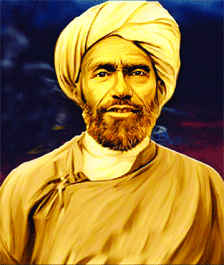
The Life and legacy of Ghulam RassulGalwan
The region of Leh has been associated with the ‘Arghon community’. It constitutes members of a trading group that has lived there for generations. During the heyday of Central Asian commerce, Arghons were employed as mule and pony drivers for the European explorers. The Arghons played a key role in trans-Himalayan trade between Leh and Kashgar. In 19th and 20th centuries, they assisted major exploratory and survey expeditions along these routes. Among them, Ghulam Rassul (1878-1925) was the most distinguished.
Ghulam Rassul Galwan’s life represents one of the most remarkable journeys recorded in the history of Himalayan exploration. Born into an impoverished family in Ladakh, Rassul was the son of a wheat-winnowing woman. He grew up in difficult circumstances that offered little opportunities for education or social mobility. However, through his strong determination, curiosity, and practical intelligence, he gradually ascended in his life and career. As a poor young boy who accompanied European and American travellers as a pony and mule rider, Galwan began his journey from a minor role. Over time, through hard work and experience, he rose to become a caravan bashi (in-charge of caravans). He later achieved the pinnacle of his career by becoming the Akskal of Ladakh and served as the chief native assistant to the British Joint Commissioner.His extraordinary journey is preserved in his autobiography-Servant of Sahibs, a work that remains a valuable source for scholars. Rassul learnt the basics of reading and writing English through his prolonged contact with different travellers and officers. With the encouragement of one of his employers, an American named Robert Barrett; he decided to pen down his own life story. His autobiography Servant of Sahibswas published in 1923. It offers a remarkable glimpse intoGalwan’slife and servicesin various expeditions and surveys. The book gives the reader rare and valuable insights into caravan life, arduous mountain journeys, and the difficulties encountered during the explorations.
Rassul traces his lineage to the legendary Kara Galwan who was his great-grandfather. The word “Kara” means black and “Galwan” means robber. Kara Galwan hence referred to a feared robber in the Kashmir hills who was later captured and executed.After this incident Kara Galwan’s descendants migrated to Baltistanand then Leh. At Leh Rassul’s maternal grandfatherMahmut Galwan, finally settled. Ghulam Rassul spent most of his life in Leh. His childhood was marked by deprivation. He recounts that from a very young age he had to do small and tiring jobs. He worked in a tailor’s shop, carried loads for traders, and laboured as a coolie. All this was done to support his mother.
His life however took a dramatic turn when he entered the world of exploration. Starting from a young age, he journeyed alongside prominent travellers including Francis Younghusband, Lord Dunmore, Dr. Tom Longstaff, Robert Barrett, Phelps, Church and St. George Littledale. His abilities earned him widespread respect. Dr. Tom Longstaff described him as “a great character,” widely travelled, absolutely honest, and trusted by all who employed him. In 1914, Galwan was appointed as the ‘caravan bashi’ of a major Italian scientific expedition led by Filippo de Filippi.
Galwan’s most lasting legacy is connected to his discovery of the Galwan Valley itself. His name became firmly linked with exploration during an expedition in 1899 with the British Joint Commissioner. The team was studying possible routes eastward from the Shyok River through the Chang Chenmo Valley.During this journey, Galwan noticed and identified a river valley that was previously unknown. It was located to the north of the Chang Chenmo region. His discovery was later recorded in official reports and maps. Over time, the valley was named after him and came to be known as the Galwan Valley.
Thus, a region that today occupies a central place in India’s strategic consciousness is named after an explorer whose life reflected perseverance, skills and indigenous knowledge. Remembering Ghulam Rassul Galwan restores a long forgotten memory to a landscape now largely known by conflict. It reminds us that long before the valley became a contested land, it was shaped by the footsteps of this exceptional traveller.
(The authors are Ph.D. Scholars, Department of History, University of Jammu)
 Follow our WhatsApp channel
