

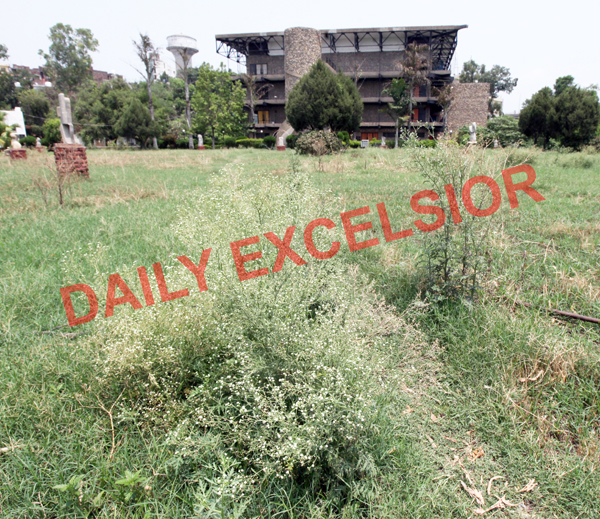
It is disheartening that the Jammu & Kashmir Academy of Art, Culture and Languages, a full-fledged Government institution meant to preserve, protect, and promote the region’s art and culture, has for decades been nothing more than a passive collector and careless keeper of invaluable sculptures created by local and national artists. The sprawling lawn at the academy’s premises in Jammu, once envisioned as a vibrant Sculptors Garden, now resembles an abandoned dumping ground. Sculptures-masterpieces shaped by skilled hands-lie neglected amidst overgrown grass and broken pedestals. What could have been an iconic cultural space today stands as a monument of official apathy.
Since the 1970s, JKAACL has been gathering sculptures crafted during various artist camps and workshops. These art pieces, created with passion and deep cultural consciousness, are not just stone carvings-they are silent storytellers of Jammu and Kashmir’s artistic legacy. The fact that the Academy still doesn’t have an exact count of these sculptures speaks volumes about the indifference and disorganisation prevailing within the institution. Officials say the number could be 30 to 35, a guess as vague as their preservation plan. Worse still, even those sculptures that have been placed within Kala Kendra suffer from the same fate-poor display, no proper signage, missing nameplates, and no context for visitors to understand their cultural significance. Many artists who created these works remain unacknowledged, their names erased by weather, neglect, or perhaps sheer bureaucratic laziness. Such a casual approach not only disrespects the artists but also robs future generations of inspiration and knowledge about their cultural heritage.
This chronic mismanagement is especially disappointing when juxtaposed with the efforts being made by other departments to beautify Jammu City. Under the Smart City initiative, significant attention has been paid to enhancing public spaces through murals and installations, with the statues at Indira Chowk being one such example. But the irony is painful: while one arm of the Government is searching for ways to uplift the city artistically, the very institution tasked with nurturing local talent is doing the exact opposite. The lack of coordination between departments, or perhaps a complete lack of interest from JKAACL, is the root of this dysfunction.
Contrast this with Chandigarh’s famed Rock Garden-an artistic marvel built from industrial and domestic waste, which has not only elevated the city’s tourism potential but also created a lasting cultural legacy. The idea of a Sculptor’s Garden in Jammu was first envisioned as early as 1980 by the legendary V.R.Khajuria, the pioneer sculptor of J&K. That dream remains unrealised, not because of any inherent limitations, but because of persistent institutional lethargy. Even the live exhibitions organised once in a blue moon appear to be mere token gestures-organised more for photo ops and headlines than any long-term vision or commitment. Veteran sculptors like Ganesh Sharma, who invested their time and soul into these art camps, are right to feel disappointed. Artists expect respect for their work, not just temporary accommodation. A proper park, a curated gallery, or even a well-maintained sculpture trail in prominent city locations would be a fitting tribute to their creative effort.
The Government must intervene decisively. JKAACL should be directed to come up with a concrete proposal to develop the long-overdue Sculptors Garden finally. While approvals and funds might take time, the city’s roundabouts under JMC can serve as interim display zones for these sculptures. Office premises, public parks, and CSR-supported spaces-such as those under J&K Bank or the Shrine Board-can be identified for this purpose. Even schools, libraries, and tourist complexes can be roped in to provide platforms for these silent marvels.
The art pieces currently languishing at JKAACL and Kala Kendra are more than just decorative items; they are representations of local stories, cultural ethos, and regional identity. They deserve a place of pride, not neglect. If stone can be turned into soul by an artist’s hand, then at the very least our institutions can do is treat them with the dignity they deserve.
 Follow our WhatsApp channel
