

Kaisar Malla
Once celebrated as the saffron capital of the world,Pampore’s fields are witnessing a worrying decline in both yield and land area.Government efforts like the National Saffron Mission,the Spice Park and GI tagging have brought recognition,but without urgent action on irrigation and land protection,this heritage could fade into memory.
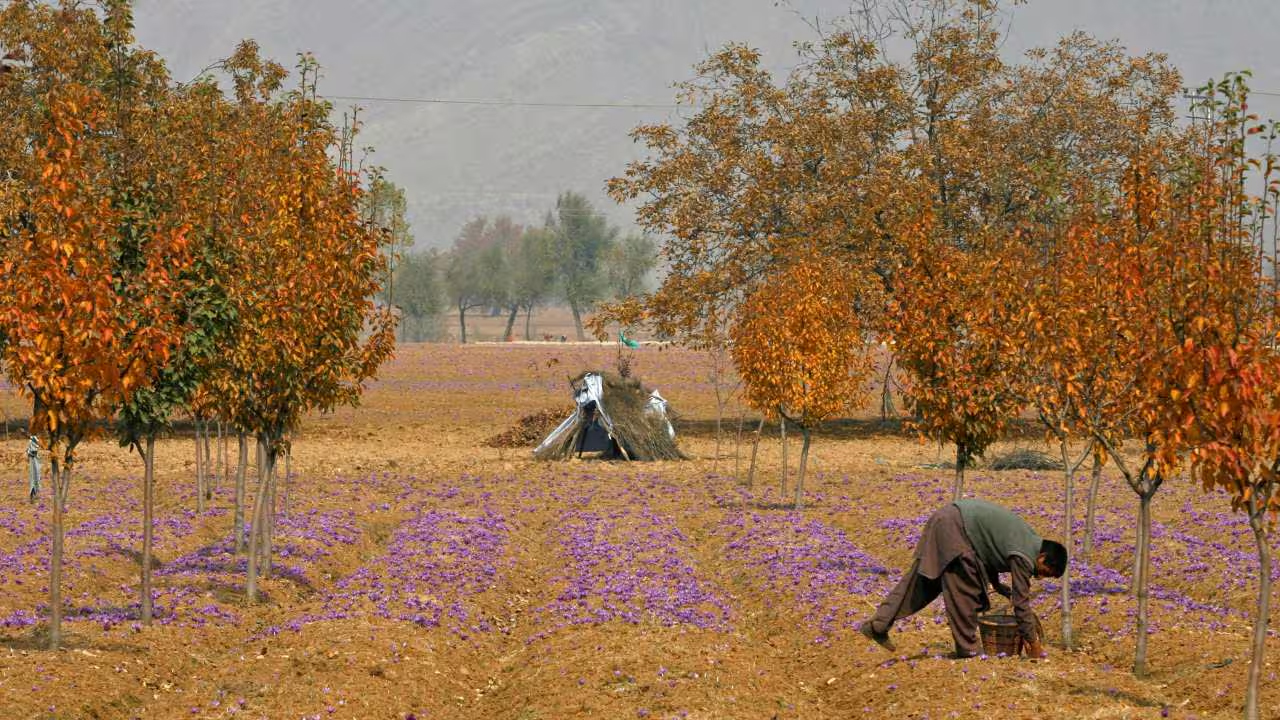
Drive into Pampore today and you will still sense its quiet charm,but it is not the same town it once was.The stretches of land where endless rows of purple flowers once danced in the breeze now seem weary and waiting.The fragrance that once drifted across the fields lingers faintly,like a memory holding on against time.For centuries,this small town in Kashmir has been known as the heart of the world’s finest saffron,a spice so prized that it is sought after by chefs and buyers across continents for its unmatched aroma and deep crimson threads.Today,those who have spent their lives caring for these delicate flowers fear that this heart is slowly growing silent.
For the people of Pampore,saffron is not just a source of income.It is woven into their stories,kitchens,festivals and livelihoods.Families remember how entire households would gather in the fields at sunrise,bending down together to pluck each flower with patience and pride.It was not merely work,it was tradition,honour and a symbol of belonging.But over the years,that joy has dimmed.In the last two decades,production has steadily declined,leaving farmers with yields that are only a shadow of what their parents once collected.The reasons are easy to see for anyone who walks these lands.Where water once flowed freely to nourish the crop,fields today lie waiting for uncertain rains.Without irrigation,every dry spell feels like a gamble and every lost bloom is another step toward decline.What hurts even more is watching saffron fields being sold or levelled for commercial buildings and housing.When land that has nurtured a legacy for centuries is covered with cement,Pampore loses not just space but a piece of its soul.
Recognising this crisis,the government launched the National Saffron Mission to revive production. Sprinkler irrigation systems,quality corm distribution,and improved post-harvest facilities were among its key goals.The setting up of the Spice Park in Dusoo and the Geographical Indication (GI) tag for Kashmiri saffron were commendable achievements,signs of how unique and valuable this spice is to the world.Yet,farmers often express a painful truth: “A tag may protect the name and a park may process the spice,but neither can make flowers bloom in fields that lie thirsty.”These initiatives,while important,need to be backed by real,on-ground irrigation and land protection to save this heritage.
If saffron is to bloom again,the path is clear.Water must reach every saffron field through functional sprinkler systems.Quality corms need to be supplied so the crop can regenerate and regain strength.Most urgently,saffron land must be preserved,once lost to construction,it will not return.Despite the challenges,hope remains alive in Pampore’s farmers.Even now,before the blooming season begins,they are preparing their soil with patience,believing that the land still has the strength to revive.One farmer,standing at the edge of his field,looked across the empty expanse and said softly, “We may see fewer flowers today,but one day these fields will be purple again.I am keeping them alive for that day.”
That hope is what Pampore needs most today.With sincere action,support and protection,this town can once again become a valley of colour and fragrance,where families walk together under the open sky,gathering flowers as their ancestors once did.If that day comes,Pampore will not just regain its saffron,it will reclaim its soul.The time to act is now,for policymakers to ensure irrigation and land protection and for every reader to value and support this heritage before it becomes only a story of what once was.
 Follow our WhatsApp channel
