

K B Jandial
kbjandial@gmail.com
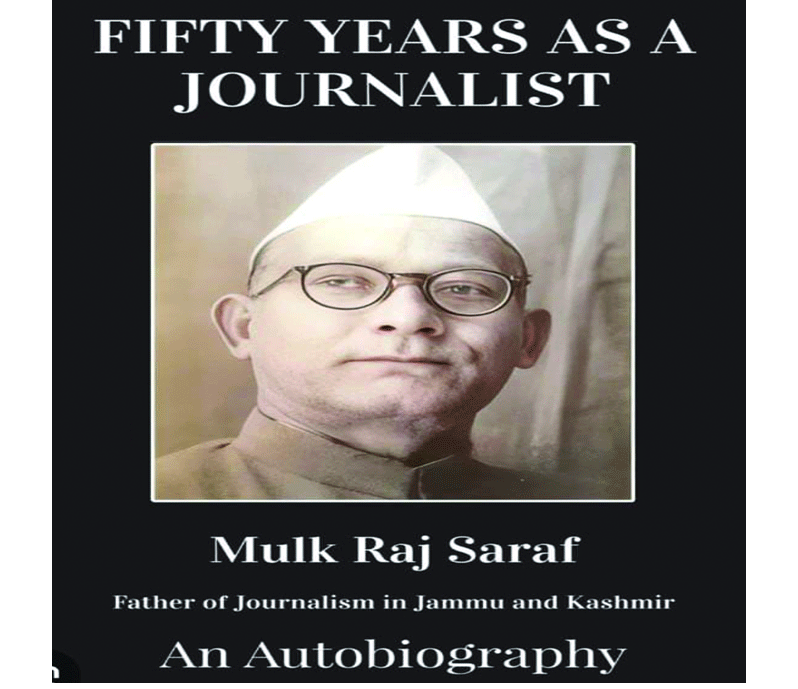
Book Review: Fifty Years As A Journalist Author: Mulk Raj Saraf
Publisher: Jamna Devi Gian Devi Saraf Trust (JDGD)
Printer: Notion Press
Price: Rs. 299
In the contemporary digital age, where news cycles refresh by the second and information is ubiquitous, it is difficult to imagine a time when the mere act of publishing a newspaper was considered a radical, even subversive, defiance of the state. Yet, exactly one hundred years ago, the princely state of Jammu & Kashmir existed in a virtual information vacuum. There were no local newspapers, no private printing presses, and no formal platform for the public voice.
To commemorate this centenary, the Jamna Devi Gian Devi Saraf Trust has recently released a timely reprint of Fifty Years As A Journalist, the autobiography of the late Lala Mulk Raj Saraf. Originally published in 1967, this memoir is far more than a personal recollection; it is a foundational text that chronicles the birth of the Fourth Estate in Jammu & Kashmir. Saraf, popularly revered as the “Father of Journalism in J&K,” provides a masterclass in perseverance, charting a journey that transformed the region’s socio-political consciousness.
From Law to the Ledger
The narrative begins not in Jammu, but in the intellectual ferment of Lahore. Saraf was initially a reluctant student of law, pursuing the degree only to satisfy his elder brother’s ambition for him to become a Judge. However, the year 1919 proved to be a turning point. Attending the Congress session in December, the young Saraf found himself in the company of the stalwarts of the Indian freedom movement and became mesmerized by their patriotic aura.
The pull of the nationalist cause was stronger than the promise of a stable legal career. In early 1920, Saraf took a leap of faith that would change the course of history for his home state. He persuaded his brother to let him abandon his studies, and joined Bande Matram, the fiery newspaper run by the legendary “Lion of Punjab,” Lala Lajpat Rai. It was here, as a sub-editor, that Saraf learned that journalism was not merely a profession, but a “courageous and revolutionary mission.”
The Three-Year Battle for a License
The most compelling segment of the autobiography details Saraf’s gruelling struggle to bring a newspaper to Jammu & Kashmir. He was haunted by a singular, persistent question: “If Lahore could provide many newspapers, why can Jammu & Kashmir not afford even a single one?” At the time, the bureaucratic hurdles were designed to be insurmountable. The state authorities viewed the press with deep suspicion, equating the desire for a newspaper with a desire for insurrection. Saraf describes an era where “applying for permission to bring out a newspaper was looked upon as an act against the State.”
For three long years, Saraf navigated a labyrinth of petitions and official silences. The breakthrough finally came on March 28, 1924, when a letter arrived stating that “His Highness the Maharaja Bahadur in Council has been pleased to accord permission” to start a newspaper and a private printing press. On June 24, 1924, the first regular issue of Ranbir-named after Maharaja Ranbir Singh and meaning “Knight of the Battlefield”-hit the stands. It was a victory not just for Saraf, but for the very concept of free speech in the region.
The “Knight” and the Palace
Launching the paper was only half the battle; sustaining it without funds was the next challenge. Saraf’s ingenuity shines through his description of the early days. Lacking a marketing budget, he posted banners announcing the arrival of the Urdu weekly. The response was electric. Subscribers began to pour in, including, interestingly enough, the royalty themselves. Maharaja Pratap Singh subscribed for Rs 100 annually, and Raja Hari Singh for Rs 50.
However, Ranbir was never a court circular. Saraf maintained a delicate but firm independence. One of the most endearing and telling anecdotes in the book involves Saraf’s report on the “dishonest cooks” of the Royal household. The story caused a literal flutter in the Palace. Rather than being silenced, Saraf was summoned to the Darbar. In a surprising twist of fate, he was not punished but honoured with an award of Rs 200 for his courage in exposing corruption within the palace walls. It was an early validation of the watchdog role of the press.
A Galaxy of Intellectuals
Saraf’s memoir also serves as a cultural archive. Under his editorship, Ranbir became a magnet for the greatest minds of the era. The book lists a “galaxy” of contributors, including the iconic poet Mahjoor, Lala Hans Raj Vakil, Sardar Budh Singh, and Pt Vitasta Prasad Fidda.
The influence of the paper reached far beyond the borders of the state. Saraf proudly records the congratulatory messages received from literary and political giants such as Munshi Prem Chand, the revolutionary Lala Har Dayal, and the noted historian Munshi Mohammad Din Fauq. These interactions paint a picture of a vibrant, interconnected intellectual world that Ranbir helped foster.
A Mirror to History
As the narrative progresses, it shifts from personal triumphs to the broader historical canvas. Saraf’s eyewitness accounts of the 1930s and 40s are invaluable for historians. He details the 1930 ban on Ranbir, which occurred after the paper covered the arrest of Mahatma Gandhi-an act labelled “subversive propaganda” by the state.
Perhaps most poignant are his reflections on the 1947 crisis. Saraf was a front-row observer of the Partition and the political upheaval that followed in J&K. His use of the press to advocate for social reforms-specifically the abolition of forced labour and rural indebtedness-proves that he viewed the newspaper as a tool for the upliftment of the “inarticulate labourers and the dumb-driven indigents.”
The Ethical Compass
The book is punctuated by Saraf’s speeches, which provide an ethical grounding for the profession. His 1942 address to the Newspaper Editors Conference contains a quote that should be mandatory reading in every journalism school:
“The power of the Press… is neither a gift bestowed on us by any capitalist nor an estate conferred on us by any Government. It is a trust placed in our hands by the people and to use it honestly is our conscientious duty.”
This philosophy-that the press belongs to the people-is the heartbeat of the entire autobiography.
Why This Book Matters Today
The Jamna Devi Gian Devi Saraf Trust has done a great service by reintroducing this work to a new generation. Fifty Years As A Journalist is more than just the story of one man; it is a testament to the enduring power of perseverance and the moral obligation of the media.
In an age of “fake news” and corporate-driven narratives, Saraf’s life offers a roadmap back to integrity.
Lala Mulk Raj Saraf did not just write the news; he paved the way for the news to be written. His legacy, as captured in these pages, remains a guiding light for the spirit of freedom, equality, and the unyielding power of the press.
This autobiography is a significant contribution to the literature on Indian journalism. It acts as an enduring testament to Saraf’s legacy-proving that journalism in J&K began not as a business, but as a “courageous and revolutionary mission.” It is a compelling read that combines autobiography with a broader narrative of freedom, equality, and the power of the press. It is a compelling read for aspiring journalists looking for ethical grounding, students and scholars of J&K history and anyone seeking inspiration in the fight for freedom of speech and expression.
 Follow our WhatsApp channel
