

Vishal Sharma
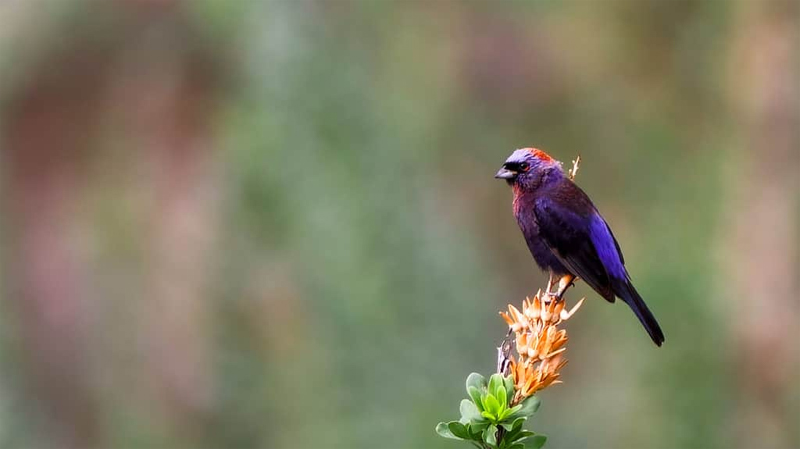
A small bird of the size that one’s palm can hold; its neck purple colored and rest of the body grayish, perched on the roof of the gate held my attention as I stepped out of the room early morning the other day to shut off the street light. I froze in my tracks for a moment as I looked on. It was a pretty sight. It looked steady for a moment as it fixed me with its beady eyed gaze, but then its head started bobbing like those of pigeons and chickens do.
My mind was drawn back to the last winter, and I suddenly recalled seeing this lovely thing then as well exactly at the same spot; almost around the same time. I vaguely remembered that it pretty much did the same thing before making a sharp pitched mellifluous sound and flying away. I quietly waited to watch its next move as it held me in its thrall; even as I did that I did not stop thinking if it would do what it did last winter.
Lo and behold, it opened its vocal chords much in the same manner it had done last year and then took a flight. Only a day after it had flown away last year, never to be seen again, the winter had become colder. As I watched its fly away, I wondered if it had come to announce that it was going to get colder from that day onwards.
And boy, the winter has indeed turned colder, as it did the last time after the pretty thing bade me good bye!
Winter is upon us and with it is its effects and the responses it draws from the people, the birds, the animals, the plants and what have you. The deep brooding following pangs of separation and melancholy represented by autumn have given way to the love and warmth for some and despair and desolation for others of the winter. The lightness of touch and transparency of fall has changed into solemnity and denseness of the winter.
The somberness of the spirit and the duskiness of the thoughts are disposition of the winter. At a philosophical level, winter is when one has traditionally paused, taken stock and self introspected. It was historically the period when the communities took break from the work as nothing got done during the winter. All that was produced in other seasons was laid by for the rainy day, which the winter was. When one does not do anything except wait till the winter appears in the rear view mirror that is the time for one to do the moral housekeeping. That is where and when humans are made or remade, as it were, or rather reformed to be the best human specimens. Thus, winter has traditionally been the crucible in which one has been truly been made or remade into someone who one should be. It has sought to force one out of one’s comfort zone. It has touched one’s soul. This is what gives winter the unique place in the four seasons; it indeed makes it first among equals.
But times have changed, although arguably nature has not. Seasons still come and go at the same time and have the same characteristics. Summers are still hot; as are the winters cold, and flowers still bloom in spring just as leaves still fall off from trees in the fall. We have not seen the effect of winter in summers and scorching heat of summers in the winters. Flowers have not ever blossomed in autumn and trees have never ever shed leaves during spring. Our response to the effects of the seasons has also not changed much except that we don’t save for the rainy day, as it were, and winters or to cope with the harsh effects of any season any longer as we did in the past. That is the consequence of the technological advancement of the modern times. Life’s much easier today and the extremes of the weather don’t effect us as much today as indeed they did in the past.
However, at the primal level, we are still the same persons we once were. Nowhere is it more conspicuous than during winters. An early morning walk in a wintry morning offers one the snapshot of the life that is lived today in many different ways. Morning walkers still do their regular walks, all wrapped up in woolen clothes; they have their heads covered in caps and necks with scarves. Some of them even wear gloves. Most women wear track; some are out in suits, but drape themselves with shawls and match their men folk stride for stride. The young boys and men walk with fewer woolens and are more energetic. They seem to be driven more by the need to look fitter and healthier while the older men generally seem a reluctant lot, giving the impression that they would much rather remain in their beds at this godly hour, than be up and about. They are perhaps doing the bidding of their doctors. Then there is another category of people, who go for morning walk not because they must, but because they have to walk their dogs.
Small vendors, who are early risers, still open their shops early in the morning to sell tea and light snacks as their predecessors did in the past. One such unbathed, bleary eyed small time tea vendor has woken up and stepped out of his room into the adjacent makeshift outlet to prepare tea for the waiting consumers. He has wrapped himself up in a light blanket and covered his head with an old, worn out cloth. He gets down to washing his pots and pans and warming water on a gas stove for tea even as a small misty cloud rises from his mouth and a few labourers huddled around a bonfire some distance away from the shop await their tea.
The huddles around the leaping flames of the fires from small bonfires made outside- some open and some closed shops- are a frequent sight in the bazaars. The sight of people rubbing their palms on the bonfires to warm themselves in the early hours of the morning has been a part of our tradition. It is still a part of our way of life. The tradition survives.
The other exciting spectacle is of the kids being transported to schools in school buses or by their parents in their private vehicles. School kids attired in uniforms of different colours add colour to the early morning life. With too many layers on their bodies, some of them look just overdressed. Some of them look to have been pulled out of their beds and forced onto the buses or dragged into the cars/motorbikes etc. Others don’t look as sullen or morose, but they don’t look happy either. They don’t seem to be going to schools out of their own volition. Left to them, it appears that they would rather stay back or go elsewhere.
The sight that is indeed sore for the eyes is a few men and women walking with water filled bottles in their hands to look for the nearest bush in a semi wooded area or a place under the bridges in a dry water course to relieve themselves. Even though it is cold; and numbing cold at that, they are generally skimpily clad; with only a tacky thin fabric covering them. Women wearing sarees in particular are generally seen to drape ragged pieces of semi woolen clothing over their sarees, but they are just not enough to take every part of their bodies in their folds; some parts of their bodies still expose themselves to the biting cold of the early morning. Some things don’t ever change and this appears to be one of them.
Winter has many colours; many hues. It is harsh; it is pleasant too ! It does not have everything, but it has more than what others have. It may not be the best, but it is not the worst either. For all its flaws, it remains the first amongst the equals; if all seasons were held to be equal.
(The writer is a novelist.)
 Follow our WhatsApp channel
