

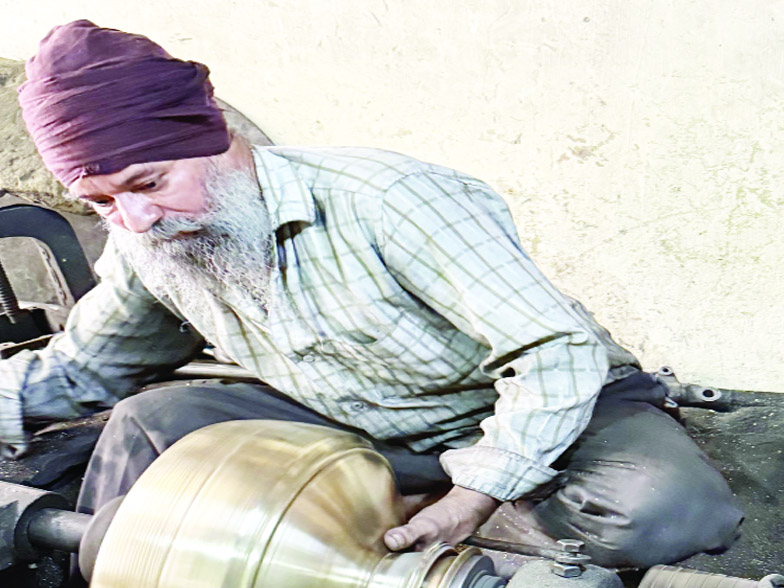
A fading legacy of craftsmanship
Sunny Dua
The Thathiyars (Utensil makers) are a community of skilled artisans in Jammu who trace their origins to the partition era, when they migrated from Jammu suburbs to city interiors during the period of turmoil in 1947. Majority amongst them were already working here in the town well before partition and were settled in areas like Peermitha, Gummat, Kanji House, New Plot, Moti Bazar, Rehari and Talab Tillo where they carried rich tradition of working with brass and copper, crafting utensils and decorative items that once adorned homes and the courts of the erstwhile Maharajas of Jammu and Kashmir as well.
Their expertise extended beyond mere utility, creating intricate designs for temple articles including Patras, Sapphires and even ceremonial items for police and army bands, including polished brass pots for decorating residences of highest government officials.Despite the challenges of displacement, these artisans have clung to their craft, showcasing a spirit of resilience that defines their identity and are known by their craftsmanship, though the craftwork is fading into oblivion now.
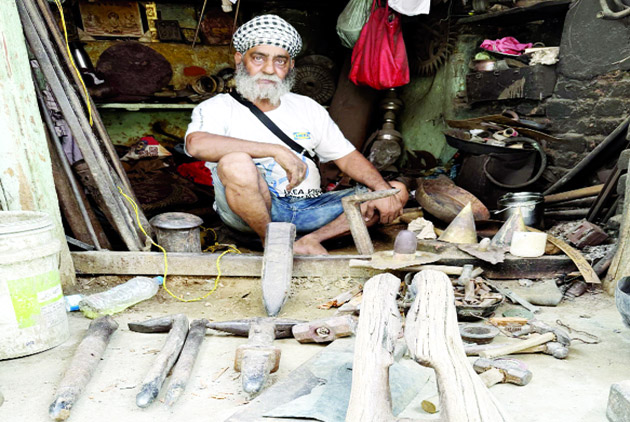 Thathiyars, especially from Jandiala Guru of Punjab have garnered international recognition from United Nations Educational, Scientific and Cultural Organization (UNESCO). This ancient art, inscribed on the representative list of the intangible cultural heritage of humanity, represents the only Indian craft to hold such a distinction. It is meticulously practiced by the Thathiyars of Jammu as well and the process, passed down orally from father to son, involves time-honored techniques of flattening metal plates and then hammering them into various shapes, including bowls, plates, and vessels.
These handcrafted utensils serve both utilitarian and ceremonial purposes, used in everyday life, at temples, and during special occasions like weddings. Faced with the challenges of declining traditional utensil use, Punjab had initiated revitalization efforts like “Project Virasat” to safeguard this invaluable heritage but the government of Union Territory (UT) of Jammu and Kashmir is yet to come out with any such matching promotional scheme for Jammu Thathiyars.
Thathiyar by profession and an Amritdhari Sikh, Sardar Makhan Singh Malhotra, claims that no government has ever done anything for this art or artisans. He regrets that little benefits that the community used to get from backward certificates during pre-partition era has also been excluded from the list of beneficiaries. There are no integrated efforts, specific initiatives or dedicated programmes focused on reviving the traditional brass and copper utensil making craft akin to the Thathiyarsof Jandiala Guru in Jammu and Kashmir.
Makhan Singh’s voice carries the weight of nearly four decades of toil, a life woven into the fabric of resilience and legacy. For 38 years, he has poured his heart into the small, weathered shop in the Peer Mitha area, a humble corner that sustains his family’s livelihood. It was his father’s trade first, a modest enterprise born from necessity, which Makhan joined after his early years of learning. He recalls his childhood with a quiet pride, walking the halls of the government high school in Jullaka Mohalla for his primary education, balancing books and dreams before stepping into the rhythm of his father’s work.
The story of his family is one of upheaval and rootedness. Before 1947, they held land inParyar Bhahamana, R.S. Pura, a life tied to the soil. But the partition’s shadow forced them to leave it all behind, drawing them to Peer Mitha. There, they found refuge in a house claimed as evacuee property, a new beginning amidst the chaos of displacement. In that home, generations gathered, weaving a tapestry of shared memories and unyielding togetherness. It is here, in this enduring sanctuary, that Makhan and his family have built their lives, carrying forward a legacy of perseverance through the years.
In the heart of Peer Mitha, where the clang of metal once echoed like a symphony of tradition, the Thathiyars-master artisans of Parath, Gagri, Kadai, Pateela, and Sagla – crafted utensils that were the soul of Yagyas and Langars. These vessels, forged with skill and reverence, were not just tools but carriers of culture, sent far and wide to places like Sialkot, loaded onto tongas that rumbled across the region. Yet, the winds of change have swept through, and the story of these craftsmen is one of resilience, loss, and a fading legacy that begs to be remembered.
S. Inder Singh, who once was into utensil making and is now a State Awardee for his interest in numismatics, reminisces about the rich legacy of Moti Bazaar, once famously known as Thatiyara Bazaar. Moti Bazar was once called Thatiyara Bazaar but with changing times and better educational opportunities, many like him have moved on to other professions. Today, only a few artisans remain, primarily engaged in polishing (Kali) or retailing utensils, while most have shifted to alternate livelihoods. Despite this decline, Inder Singh proudly remembers the vibrant era when Moti Bazaar was the hub of skilled blacksmiths and brass utensil makers known across the region.
(INTANGIBLE CULTURAL HERITAGE)
Among the most notable craftsmen were S. Atma Singh, expert in making Saglas, and Mool Singh, known for his Gagars. Others like Prakash Pehalwan, Shri Chand Pehalwan, and S. Gopal Singh were part of a robust community that included Hindus and Sikhs working together harmoniously. The Thatiyars not only shaped utensils but also local culture – establishing an Akhara at Diwan Mandir and instituting a wrestling award that’s still celebrated today. As a tribute to their craftsmanship, utensils like a Hukka made by Gopal Singh and Inder Singh himself are now preserved in the Dogra Art Museum, serving as tangible reminders of Jammu’s once-thriving utensil-making heritage.
“Once, the Thathiyars of Moti Bazar thrived, their homes and workshops lining the bustling main road. But as commerce shifted, many abandoned the forge, turning instead to selling utensils rather than crafting them”, Inder Singh said. In Peer Mitha, however, a stubborn few-some 60 families or more-clung to the old ways, hammering out their livelihood with sweat and pride. “We kept working as Thathiyars,” one artisan shares, his voice tinged with both defiance and weariness. But the world has not been kind to their craft.
The new generation, seeing no future in the gruelling labor, has turned away. “I am the last generation learning this,” he laments, a poignant admission that the art of the Thathiyars is teetering on the edge of extinction.”Our work is tough,” the artisan explains, his hands calloused from years at the anvil. Without support, without recognition, the Thathiyars face a future where their craft once vital to community rituals and daily life may vanish entirely. This is not merely a story of metal and fire; it is a call to honor a heritage, to preserve a craft that has shaped generations”, another Thathiyar said.
Will we let the Thathiyars’ legacy fade into silence, or will we champion their resilience and skill before it’s too late, he asked.
In the heart of Sikh communities, where devotion meets craftsmanship, families of artisans uphold a sacred tradition, forging utensils and ritual items with reverence and skill. While machines have taken over much of the mass production, these craftsmen breathe life into works that demand the human touch-pieces too intricate, too holy for mechanical hands. With unwavering sanctity, they craft in Peetal (Brass) and Kansa (Copper), materials that carry the weight of tradition and the sheen of devotion.
Their expertise shines in the creation of Kalash, the ornate spires crowning temples, each one meticulously handcrafted to embody divine grace. Large Gagars, too grand for machines, are shaped with care, ensuring every curve reflects the artisans’ dedication. They pour their skill into Patras for Shivling, Naag Devta and the resonant Dhool drums that echo through the hills of Bhaderwah and Kishtwar during sacred festivals. The Kail, a long musical instrument, hums with spiritual energy during the Machail Mata Yatra, its creation a labour of love by these families. Charri, the ceremonial maces carried in yatras, are crafted with the same devotion, each piece a testament to their commitment to faith and community.
These Sikh artisans approach their work as an act of seva, polishing Kalashas to mirror the divine light and shaping instruments that carry prayers through the air. More than 80 per cent temples across regions seek their craftsmanship, trusting them to imbue every piece with sanctity. In a world leaning toward mechanization, these families stand as guardians of a sacred art, their hands weaving tradition, faith, and beauty into every creation-a legacy that continues to sanctify the spaces where devotion thrives.
Raw brass and copper, sourced from Gangyal’s factories, and steel from Jagadhari, are transformed through a meticulous ritual of creation. Each piece begins with careful measurements, sketched on newspaper to ensure precision. Using sheets of 18- and 20-gaugePeetal (Brass) and Tamba (Copper), the artisans wield chisels, hammers, and an array of timeworn tools to shape and engrave, pouring their expertise into every curve and detail. Whether crafting a humble utensil or a temple artifact, their work is a labor of love, each strike of the hammer resonating with purpose.
Yet, their craft faces challenges! Limited by scarce resources, these artisans lack the funds for modern machines, relying instead on traditional tools that carry the weight of their heritage. In the world of traditional craftsmanship, artisans rely on time-honored tools, each meticulously designed for specific tasks and passed down through generations. These tools, often bearing the worn hand marks of their masters, are integral to creating and refining handcrafted articles, particularly in metalwork and pottery.
Some key tools used by these skilled artisans are Naulaa – a specialized tool used to shape articles into smooth, rounded forms, essential for creating symmetrical and aesthetically pleasing designs, Sardaan -aT-shaped tool employed for rounding edges and crafting joints, Killa – similar to the Naulaa, this tool is used to impart a rounded shape to various items, Jeebi – featuring a flat top, it is ideal for smoothing and shaping surfaces, particularly for flat or broad components, Kharwaand -an iron tool designed for shaping and refining heavy-duty articles, Khreon – a wooden tool resembling a slingshot (Gulel), used for cleaning pots and removing dents, Mekh – an iron plane used for massaging and finishing items like Kadais, Paraths, and Lids, ensuring a polished and even surface.
These L-shaped iron tools often customized and handed down through generations, bear the unique hand marks of their artisan owners, symbolizing a legacy of craftsmanship.Together, these traditional and contemporary methods ensure that the artisans’ creations maintain their cultural significance while meeting modern standards of quality.The rise in awareness of the health benefits associated with traditional materials like Copper,Brass and Bronze has led many to shift away from using steel and aluminum utensils, which are sometimes linked to health concerns. Despite that the traditional art of crafting these metal utensils is on the verge of extinction. The emergence of large-scale utensil manufacturing factories in places like Jagadhri, Moradabad, Punjab, and Haryana has overshadowed the age-old methods practiced by artisans.
Swaran Singh Malhotra, a Thathiyar from Paryar Brahmana, has been polishing utensils for the past 45 years at Peer Mitha, continuing the legacy of his father Ameer Singh. He recalls how their family once possessed land and a pakka house, with all legal documents in order, but it was wrongfully occupied, and despite having state subject papers and site maps, the land was never restored. Traditionally, their family was involved in dhalai work-melting peetal (brass) to forge utensils like Gagar, Kunda, Karah, and other items commonly used in Dogra weddings.
One of the sustaining customs has been the gifting of a Gagar filled with Gulra (a traditional Dogri panjeeri made with crushed rice and dry fruits) by the bride’s side-a practice still alive in both urban and rural areas of Jammu. Their daily routine involves chiselling, denting, and polishing utensils with chemicals, earning just enough by day’s end to manage basic needs. However, with his children pursuing college education, they no longer see a future in the family trade.
Reflecting on the challenges facing their community, Swaran Singh said, “Today, the Thathiyars face an uphill battle to keep their tradition alive.” The rise of machine-made brass and copper items has drastically impacted their livelihood, making it hard to compete with cheaper, mass-produced alternatives. Without access to modern machinery or training in updated techniques, Thathiyars are confined to time-consuming, traditional methods using wood-fired stoves and hand-held bellows.
These age-old techniques, though rich in heritage, cannot match the speed or efficiency of industrial manufacturing. The situation is worsened by the absence of government support-no subsidies, skill upgradation programs, or access to global markets for their decorative work-leaving artisans like Swaran Singh struggling to preserve their fading legacy.
The Thathiyarsrely entirely on knowledge passed down orally from parents to their children, a practice that is dwindling as the younger generation seeks better-paying opportunities in other fields. Unlike other handicrafts, such as embroidery or pottery, which have found some institutional backing, utensil making is considered outdated, with machines largely replacing traditional tools and techniques. This lack of formal training or recognition leaves the community without a pathway to preserve or innovate their craft.
The younger generation of Thathyars, increasingly educated and aware of better prospects, is reluctant to take up this arduous trade. The work is physically demanding, requiring long hours of hammering, heating, and polishing, yet it offers meagre financial returns. The Thathiyars’ struggle is not just about economic survival but also about preserving a vital piece of Jammu’s cultural heritage.
The Thatiyaars of Jammu stand at a crossroads, their hands still shaping brass and copper with the same techniques their ancestors used centuries ago. As the last generation of traditional utensil makers, they carry the weight of a fading legacy. It is imperative that policymakers, cultural institutions, and society at large recognize the value of their work and take action to empower this marginalized community. By investing in their skills and providing access to modern tools and markets, we can ensure that the Thatiyaars’ craft not only survives but thrives, continuing to enrich India’s cultural tapestry for generations to come.
(The writer is senior journalist)
 Follow our WhatsApp channel
