

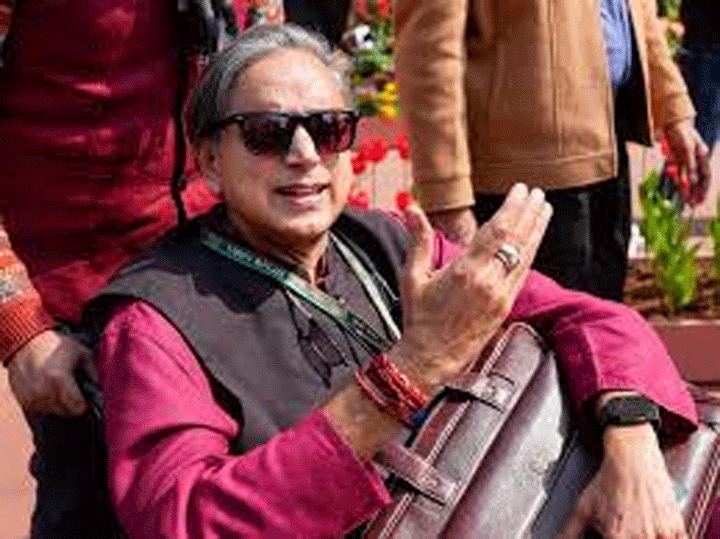
NEW DELHI: (Feb 10) Describing the Budget as an “underwhelming” and a “squandered opportunity”, Congress MP Shashi Tharoor on Tuesday likened it to rearranging air bags on a crashing car while assuring the passengers that the chassis is sturdy and they will feel better afterwards.
Initiating the debate in Lok Sabha on the Union Budget, Tharoor quoted Mirza Ghalib’s famous Urdu couplet — ‘Dil ko khush rakhne ko yeh khayaal achcha hai’ — to attack the government and said the real weakness of the budget lies in implementation as rhetoric is not matched by reality.
“This is headline management — where promises are loud like that horn, budgets are grand, but delivery is conspicuously absent. The Budget this year has landed with a thud, not because of what it contains, but because of what it omits. Behind claims of fiscal prudence lie a more uncomfortable reality: the Indian state is shrinking not by design, but by compulsion,” the Congress MP said.
Hitting out at the government for not meeting the promises it made in the agriculture sector, Tharoor said, “These announcements are like modern courtships — promises without commitments.”
“I had remarked that the 2025 Finance Bill reminded me of the garage mechanic who said, ‘I couldn’t fix your brakes, so I made the horn louder.’ Looking at the Budget this year, I am saddened to observe that though the horn has been muted, that there hasn’t been enough movement: for this Budget too appears to be a squandered opportunity, equivalent to rearranging the airbags on a crashing car, while assuring the passengers that the chassis is sturdy and they will feel better afterwards,” Tharoor said.
This Budget is praised for prudence, but prudence without vision or fairness is hollow, he said.
“It ignores unemployment, rising living costs, and inequality, offering little to address the real struggles and aspirations of the aam aadmi,” the Congress leader said.
The government speaks endlessly of welfare, but its spending tells a very different story as behind flashy announcements lie chronic under-utilisation and administrative failure, he claimed.
“Media reports show that of over Rs. 5 lakh crore budgeted for 53 major welfare and infrastructure schemes last year, barely 41% was spent in the first nine months of the fiscal year. Take the Jal Jeevan Mission – allocated Rs. 67,000 crore, it managed to spend an astonishingly low Rs. 31 crore in nine months. The much-touted PM Schools for Rising India scheme spent only Rs. 473 crore out of Rs. 7,500 crore.
“Most shocking of all, the Pradhan Mantri Anusuchit Jati Abhyuday Yojana, meant for the socio-economic upliftment of Scheduled Castes utilised merely Rs. 40 crore of its Rs 2,140 crore allocation,” he said.
This is not governance but headline management — where promises are loud, budgets are grand, but delivery is conspicuously absent, Tharoor said.
He said the reality of the government’s tall promises and narratives of “model governance” was out in the open.
They are not policies grounded in outcomes, but carefully curated illusions, glossy schemes and utopian projections that might soothe the imagination but everyday life for the ordinary citizens of India remains unchanged, he said.
“Hope is repeatedly sold, but delivery remains perpetually deferred. Viksit Bharat by 2047 is an admirable ambition, but this Budget offers no credible pathway to reach it,” Tharoor said.
He further said unemployment continues to rise, poverty hardens, jobs remain scarce and wages stagnant.
“Small businesses, already gasping for relief, are smothered under layers of compliance, while informal workers, who sustain our economy with their labour, are pushed further into invisibility and insecurity. They promise railways, yet stations crumble. They speak of flight, yet UDAN has flown away. Our pepper, once celebrated as black gold, withers under neglect,” he said.
Education is curtailed precisely when it should be expanded, he said.
“One and a half lakh schools still function without electricity, yet ‘Viksit Bharat’ is spoken of as if the lights are already on. When vision is severed from reality, it ceases to be aspiration and becomes merely an illusion,” he said.
A truly Viksit Bharat will not be built on slogans, speeches or symbolism, but on delivery that reaches the last citizen of India, Tharoor asserted.
“Turning promises into outcomes is not a favour. It is not a choice. It is our kartavya,” he added.
Tharoor pointed out that government expenditure as a share of GDP has declined over the past decade, briefly rising during the pandemic before reverting close to its 2016 level, driven by stagnant revenue mobilisation.
“Tax receipts have remained flat relative to GDP, disinvestment has underperformed, and non-tax revenues increasingly rely on extraordinary transfers such as RBI dividends — an unsustainable substitute for a stable revenue base. More troubling is the shift in the tax burden towards individuals, bearing a greater share of the tax burden than corporations, despite sharp post-pandemic profit growth,” he said.
Capital expenditure is emphasised, yet weak demand, stagnant wages, high youth unemployment, compressed welfare spending, and inadequate devolution to states, all persist — leaving India fiscally disciplined but developmentally constrained, without the revenue capacity or strategic clarity to deliver real economic security for the aam aadmi, he said, adding that this is why he calls it an “underwhelming budget”.
 Follow our WhatsApp channel
