

‘Close cooperation imperative for global peace, security’
New Delhi, Mar 2: Prime Minister Narendra Modi on Monday highlighted that terrorism, extremism and radicalisation are shared and serious challenges not only for India and Canada but the world at large. He underlined that the close cooperation between the two countries is imperative for global peace and security.
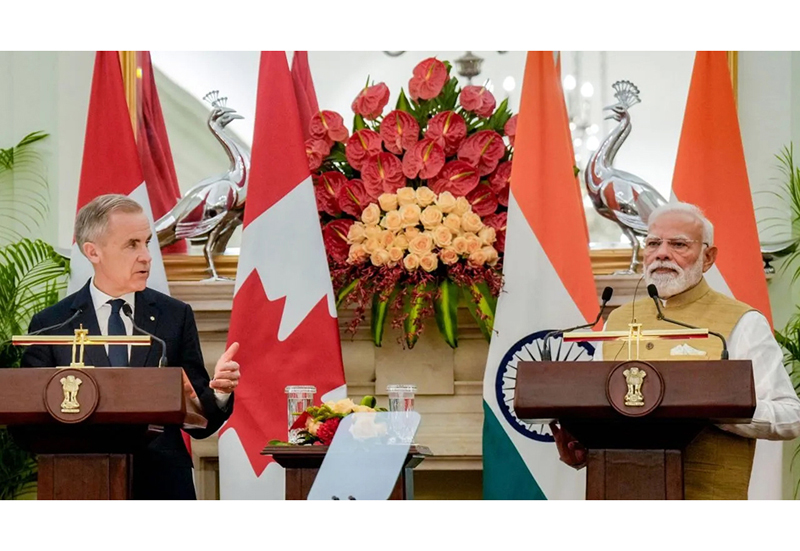
He made the remarks during the joint press conference with Canadian Prime Minister Mark Carney here in the national capital on Monday.
Follow the Daily Excelsior channel on WhatsApp
“We agree that terrorism, extremism, and radicalization are shared and serious challenges not just for both countries but for all of humanity. Our close cooperation against these is extremely important for global peace and stability. India’s vision is clear when it comes to the several challenges which the world is facing. We have always called for maintaining peace and stability. And when two democracies stand together, the voice of peace becomes even stronger,” he said.
Click here to watch video
Meanwhile, India and Canada on Monday inked landmark pacts on supplies of Uranium and critical minerals and vowed to seal a comprehensive economic partnership agreement this year with Prime Minister Narendra Modi and his Canadian counterpart Mark Carney finalising an ambitious roadmap of cooperation to shore up ties including taking bilateral annual trade to over USD 50 billion by 2030.
In their wide-ranging talks, the two leaders also pledged to ramp up cooperation in defence, critical technologies, small and modular nuclear reactors, education, artificial intelligence and renewable energy, demonstrating that the relationship has moved beyond turbulence into a more stable and forward-looking phase.
The ties between the two countries hit rock bottom following then-PM Justin Trudeau’s allegations in 2023 of a potential Indian link to the killing of Khalistani terrorist Hardeep Singh Nijjar in Canada.
The two sides initiated a series of measures to rebuild the relations after Carney became the prime minister in March last year.
To leverage their strengths as complementary economies, India and Canada announced a new strategic energy partnership, including in LNG, LPG, uranium, solar and hydrogen.
As the first step, a USD 2.6 billion agreement was signed between the government of India and Saskatoon-based Cameco to supply nearly 22 million pounds of uranium to India for nuclear energy generation from 2027 to 2035.
Besides the pacts on uranium and critical minerals, India and Canada signed six other MoUs, including one on the terms of reference for the India-Canada Comprehensive Economic Partnership Agreement (CEPA).
“Our goal is to reach USD 50 billion in trade by 2030. Unlocking the full potential of economic cooperation is our priority. Therefore, we have decided to finalise the Comprehensive Economic Partnership Agreement soon.
“This will create new investment and employment opportunities in both countries,” Modi said in his media statement.
“Canada’s pension funds have invested USD 100 billion in India. This symbolises their deep belief in India’s growth story,” he said.
The volume of two-way annual trade at present is around USD 13 billion.
The Prime Minister said the Memorandum of Understanding (MoU) on critical minerals will strengthen resilient supply chains. Canada is known for its significant reservoir of critical minerals and rare earth materials.
“In the energy sector, we are building a next-generation partnership, which will focus on hydrocarbons as well as renewable energy, green hydrogen and energy storage,” Modi said.
“In civil nuclear energy, we have signed a landmark deal for long-term uranium supply. We will also work together on small modular reactors and advanced reactors,” he said.
A Canadian readout said the two leaders agreed to advance bilateral cooperation on security and law enforcement and it includes issues of mutual concern to Canada and India, such as the illegal flow of drugs, particularly fentanyl precursors, and transnational organised criminal networks.
Prime Minister Carney also underscored that Canada will continue to take measures to “combat transnational repression”, the readout said without elaborating.
Secretary (East) in the external affairs ministry, P Kumaran, said at a media briefing that the process for normalisation of India-Canada ties has already begun translating into “tangible economic outcomes”.
“The relationship has clearly moved beyond turbulence into a more stable and forward-looking phase,” he said.
Modi and Carney also deliberated on the precarious security situation in West Asia, with PM Modi asserting that India supports the resolution of all conflicts through dialogue and diplomacy.
“The current situation in West Asia is a matter of deep concern for us. India supports the resolution of all disputes through dialogue and diplomacy. We will continue to work with all countries to ensure the safety of all Indian citizens in the region,” Modi said. (Agencies)
 Follow our WhatsApp channel
