

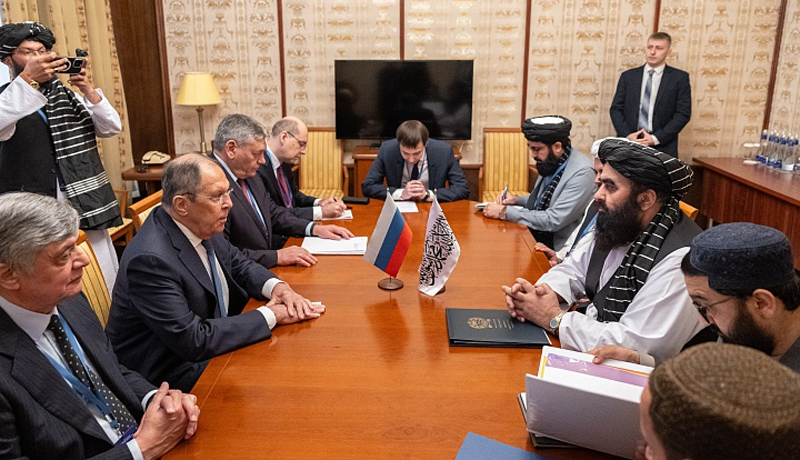
NEW DELHI, Oct 7: Eleven countries including India, China, Russia and Pakistan today decried attempts by some countries to deploy their military infrastructure in Afghanistan and neighboring States.
At the 7th meeting of the Moscow Format Consultations on Afghanistan, special representatives and senior officials from India, Afghanistan, Iran, Kazakhstan, China, Kyrgyzstan, Pakistan, Russia, Tajikistan and Uzbekistan, described as unacceptable the attempts by countries to deploy their military infrastructure in Afghanistan and neighboring states, saying this does not serve the interests of regional peace and stability.
US President Donald Trump recently warned Afghanistan to hand over the Bagram airbase or face the consequences. Afghanistan’s Taliban government rejected outright the US demand.
Russian Foreign Minister Sergey Lavrov, in his opening remarks at the conference, firmly opposed the deployment, under any pretext, of any third-country military infrastructure on Afghan territory or in neighbouring countries.
”The military presence of extra-regional actors risks triggering instability and new conflicts. Afghanistan’s history is full of foreign military presence, and the necessary lessons should have been learned by now,” Lavrov said.
He called upon the West to abandon its confrontational policies, return the funds it has seized and take responsibility for Afghanistan’s post-conflict reconstruction, including compensation for the enormous damage inflicted on the country’s economy and infrastructure over the decades.
Unfortunately, major challenges on the Afghan front still stem from the Western countries’ openly hostile policies. They continue to hold Afghanistan’s sovereign financial assets and maintain sanctions and restrictions on its banking sector.
For the first time Afghan delegation, headed by Foreign Minister Amir Khan Mottaqi, participated in the meeting as a member. A delegation from Belarus also attended the meeting as guests.
A Joint Statement issued after the meeting said the parties reaffirmed their unwavering support for the establishment of Afghanistan as an independent, united and peaceful state.
They noted the need for development of economic and trade exchanges, investment cooperation of Afghanistan with regional countries and the international community.
They also expressed interest in developing regional economic projects with Afghan participation and promoting steady progress in such fields as healthcare, poverty alleviation, agriculture and disaster prevention to help Afghanistan realize independent and sustainable development at an early date.
They supported the active integration of Afghanistan into the system of regional connectivity, the Joint statement said.
The parties reiterated their commitment to continue humanitarian support to the Afghan people and called on the international community to intensify provision of emergency humanitarian assistance to the Afghan people, while simultaneously reaffirming opposition to the attempts of politicizing it.
The parties called for strengthening counter-terrorism cooperation at both bilateral and multilateral levels and emphasized that Afghanistan should be supported to undertake comprehensive measures aimed at the elimination of terrorism and its eradication within a short timeframe so that Afghan soil is not used as a threat to the security of the neighboring countries and beyond.
The parties underscored that terrorism constitutes a serious threat to the security of Afghanistan, the region and the wider world and underlined the significant role of regional frameworks.
The parties urged the countries mainly responsible for the current predicament in Afghanistan to earnestly fulfil commitments on the economic recovery and future development of Afghanistan.
(UNI)
 Follow our WhatsApp channel
