

Dr Vikas Sharma
drvikassharma20202020@gmail.com
The Daily Excelsior is bringing out a weekly column titled “YouthSpeak”, aimed at giving voice to the issues, challenges, expectations and aspirations of the youth. The column will serve as a platform where young people can articulate their views and opinions on a wide range of topics concerning youth and contemporary society. Those interested in contributing may send their articles (between 800-900 words) to editor@dailyexcelsior.com for consideration. As such, the
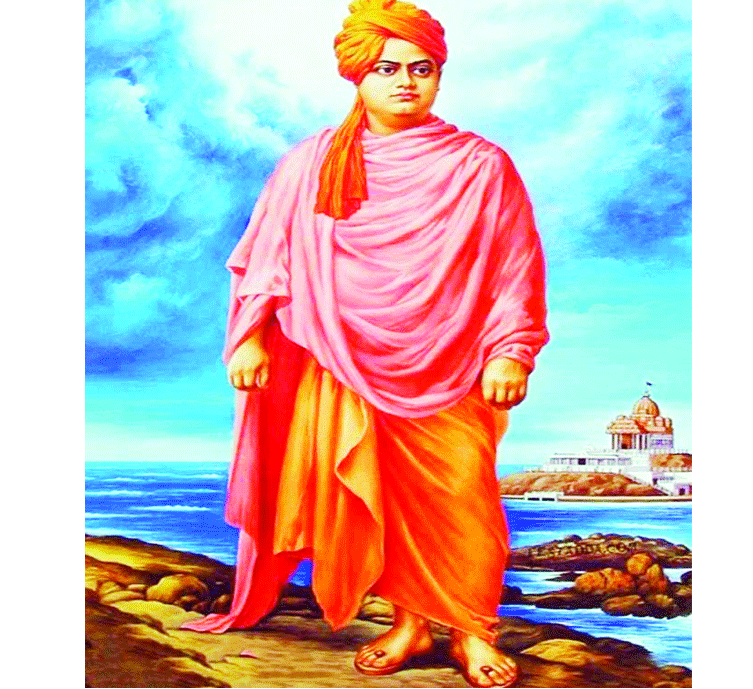
Daily Excelsior has started the column with the article on Swami Vivekananda who is acknowledged as Youth icon, and who has influenced a multitude of youth throughout the world. – Editor
Being young is often seen as the most energetic and hopeful phase of life. From the outside, youth appears confident, ambitious, and full of possibilities. In reality, however, this phase is far more demanding. Young people today are expected to perform well academically, make important career choices early, achieve financial stability, fulfil family expectations, and succeed in an intensely competitive environment. At the same time, they are expected to remain confident, motivated, and emotionally strong, even when faced with failure and uncertainty. Under constant pressure and comparison, many young minds struggle to find direction and inner stability. It is during this challenging phase of life that the teachings of Swami Vivekananda acquire renewed importance, offering youth not temporary comfort, but lasting strength, clarity of thought, and a sense of responsibility towards oneself and society.
Swami Vivekananda never viewed youth as weak or dependent. He believed youth was the strongest force in society and the real foundation of national progress. His confidence in young minds was absolute. When he declared, “Give me a few men and women who are pure and selfless, and I shall shake the world,” he was expressing faith in disciplined character and moral courage. At a time when India struggled with loss of confidence, he spoke directly to young people and reminded them that strength already lived within them. This belief continues to inspire youth even today.
One of the most common struggles among young people is self-doubt. Comparison has become a daily habit. Someone always seems to be doing better-earning more, achieving faster, or appearing happier. Gradually, confidence fades and self-criticism grows louder. Vivekananda strongly opposed this tendency. His powerful words, “You cannot believe in God until you believe in yourself,” strike at the root of insecurity. According to him, doubting oneself is more damaging than failure. He encouraged youth to trust their effort, sincerity, and character rather than seek constant approval.
Exhaustion is another challenge that appears early in modern life. Students feel the pressure of competition and examinations, while young professionals feel drained by long hours and uncertainty. Even rest does not feel truly restful because the mind remains restless. Vivekananda understood the role of the mind in human suffering. He stated, “The mind is everything. What you think, you become.” An uncontrolled mind creates unnecessary pain, while a calm and disciplined mind becomes the base of strength and stability.
Career confusion adds further pressure. Young people are often told to choose the “right” career early, as if one wrong decision will ruin everything forever. Fear increases, thinking becomes excessive, and action decreases. Vivekananda offered a practical solution-action itself. His timeless call, “Arise, awake, and stop not till the goal is reached,” urges youth to move forward despite uncertainty. According to him, clarity comes after effort, not before it.
Family and social expectations also weigh heavily on young minds. Parents seek stability, society celebrates success, and relatives expect regular updates. Many young people feel caught between personal goals and external demands. Vivekananda respected family and society, but he also believed youth must think independently. His reminder, “We are what our thoughts have made us,” encourages young people to develop judgment and self-respect rather than blind obedience.
Loneliness is another silent struggle. Despite constant digital connection, genuine understanding is often missing. Vivekananda believed life gains meaning through purpose and service. His simple teaching, “They alone live who live for others,” highlights how service strengthens the mind and gives direction. Helping others, according to him, reduces inner emptiness and builds resilience.
Vivekananda also spoke strongly about emotional strength. He never promised that life would be easy. Instead, he accepted struggle as a natural part of growth. His words, “Strength is life; weakness is death,” reflect his belief that inner strength is essential for progress. Difficulties build resilience, and failures prepare individuals for greater wisdom.
Education was another area where his ideas stood out. He believed education should not be limited to degrees and certificates. True education, according to him, builds character, courage, confidence, and independent thinking. He criticised learning that focused only on memorisation and fear of examinations, urging youth to become thinkers rather than imitators.
What truly makes Swami Vivekananda a youth icon is that he did not flatter young people. He did not promise easy success or shortcuts. He trusted youth enough to expect discipline, courage, and honesty from them. He believed young people were capable of responsibility and sustained effort-and that trust itself becomes a source of motivation.
He also believed that success without values creates inner conflict. Ambition without compassion leads to emptiness. Growth, according to him, mattered only when guided by character and used for the welfare of others.
On National Youth Day and beyond, Swami Vivekananda stands not merely as a historical figure, but as a living guide for today’s youth. His message remains clear and timeless-to believe in oneself, discipline the mind, act with courage, and live with purpose. As long as youth face challenges, doubts, and dreams, his teachings will continue to guide them-not as memories of the past, but as a light for the present and the future.
 Follow our WhatsApp channel
