

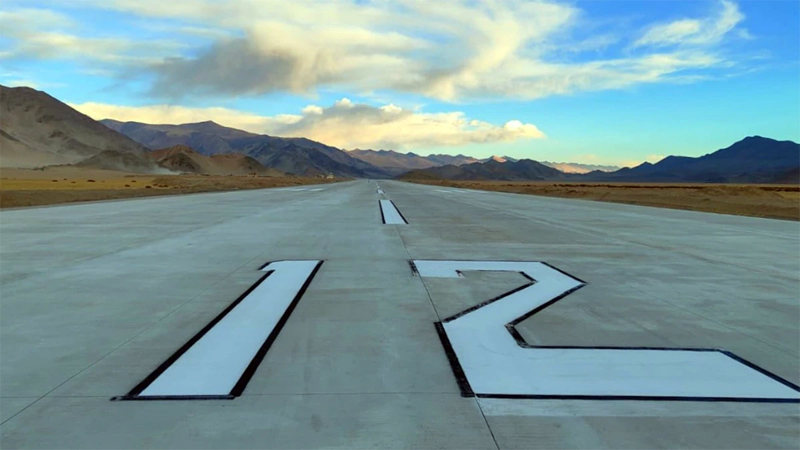
The operationalisation of the Mudh-Nyoma airbase in Ladakh marks a watershed moment in India’s evolving military posture along the volatile LAC. Situated at an altitude of nearly 13,000 feet and barely 25 km from the LAC, Nyoma is not just another addition to the Indian Air Force’s network of high-altitude bases-it stands as a decisive assertion of India’s strategic intent, technological capability, and infrastructural resilience in one of the harshest operational theatres in the world. The landing of Chief of Air Staff aboard a C-130J Super Hercules to inaugurate operations is emblematic of the base’s readiness to support major force multipliers.
For decades, Ladakh’s extreme climate, sparse habitation, and fragile surface infrastructure have posed formidable challenges to India’s defence preparedness. Many stretches of critical road networks remain snowbound for months, while high-altitude passes frequently close due to avalanches and blizzards. Yet, it is precisely this inhospitable geography that makes air connectivity indispensable. The events of 2020-particularly the Galwan Valley clash-were a stark reminder of how swiftly situations can escalate in this region and how important it is for India to maintain a rapid-response capability. In this context, Nyoma fills a crucial operational gap by offering an all-weather platform for fighters, helicopters, and transport aircraft.
The transformation of Nyoma’s earlier rudimentary mud runway into a robust, fully operational airbase within a compressed timeframe stands as testimony to India’s accelerated push in border infrastructure. Implemented by the Border Roads Organisation at a cost of Rs 218 crore, the project showcases engineering grit at altitudes where even survival is an achievement. Operating machinery and maintaining labour strength above 13,000 feet, with oxygen-deficient air, sub-zero temperatures, and a narrow working window each year, is nothing short of extraordinary. BRO’s growing list of high-altitude achievements-from the Darbuk-Shyok-DBO road to the upgrade of Advanced Landing Grounds-has cemented its role as a silent force multiplier in India’s border defence matrix.
The strategic significance of Nyoma must also be viewed against the backdrop of China’s aggressive expansion of infrastructure across the LAC. In recent years, Beijing has rapidly expanded its network of roads, rail lines, tunnels, and airfields in Tibet, enabling the swift mobilisation of troops and heavy weaponry. Its inch-by-inch posture, combined with fast-paced construction, has altered the security calculus in the region. India’s response has been resolute, if delayed. The renewed emphasis on building resilient airbases, ALGs, and all-weather connectivity indicates a clear shift from a reactive posture to proactive deterrence.
Nyoma, alongside existing bases at Leh, Thoise, and Kargil, forms a potent web of aerial logistics and combat readiness. When complemented by operations at Daulat Beg Oldie-the world’s highest ALG at 16,700 feet-India gains a multi-layered advantage in surveillance, troop deployment, casualty evacuation, and rapid airlift capability. In an era of hybrid warfare, where dominance of the skies often dictates tactical superiority, the ability to sustain year-round aerial operations is indispensable.
All-weather roads to forward areas will still take years of tunnelling and meticulous engineering. Until then, and even beyond, airfields like Nyoma will be the backbone of India’s operational readiness. The focus on expanding ALGs reflects an understanding that emergencies demand agility: whether it is troop reinforcement, supply drops, or rapid response to Chinese manoeuvres, air assets offer unmatched speed and flexibility.
What Nyoma ultimately represents is a larger shift in India’s strategic consciousness. The government’s consistent push over the past five years-accelerating clearances, funding critical projects, empowering the BRO, and modernising the IAF’s high-altitude capabilities-signals an unambiguous commitment to closing the infrastructure gap with China. It acknowledges that parity on the ground is not merely a matter of prestige but an essential requirement for maintaining peace through strength. In the icy silence of the Himalayas, where sovereignty is tested not through declarations but through presence and preparedness, the roar of aircraft engines at Nyoma carries a powerful message: India is no longer playing catch-up. It is building, adapting, and preparing-determined to defend every inch of its territory, regardless of altitude or adversity.
 Follow our WhatsApp channel
