

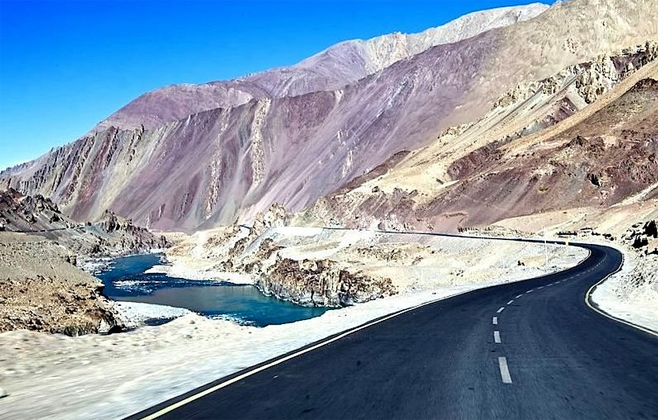
India’s renewed thrust on developing border infrastructure in Ladakh, specifically the Nyoma air base, marks a critical milestone in our military preparedness and strategic parity with China. Scheduled for completion by October this year, the air base at Nyoma, just 30 km from the LAC, is more than just a strip of concrete-it is a strategic assertion of India’s capability and intent in one of the most hostile terrains on earth. The harshness of the climate in Ladakh, especially along the LAC, cannot be overstated. Biting cold, frequent snowstorms, oxygen-deficient high altitudes, and barren landscapes render the region among the most inhospitable in the world. Adding to this challenge is the sparse population and a historically neglected road network. Yet, despite these constraints, the Indian Army continues to maintain the highest military posts in the world, most notably at Siachen Glacier, where temperatures routinely dip below -50°C.
However, the series of border skirmishes with China in the recent past, particularly the Galwan Valley clash in 2020, has served as a hard lesson, prompting the Indian Government to reassess and significantly enhance its strategic posture. This has led to a multi-pronged focus: while roads remain vital, especially for peacetime logistics and troop movement, air connectivity is now emerging as the most dependable lifeline in Ladakh. Given the seasonal limitations of roads in the region-many of which remain snowbound and impassable for months-air bases serve as indispensable platforms for both logistics and rapid deployment of troops and equipment. It is in this context that the development of Nyoma air base, the fourth for the Indian Air Force in Ladakh, assumes vital importance. Alongside Leh, Thoise, Kargil, and Daulat Beg Oldie serving special operations, Nyoma will plug a critical gap in India’s aerial coverage in eastern Ladakh.
The transformation of Nyoma’s rudimentary mud-paved runway into a modern airstrip by the Border Roads Organisation in 2023 was itself a considerable feat. Now, with the full-fledged airbase expected to be ready before the onset of winter, India’s deterrent capacity in the region is set to increase significantly. This will not only ensure reliable year-round logistics support but also enable swift troop rotation, casualty evacuation, and air patrols. In the age of hybrid warfare, where air superiority often dictates the outcome of military engagements, such infrastructure is not just strategic but essential.
India’s challenge lies in matching China’s already robust infrastructure. Beijing’s extensive road networks, high-speed rail, and multiple airfields near the LAC give it an operational advantage in terms of logistics and troop mobility. But India is catching up fast, with the BRO emerging as an unsung hero in this silent race. Its personnel, often working in sub-zero conditions at altitudes of over 15,000 feet, have made immense contributions to the national cause. Their efforts, whether on the Darbuk-Shyok-DBO road or the Nyoma runway, symbolise India’s grit and determination to secure its borders.
Equally commendable has been the Indian Air Force’s track record in Ladakh. From executing swift landings at high-altitude airstrips like DBO to air-dropping supplies in remote regions, the IAF has repeatedly showcased its capability to operate in high-altitude, low-oxygen, and high-risk zones. The modernisation of air infrastructure will further amplify these capabilities, allowing India to maintain a credible and sustained presence in the region. However, the PLA has often employed inch-by-inch tactics, creeping into unguarded territories. While high-tech surveillance and aerial capabilities are essential, they must be complemented by physical presence on the ground. Manned posts, patrolling, and a network of observation points remain indispensable. For this, reliable logistics-both by road and air-are the backbone.
In essence, the Nyoma air base is not just about a new airport; it is a vital link in India’s defence architecture in Ladakh. India may have once lagged in border infrastructure, but that gap is closing fast. The balance of power in eastern Ladakh will see a significant correction. In the icy silence of the Himalayas, the roar of jet engines will send a clear message: India is ready.
 Follow our WhatsApp channel
