

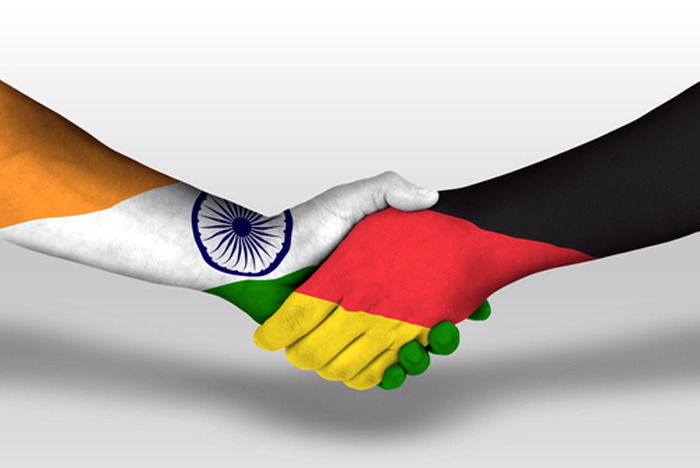
In an era marked by geopolitical churn, economic uncertainty, and an increasingly weaponised global trade environment, the strengthening of the Indo-German partnership assumes exceptional strategic significance. The joint statement issued after talks between PM Modi and Chancellor Merz is not merely a diplomatic ritual; it is a clear signal of intent by two major democracies to align their political, security, and economic priorities in response to shifting global realities.
At the geopolitical level, the most consequential takeaway from the Modi-Merz engagement is Germany’s unequivocal alignment with India on the issue of terrorism. By strongly condemning the terror attacks in Pahalgam and Delhi, and by reiterating the need to eliminate terrorist safe havens, infrastructure, networks, and financing, Germany has reinforced India’s long-standing position on cross-border terrorism. This convergence is vital for New Delhi. Germany, as Europe’s largest economy and a key influencer within the European Union, carries considerable diplomatic weight. Sustained Indo-German cooperation on counter-terrorism-especially through mechanisms such as the UN 1267 Sanctions Committee and the Joint Working Group on Counter-Terrorism-will strengthen India’s ability to isolate and counter Pakistan in international forums. In a global environment where narratives often dilute accountability, Germany’s clarity lends India moral, political, and diplomatic reinforcement.
Equally important is the broader strategic context. The world today is witnessing what may be termed a “tariff syndrome”-a resurgence of protectionism, trade barriers, and strategic decoupling, particularly among major economies. For India, which is increasingly conscious of overdependence on any single market, diversification of trade partnerships has become a strategic necessity. With India looking to compensate for over $100 billion worth of trade exposure to the United States amid evolving tariff regimes and uncertainties, Europe emerges as a natural and reliable alternative. The numbers already tell a compelling story. Bilateral trade in goods and services between India and Germany has crossed the $50 billion mark, accounting for over 25 per cent of India’s total trade with the European Union. This makes Germany our largest trading partner in Europe and also a gateway to the wider EU market. With trade reaching a record high in 2024 and momentum continuing into 2025, the renewed political push for deeper and broader economic engagement is likely to yield tangible dividends for both sides.
Germany can be a big market for Indian goods, services, and talent in the future. From pharmaceuticals and chemicals to IT services, engineering goods, and green technologies, India’s competitive strengths align well with Germany’s industrial needs. At the same time, German investments have played a crucial role in diversifying global supply chains-an objective increasingly shared by both nations amid global disruptions. Perhaps the most promising dimension of the Indo-German alliance lies in technology and innovation. Germany’s global leadership in automobiles, advanced manufacturing, semiconductors, batteries, automation, and industrial AI dovetails with India’s ambitions under initiatives such as “Make in India” and “Digital India”. India is actively seeking cutting-edge technologies in semiconductor fabrication and battery manufacturing, areas where German expertise can be transformative. The opening of Infineon’s Global Capability Centre in GIFT City and the launch of a Semiconductor Ecosystem Partnership are early indicators of this synergy. Beyond semiconductors, collaboration in AI, Industry 4.0, automation, telecommunications, and critical minerals-including rare earth extraction and recycling-offers immense long-term value. For India, access to German know-how in these sectors can accelerate domestic manufacturing, reduce import dependence, and strengthen strategic autonomy. For Germany, India provides scale, skilled manpower, and a rapidly expanding market.
Germany’s position as a central pillar of the European Union further amplifies the importance of this partnership. A robust Indo-German economic relationship can serve as a catalyst for deeper engagement with other EU countries. A successful FTA would unlock new collaborations, reduce trade barriers, and institutionalise a win-win economic framework. At the level of foreign policy, the hand-in-hand stance of India and Germany adds considerable heft to India’s global posture. Shared commitments to a free and open Indo-Pacific, UN reforms, climate action, and a rules-based international order reinforce India’s image as a responsible and influential global actor. In a volatile world, this partnership offers India both balance and leverage-and promises Germany a trusted partner in Asia’s fastest-growing major economy.
 Follow our WhatsApp channel
