

DyCM stresses self-regulation alongside Govt measures
*Pathania demands strict law, 36-hour takedown rule
Bivek Mathur
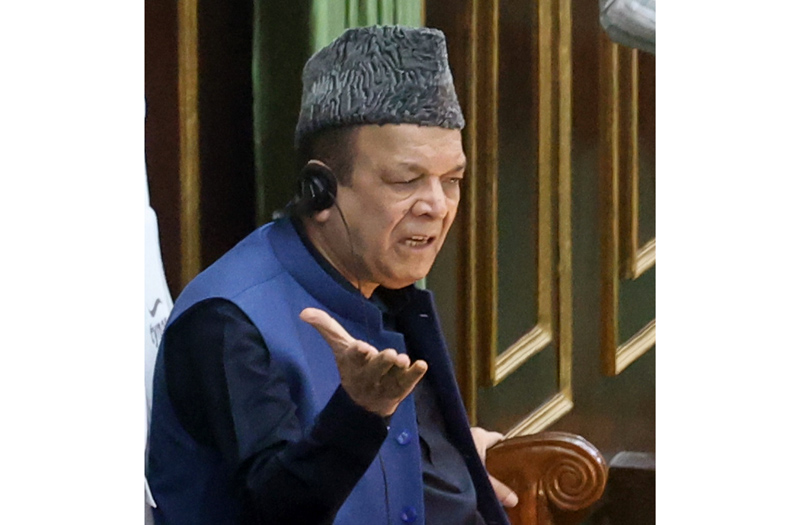
JAMMU, Mar 27: Speaker of the Jammu and Kashmir Legislative Assembly, Abdul Rahim Rather, today called for framing a comprehensive legal framework to effectively tackle the growing challenge of fake news and misinformation across the Union Territory, emphasizing that the issue has serious implications for governance, public trust and social harmony.
The Speaker made these remarks during a short duration discussion in the Assembly on measures to address the spread of fake and unregulated information, particularly on social media platforms.
Click here to watch video
He underscored that any proposed legislation must be carefully crafted to strike a balance between curbing misinformation and protecting democratic values, including freedom of expression.
Rather stressed that the Government must undertake an extensive study of existing legal frameworks and best practices adopted by other States and countries before drafting such a law.
Follow the Daily Excelsior channel on WhatsApp
He said the legislation should aim to establish a robust and credible mechanism capable of countering fake news while safeguarding responsible communication.
The Speaker also took strong exception to the absence of senior officers from the Information Department, including the Information Secretary and Director Information, during the discussion, and termed it a “casual approach” towards a matter of serious public importance.
He directed that the Government must remain responsive and accountable on such critical issues raised by legislators.
Earlier, initiating the discussion, BJP MLA Ranbir Singh Pathania raised serious concerns over the unchecked spread of fake and unregulated news, calling it a major threat to governance, cyber security, and democratic institutions.
Pathania informed the House that despite the rising menace, the Government has not penalised a single individual for spreading fake news.
“Earlier, when I asked during the question hour how many people were penalised, the reply was zero. Even on the question of how many were asked to take down misleading content, the answer again was none,” he said, adding that the Information Department has only issued over 20 rebuttals so far.
He described the issue as “highly sensitive”, not only for Jammu and Kashmir but also at the national level, stating that while freedom of expression is a fundamental right, the right to receive correct and verified information is equally important and must be protected from misinformation and disinformation.
Highlighting the absence of an effective mechanism to regulate online content, Pathania said defamatory posts on platforms such as Facebook and Instagram often cause irreversible damage before any action can be taken.
He stressed the need for a mandatory provision to ensure removal of fake content within 36 hours.
Referring to discussions at the national level, including remarks by Union I&B Minister Ashwini Vaishnaw, Pathania said fake news has emerged as a serious concern requiring immediate legislative intervention.
Quoting recommendations of a Parliamentary Standing Committee report presented in December 2025, he said there is a need to clearly define fake news, prescribe penalties, and establish Fact Checking Units (FCUs).
He further suggested that private individuals could also be authorised to report fake news to Government-designated FCUs.
The BJP legislator demanded a similar legal framework in Jammu and Kashmir, including mandatory registration of all social media platforms disseminating news, appointment of grievance redressal officers, and creation of a UT-level Fact Checking Unit.
He also advocated for citizen reporting mechanisms, incentives for identifying fake news, digital literacy programmes, and better coordination with national initiatives.
Participating in the discussion, several legislators cutting across party lines expressed concern over the misuse of social media and the absence of regulatory mechanisms.
NC MLA Bashir Ahmad Veeri said that while media has historically contributed to social progress, a disturbing trend has emerged where individuals with mobile phones and cameras engage in unethical practices, which must be checked.
Congress MLA Iftikhar Ahmad called for a clear policy to register social media journalists and stressed the need to prescribe minimum qualifications and penalties for those indulging in unfair practices.
NC legislator Sajjad Shaheen termed the trend of unverified individuals posing as journalists as alarming, alleging that some platforms are being used for extortion. He demanded strict regulation of misleading and defamatory content.
Raising a personal example, NC MLA Khurshied Ahmed said a local social media report had tarnished his image following a recent accident in his constituency, and called for strict punishment for those spreading false information.
BJP MLA Pawan Gupta pointed out that while local cable networks are regulated through district-level committees, there is no mechanism to control social media platforms, allowing unchecked dissemination of fake news.
NC MLA Nazir Ahmed Khan (Gurezi) said that freedom of speech is not absolute and cannot be used to defame individuals. He observed that lack of coordination between the Cyber Cell and Information Department has resulted in regulatory gaps.
PDP MLA Rafiq Ahmad Naik extended the criticism to sections of national electronic media, alleging instances of misinformation and sensationalism. He, however, said that people are capable of distinguishing between credible and non-credible information.
Congress MLA Nizam Uddin Bhat blamed sections of social media for moral degradation and provocation, asserting that anyone misusing media platforms for fraud must be held accountable, irrespective of their position.
Independent MLA Rameshwar Singh highlighted the role of untrained individuals in spreading misinformation and called for a verified list of accredited media persons.
NC MLA Sajjad Shafi said that a section of social media has turned into a tool for blackmail, particularly after the abrogation of Article 370, and stressed the need to restore credibility through regulation.
NC MLA Saif-ud-Din Bhat alleged that media is sometimes used to settle personal scores and spread propaganda, while NC legislator Farooq Shah warned that misinformation often shapes public perception before the truth emerges.
Senior BJP leader Sham Lal Sharma said professional ethics are declining and called for constitution of a House Committee, including accredited journalists, to address misuse of social media through periodic reviews.
Minister Satish Sharma remarked that he has personally been a target of online propaganda, highlighting the widespread nature of the issue.
Replying to the discussion, Deputy Chief Minister Surinder Choudhary acknowledged the concerns raised by legislators and assured that the Government will take necessary corrective measures to address the issue.
He said that the media, regarded as the fourth pillar of democracy, has historically played a vital role in the country’s freedom struggle and continues to hold the trust of the people.
However, he noted that with the advent of social media, new challenges have emerged that require both regulatory intervention and self-discipline.
Choudhary stressed that while the Government will act to curb misinformation, the media must also introspect and work towards strengthening its credibility.
“No law can be effective without self-regulation and ethical conduct,” he said, urging media professionals to act responsibly and uphold journalistic values.
He added that a strong and responsible media is essential for strengthening Jammu and Kashmir and, in turn, the nation. “A strong J&K will lead to a strong India. For this, all stakeholders must play their role,” he said.
Concluding the discussion, Speaker Abdul Rahim Rather reiterated the urgent need for a comprehensive and well-researched legal framework to tackle fake news and misinformation.
He directed the Government to examine best practices from across jurisdictions and come up with an effective law to curb unethical use of social media while preserving democratic freedoms.
 Follow our WhatsApp channel
