

Dr Umang Jamwal
secretary.ida.jammu@gmail.com
The establishment of the Shri Mata Vaishno Devi Institute of Medical Excellence (SMVDIME) at Katra was envisioned as a landmark initiative in strengthening medical education and healthcare infrastructure in Jammu & Kashmir. Conceived under the aegis of the Shri Mata Vaishno Devi Shrine Board (SMVDSB), the institution was intended to complement the existing Shri Mata Vaishno Devi Narayana Superspeciality Hospital and create a world-class teaching and treatment ecosystem in the region.
The people of J&K were shocked as this institution faced regulatory challenges in its initial phase. But such moments often present opportunities for structural strengthening and strategic partnerships. One such opportunity lies in exploring collaboration with the Employees’ State Insurance Corporation (ESIC), a central autonomous body under the Union Ministry of Labour & Employment, which has successfully established and operated medical and dental colleges across various states of the country. Importantly, ESIC does not presently have a medical college in Jammu & Kashmir.
A collaboration between SMVDIME and ESIC could therefore prove transformative-not only for the institution itself but also for the larger healthcare landscape of the Union Territory. This will also augment the Centre’s plan to add 75,000 new medical seats in five years, as announced by Prime Minister Narendra Modi during his 2024 Independence Day address.
Strengthening Medical Education in a Critical Region
Jammu & Kashmir has made significant progress in expanding medical education in recent years, with new government medical colleges coming up in various districts. However, the demand for quality medical education still far exceeds the available seats. Many aspiring students continue to seek admission outside the Union Territory, often at considerable financial burden.
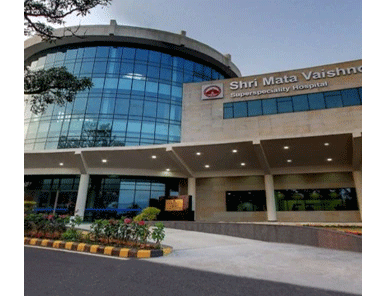
SMVDIME was envisioned to bridge this gap by offering high-quality MBBS education supported by a modern, multi-speciality hospital in Katra. The associated 467-bed Shri Mata Vaishno Devi Narayana Superspeciality Hospital already provides advanced tertiary care services across numerous specialities. With the right institutional framework and regulatory compliance, this infrastructure can serve as a strong foundation for a premier teaching institution.
ESIC’s entry into this framework could provide the administrative experience, regulatory familiarity, and institutional stability required to consolidate and strengthen the medical college’s operations.
Why ESIC Is a Natural Partner
The Employees’ State Insurance Corporation runs a vast healthcare network catering to insured workers and their dependents across India. Over the past decade, ESIC has also emerged as a significant contributor to medical education through its own network of ESIC medical colleges in states such as Punjab, Haryana, Delhi, Uttar Pradesh, Himachal Pradesh, Bihar, West Bengal, Karnataka, Rajasthan, Bihar, Assam, Telengana, Tamil Nadu and many more
Despite its national footprint, ESIC has no medical college in Jammu & Kashmir. Establishing a presence in the Union Territory through a partnership model at Katra would serve multiple purposes:
* It would extend ESIC’s healthcare and educational reach to the northernmost region of the country.
* It would benefit insured workers and their families in J&K by strengthening tertiary care access.
* It would ensure a more geographically balanced distribution of ESIC medical institutions across India.
From a policy perspective, such a move would align with the broader national goal of equitable regional development and healthcare expansion.
Addressing Regulatory and Operational Challenges
The establishment of any new medical college in India requires strict adherence to norms prescribed by the National Medical Commission (NMC). Infrastructure standards, faculty strength, bed occupancy ratios, laboratory facilities, and clinical exposure parameters must all meet defined benchmarks.
ESIC’s experience in setting up and managing multiple NMC-recognized medical colleges gives it a practical understanding of compliance requirements. A collaborative arrangement could involve:
* Structured faculty recruitment processes aligned with NMC norms.
* Strengthening of pre-clinical and para-clinical departments.
* Development of standard operating procedures for inspections and audits.
* Institutional governance models with clear academic and administrative accountability.
By integrating ESIC’s institutional expertise with SMVDIME’s existing infrastructure and local support base, regulatory compliance gaps can be systematically addressed.
Leveraging Existing Infrastructure at Katra
One of SMVDIME’s strongest assets is its proximity to a well-established superspeciality hospital catering to patients from across Jammu & Kashmir and adjoining regions. The hospital’s patient load, range of specialities, and modern facilities provide an excellent platform for clinical training.
Under a collaborative framework, this infrastructure could be further optimized to:
* Enhance clinical postings and internship exposure.
* Introduce structured community health outreach programmes in rural and hilly areas.
* Promote research initiatives relevant to regional health challenges.
* Facilitate interdisciplinary learning and skill development.
Katra’s unique position as a major pilgrimage hub also means that healthcare facilities in the area cater to a diverse and high patient footfall, adding to the clinical learning experience for medical students.
Economic and Social Benefits for the Union Territory
The establishment of a stable, fully functional medical college in Katra would have ripple effects across the regional economy. These include:
* Creation of employment opportunities for doctors, nursing staff, paramedics, technicians, and administrative personnel.
* Increased demand for housing, services, and local business engagement.
* Development of Katra as not only a religious tourism hub but also a center of medical excellence.
Furthermore, retaining medical education within the Union Territory reduces the outflow of students and financial resources to other states. It also improves the likelihood that trained doctors will eventually serve in local hospitals, thereby strengthening J&K’s healthcare system.
For ESIC, the collaboration would enhance its visibility and operational footprint in the region while contributing to national health infrastructure goals.
A Possible Roadmap for Collaboration
For such a partnership to materialize, a carefully structured roadmap would be essential. This may include:
Formal Memorandum of Understanding (MoU):
An MoU between SMVDSB/SMVDIME and ESIC outlining financial arrangements, governance structure, academic control, and long-term sustainability.
Joint Governance Framework:
Creation of a governing body or coordination committee with representation from both institutions to ensure transparent and efficient decision-making.
Infrastructure and Faculty Augmentation Plan:
A time-bound action plan to meet all NMC requirements, including recruitment of qualified faculty and upgrading of teaching facilities.
Phased Academic Expansion:
Initial stabilization of the MBBS programme followed by gradual introduction of postgraduate courses once the institution achieves full operational maturity.
Community and Stakeholder Engagement:
Building confidence among students, parents, and the public through transparent communication and consistent academic standards.
A Win-Win Proposition
At a time when healthcare and medical education are central to national development priorities, innovative institutional collaborations can accelerate progress. A partnership between SMVDIME and ESIC would combine local initiative with national institutional strength.
For SMVDIME, it offers a pathway to institutional consolidation and long-term stability.
For ESIC, it provides an opportunity to establish its first medical college in Jammu & Kashmir and strengthen its national mandate.
For the people of J&K, it promises improved access to quality healthcare, enhanced educational opportunities, and regional socio-economic development.
The vision that led to the establishment of SMVDIME in Katra remains both relevant and necessary. By exploring a structured collaboration with ESIC, that vision can be realized in a more sustainable and impactful manner.
Jammu & Kashmir stands at an important juncture in its healthcare journey. Strategic partnerships such as this could well define the next phase of its medical education and public health advancement.
(The author is President, Indian Dental Association (IDA), Jammu)
 Follow our WhatsApp channel
