

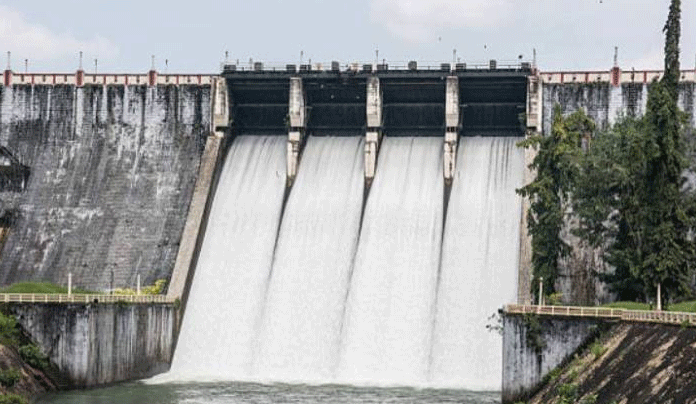
The Union Cabinet’s approval of a Rs 2,584.60 crore Small Hydro Power Development Scheme marks a significant inflexion point in India’s renewable energy trajectory, with particular relevance for the Union Territories of Jammu & Kashmir and Ladakh. In regions where energy scarcity coexists paradoxically with vast hydropower potential, the shift toward decentralised, small-scale hydro projects is a strategic necessity. For decades, Jammu & Kashmir and Ladakh have remained energy-deficient despite possessing an estimated hydropower potential exceeding 20,000 MW. The UTs continue to spend thousands of crores annually on power purchases, a burden that constrains developmental expenditure and limits economic growth. Against this backdrop, the Cabinet’s renewed focus on small hydropower offers a realistic and implementable pathway toward energy self-reliance.
The core strength of small hydropower projects lies in their scalability and feasibility. Unlike mega hydroelectric ventures that require substantial capital investment, lengthy gestation periods, and complex environmental clearances, SHPs-typically with a capacity of up to 25 MW-can be executed within shorter timelines and at significantly lower costs. The Cabinet’s provision of financial support-up to 30 per cent of project cost or Rs 3.6 crore per MW-directly addresses one of the key barriers to private participation, making these projects financially viable. For hilly and border regions such as J&K and Ladakh, the scheme is particularly well-aligned with geographic realities. The abundance of small rivers, streams, and tributaries of major river systems, such as the Indus, Chenab, and Jhelum, provides an extensive natural base for distributed hydropower generation. Harnessing these water resources through run-of-the-river projects-without large dams or displacement-ensures minimal ecological disruption while maximising local energy output. Equally important is the strategic dimension of water utilisation. By enabling localised consumption of river waters within Indian territory, the development of SHPs contributes to optimising water use in border regions. While large geopolitical narratives around river waters remain complex, incremental steps to utilise tributary flows domestically strengthen India’s position both economically and strategically.
The economic implications for UTs are substantial. The scheme is expected to generate approximately 51 lakh person-days of employment during construction alone, with additional long-term jobs in operation and maintenance. For remote areas such as Kishtwar, Doda, Reasi, and parts of the Kashmir Valley and Ladakh , these projects can act as catalysts for localised economic activity. Improved electricity availability will directly impact agriculture, cold storage, small-scale industries, and digital connectivity-sectors that remain constrained by unreliable power supply. Moreover, the decentralised nature of SHPs reduces dependence on extensive transmission infrastructure, which is both costly and technically challenging in mountainous terrain. By generating power closer to consumption centres, transmission losses are minimised, and supply reliability improves. This is particularly crucial for remote habitations.
The policy also signals a shift in the governance model of hydropower development. By encouraging private sector participation through models such as Independent Power Producers, the Government is effectively transferring financial and execution risks away from the public exchequer. For a fiscally constrained UT like Jammu & Kashmir, this approach is both pragmatic and necessary. If implemented transparently, it can unlock significant private investment-estimated at Rs 15,000 crore-creating a multiplier effect across the regional economy. Providing for multiple DPRs under the scheme will create a ready pipeline of bankable small hydropower projects, thereby accelerating future capacity additions.
However, the success of this initiative will hinge on execution. Hydropower projects in the region have faced delays, bureaucratic bottlenecks, and regulatory uncertainty in the past. Key hydropower projects such as Sawalkote, New Ganderbal, and Lower Kalnai have remained stalled for years, caught in a web of procedural delays, weak project management, and institutional inaction. The proposed seven-year timeline for small hydro projects appears excessively conservative, given their limited scale. Environmental and geological risks also require careful management. While SHPs are less intrusive than large dams, robust site assessments and disaster-resilient designs must be integral to project planning.
Ultimately, the Cabinet’s approval reflects a broader recognition that energy security in regions like Jammu & Kashmir and Ladakh cannot rely solely on large, centralised projects. The future lies in a diversified energy mix, where small, distributed, and renewable sources play a central role. The challenge now is not policy intent but administrative delivery.
 Follow our WhatsApp channel
