

Excelsior Correspondent
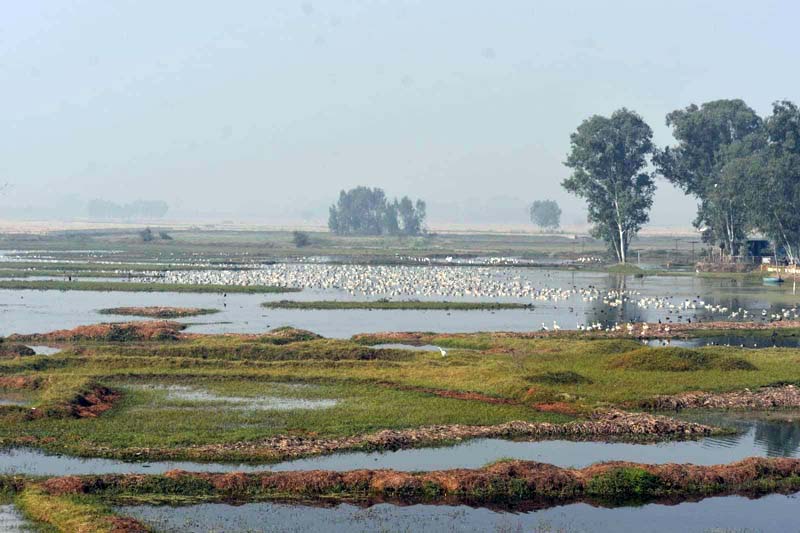
RS PURA, Nov 29: Thousands of birds from Siberia have migrated to the world famous Gharana Wetland on the Indo-Pak border in Suchetgarh area of Jammu district these winters.
Gharana Wetland, situated in tehsil RS Pura of Jammu district has emerged as one of the most important habitats for migratory waterfowl following successful ecological restoration measures undertaken by the Department of Wildlife Protection, Jammu & Kashmir.
Notified as a Conservation Reserve in 1991, the wetland, spread over an area of 408 kanals, serves as a crucial wintering and stopover habitat for thousands of migratory water-birds arriving annually from Siberia and Central Asia to the Indian subcontinent.
Over the past few years, this wetland has undergone scientific rejuvenation through a multipronged management approach implemented in accordance with the approved Management Plan. Major restoration interventions include large-scale de-silting and dredging operations, systematic removal of invasive aquatic weeds and hydrological measures to ensure sustained water recharge.
These efforts have successfully restored the wetland’s original depth profile, enhanced water-holding capacity, expanded foraging areas and created stable ecological conditions essential for supporting diverse water bird population. To strengthen protection, chain-link fencing has been installed around the wetland, effectively curbing human interference, livestock intrusion and poaching threats. This has provided a safe and undisturbed habitat for feeding, roosting and breeding of migratory birds, including several species categorised as `Endangered and `Threatened’ by the International Union for Conservation of Nature (IUCN).
During the ongoing winter season, field observations by wildlife frontline staff and independent birdwatchers indicate a significant increase in both species richness and population density compared to previous years. Officials conducting regular water-bird census report that bird activity has increased manifold, with flocks now occupying a much larger spatial extent of the wetland. Species being recorded in noticeably higher numbers and for extended durations include Bar-headed Goose, Northern Pintail, Common Teal, Eurasian Wigeon, Gadwall, Red-wattled Lapwing and Black-winged Stilt.
“With restoration of open water areas and improved availability of natural food resources, bird presence and diversity at Gharana have increased substantially,” said a senior wildlife officer.
Experts have attributed the rapid ecological recovery to timely scientific interventions, enhanced habitat quality and effective protection measures. The wetland is also witnessing growing footfall from researchers, students, birdwatchers, nature enthusiasts and wildlife photographers.
To promote eco-tourism, infrastructure such as bird observation points, a nature interpretation centre, an eco-stop and a cafeteria has been developed without compromising the ecological integrity of the habitat.
Officials further stated that the successful restoration has significantly strengthened Gharana Wetland’s case for designation under the Ramsar Convention. Located along the Central Asian flyway, one of the world’s major avian migration corridors, this wetland fulfils the criteria required for its recognition as a Ramsar site.
 Follow our WhatsApp channel
