

*Highlights policy gaps in street-animal welfare
Excelsior Correspondent
JAMMU, Nov 24: A 32-year-old animal shelter at village Hakkal, run by a migrated Kashmiri Pandit family, has emerged as a telling case study of how long-standing gaps in animal welfare policy continue to challenge grassroot initiatives in Jammu and Kashmir.
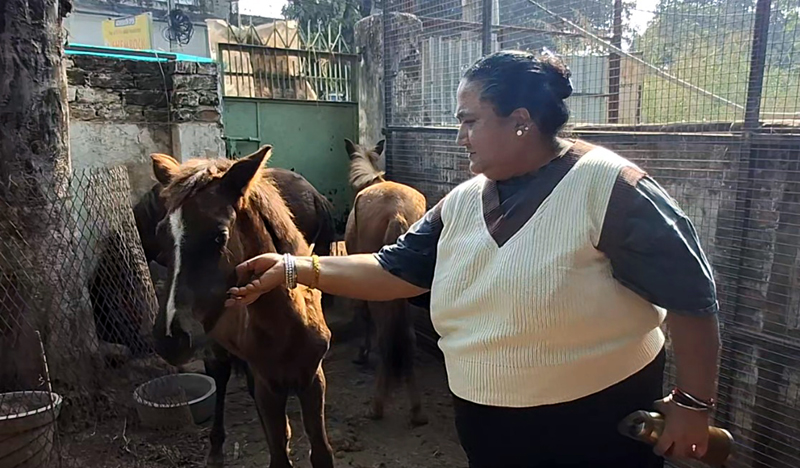
The Hakhoo Street Animals Foundation, established in 1993 and currently housing nearly 550 disabled and abandoned animals, is one of the oldest continuous rescue units in the region – yet remains outside any structured Government support system.
What began as a small rescue effort by Namrata Hakhoo’s mother after the family migrated from Kashmir during militancy has today grown into a full-scale sanctuary. It offers permanent refuge to blind, paralyzed, severely injured, old and abandoned animals, including dogs, cats, monkeys, horses, calves and pigs.
“We give lifelong care to animals who cannot survive elsewhere,” said Namrata, who now manages the shelter full-time. The Foundation spends Rs 15,000- Rs 20,000 per day on food, medical care, transportation and shelter maintenance. While donations from several Indian states and overseas supporters help sustain the operations, there is no structured funding mechanism for long-term care facilities for disabled street animals in J&K – a gap the Hakhoo shelter’s experience brings sharply into focus. Click here to watch video
Namrata noted that community participation within Jammu and Kashmir remains minimal. “People here in J&K extend help to humans in need but do not want to help animals as animals cannot speak and tell that they have been helped by somebody, but humans can speak and express gratitude,” she said, adding that although attitudes softened slightly after COVID, the shelter still receives no meaningful local support.
Namrata said she has approached multiple departments since 2018 for allotment of Government land to expand the shelter. The file was moved twice and later shelved both times. Repeated representations to senior officers and major political parties also brought no outcome.
The case highlights the absence of a clear, streamlined policy for recognizing and supporting organizations that host permanent-care animals – a category often overlooked in municipal and animal husbandry planning.
Though a Government dispensary and an Animal Husbandry processing unit are located close to the Shelter, Namrata said they routinely decline treatment. She alleged that staff “abuse us and ask us to get out as they have no time for us.”
With no dependable public veterinary support, the Foundation has relied on a private clinic at Channi Himmat since 2013. Even with outstanding dues of over Rs 2 lakh since March 2025, the Clinic continues to provide treatment through two dedicated doctors – a physician and a surgeon.
She added that she recently sent three dogs and one monkey to a Government veterinary hospital but was required to buy Rs 4,000 worth of medicines from outside. “Are Government hospitals not capable of providing free medicines?” she asked.
The Hakhoo sanctuary operates round-the-clock and functions as a full-time rehabilitation centre, something not currently defined within most urban animal welfare frameworks in J&K. Namrata said the shelter’s operations reflect a simple principle: no animal that is old, blind, paralysed or abandoned will be turned away.
Donations are accepted through the Shelter’s Instagram account or through direct visits. People can contribute medicines, clinic fees, food items or construction material for new sheds currently being built.
While national and global donors continue to keep the Foundation afloat, the Shelter’s journey highlights the broader need for a defined policy framework for permanent-care animal facilities, reliable public veterinary support, land allotment mechanisms and community participation.
As Namrata puts it, “I have donated my life to this service and my shelter home’s doors are open for every animal whenever it comes.” Her experience suggests that compassion alone cannot sustain such institutions – and policy intervention is long overdue.
 Follow our WhatsApp channel
