

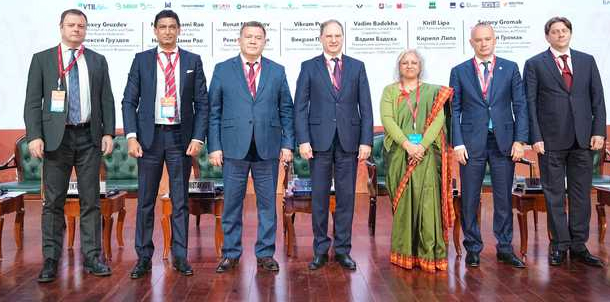
NEW DELHI, Dec 6: The India-Russia Business Forum witnessed a strong turnout, with over 2,300 participants attending the strategic session ‘Sell to Russia: New Opportunities for Indian Business,’ co-organized by the Roscongress Foundation, the Federation of Indian Chambers of Commerce and Industry (FICCI), and the Indian Ministry of Industry and Trade.
The session set the tone for deepening bilateral trade, with Deputy Chief of Staff of the Presidential Executive Office, Maxim Oreshkin, emphasizing Russia’s strategic commitment to India and highlighting the rapid growth of bilateral trade, which expanded at approximately 80 percent annually between 2022-2024, reaching USD 64 billion last year.
He noted that Indian goods currently account for only 2 persent of Russian imports and stressed the goal of raising bilateral trade to USD 100 billion by 2030 through a more balanced and diversified approach.
“We have come for Indian goods and services. This is a strategic choice for the development of relations between the third and fourth largest economies in the world,” Oreshkin said, adding that Russia is ready to facilitate the entry of Indian products into its market.
Russian Minister of Economic Development Maxim Reshetnikov underlined the need to diversify trade by increasing imports of pharmaceuticals, food, chemicals, equipment, auto parts, textiles, and electronics, calling diversification essential to achieving the USD 100 billion target set by the two nations’ leaders.
“Diversifying trade is essential to achieve the USD 100 billion target set by our leaders,” he said.
The session brought together senior government officials and ministers from both countries representing over 1,000 Indian organizations and 150 Russian ones across more than 40 sectors, including legal services, healthcare, IT, logistics, media, tourism.
Minister of Agriculture of the Russian Federation, Oksana Lut, said that India and Russia are pursuing similar policies in developing agribusiness and noted the enormous potential for expanding bilateral trade and cooperation in science, technology, and education. She emphasized the role of Indian equipment in boosting Russian food production, saying, “India and Russia share a common vision for agribusiness. Indian equipment can play a crucial role in increasing our food production by 25% by 2030.”
Highlighting healthcare and pharmaceuticals, Mikhail Murashko, Minister of Healthcare of the Russian Federation, said that India is a key player in the global market and that cooperation between the two countries has been expanding steadily over decades of trust and collaboration. He noted, “Indian drugs account for 10% of registered medicines in Russia, reflecting decades of trust and growing cooperation in the healthcare sector.”
Deputy Minister Alexey Gruzdev noting that India supplies USD 4.5 billion in industrial goods to Russia annually and highlighting prospects for localization and integration of Indian suppliers into Russian value chains.
On the second day, participants also engaged in detailed discussions on expanding cooperation in healthcare, food supply, aerospace and automotive industries, sustainable production corridors, artificial intelligence, digital technologies, B2B negotiations, and the exchange of skilled professionals, signaling a comprehensive effort to strengthen economic ties between the two countries. (UNI)
 Follow our WhatsApp channel
