

Biju Dharmapalan
bijudharmapalan@gmail.com
As the world steps into 2026, science is no longer a quiet enterprise unfolding behind laboratory doors. It is shaping geopolitics, redefining healthcare, and influencing how societies respond to climate change, technology, and uncertainty. Globally, the coming year promises breakthroughs driven by artificial intelligence, ambitious space missions, gene editing, and deep-earth exploration. But what makes 2026 especially noteworthy is India’s growing visibility-not merely as a participant, but as a contributor shaping the direction of global science.
Artificial Intelligence: From Automation to Discovery
It is thought that artificial intelligence will reach a key point in 2026. AI systems are no longer just utilised for data analysis or routine automation. They are also being used more and more to come up with hypotheses, plan experiments, and improve research workflows. The focus is moving away from big, energy-hungry models and towards smaller, more efficient systems that can think logically in certain areas.
India’s competitive advantage is in this change. Indian researchers are making AI tools that operate well with little data and minimal computing costs. They have a lot of experience in math, computer science, and data engineering. This method fits with what is happening in the country, where scalability, affordability, and inclusivity are very important.
India’s effort for public, multilingual AI infrastructure is a big thing to keep an eye on. BharatGen and other projects want to create independent AI systems that can work in all Indian languages and social situations. If it works, India may show how AI can help with governance, education, healthcare, and research in different democratic nations. This would be a better option than models that are only for business or spying.
Healthcare: Early Detection at Scale
Globally, 2026 will see the outcomes of massive clinical trials that could redefine early disease detection, including blood tests capable of identifying dozens of cancers before symptoms appear. Regulatory reforms in clinical research are also accelerating the journey from laboratory to patient.
India’s role here is quietly expanding. With its diverse population, strong pharmaceutical sector, and growing clinical research ecosystem, India is emerging as a key site for large-scale trials, digital health innovation, and AI-assisted diagnostics. Indigenous research in genomics, affordable diagnostics, and public health surveillance is aligning with national priorities such as universal healthcare and preventive medicine. As precision medicine becomes more accessible, India’s experience in balancing cutting-edge science with public health scale will be closely watched.
Gene Editing: Innovation with Caution
Gene-editing technologies are entering a new phase, with personalized therapies for rare genetic disorders moving closer to clinical reality worldwide. While these developments are currently concentrated in the United States and Europe, their implications are global.
In India, discussions around gene editing are becoming more nuanced-moving beyond technical feasibility to questions of ethics, regulation, and equity. Indian researchers are actively contributing to foundational work in genomics, plant biotechnology, and biomedical ethics. As the country refines its regulatory frameworks, 2026 could be a year when India asserts a distinctive voice: advocating innovation that is scientifically robust, ethically grounded, and socially inclusive.
Space Science: From Milestones to Continuity
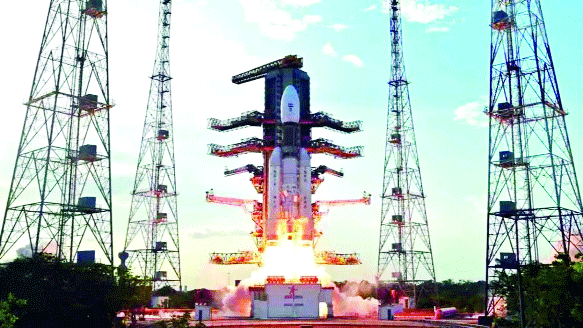
India’s space program has had some of its most conspicuous scientific breakthroughs in the last few years. As 2026 goes on, the focus is moving from symbolic milestones to a long-term scientific presence.
The Aditya-L1 solar observatory will help us learn more about solar activity and space weather, which have a direct impact on satellites, power grids, and communication systems. India’s successful lunar mission near the Moon’s south pole has already changed how people around the world think about its space capabilities.
The Gaganyaan program’s steady advancement is also very important. Several test flights without crew, including missions with the humanoid robot Vyommitra, are testing life-support systems, crew modules, and technologies for re-entry. These missions will show that India is ready to start human spaceflight in 2026.
India stands out because it focusses on mission-driven, cost-effective science, which is becoming more important in a world with limited resources.
Exploring the deep Earth and the deep future
One of the more dramatic global science stories of 2026 is the launch of ultra-deep ocean drilling missions designed to penetrate Earth’s crust and reach the mantle. These projects aim to answer fundamental questions about how the planet formed and how tectonic processes shape life-supporting environments.
India’s own engagement with Earth system science-through oceanography, monsoon research, seismology, and climate modelling-is becoming increasingly integrated. With climate extremes intensifying, Indian scientists are at the forefront of studying monsoon variability, coastal vulnerability, and disaster resilience. The relevance of this work extends far beyond national borders, particularly for regions facing similar climate risks.
Big physics and India’s quiet preparation
While particle physicists worldwide look ahead to major upgrades at global facilities such as the Large Hadron Collider, India is strengthening its participation in international mega-science collaborations. From detectors and instrumentation to theoretical physics and data analysis, Indian teams are laying the groundwork to contribute meaningfully to discoveries that probe the fundamental structure of matter.
Equally important is the domestic push to nurture high-energy physics, quantum science, and advanced materials research within the country. These fields may not dominate headlines in 2026, but they are essential for long-term scientific sovereignty.
Why 2026 Matters
What makes 2026 different is not just the promise of individual breakthroughs, but the convergence of science with societal needs. Artificial intelligence is no longer abstract; it is influencing how research is designed. Space science is no longer symbolic; it is operational. Health research is no longer reactive; it is preventive.
For India, this is a year to watch because its science is increasingly defined by relevance-addressing real-world problems at scale while contributing to global knowledge. The challenge ahead is not talent or ambition, but coherence: aligning policy, funding, ethics, and public trust.
(The author is the Dean -Academic Affairs, Garden City University, Bangalore)
 Follow our WhatsApp channel
