

Dr Rajiv Kumar Gupta
rajivguptagmc@rediffmail.com
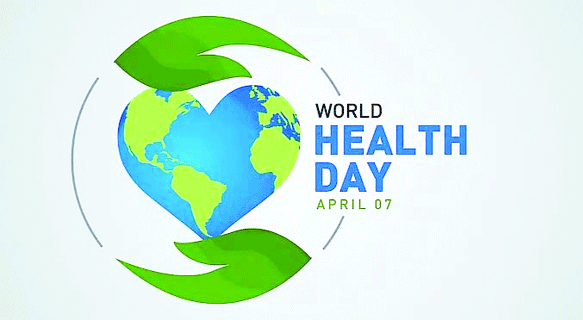
Every year on April 7, the world comes together to mark World Health Day, a global initiative led by the World Health Organization. In 2026, the theme “Together for health. Stand with science” resonates more strongly than ever, emphasizing the vital role of science, collaboration, and trust in safeguarding global health. The observance launches a year-long campaign that highlights how scientific innovation and partnerships can address some of the most pressing health challenges facing humanity today. At the heart of this year’s theme lies the recognition that health is interconnected across humans, animals, plants, and the environment. This integrated perspective, known as the One Health approach, underscores the need for multidisciplinary collaboration. From emerging infectious diseases and antimicrobial resistance to climate change and food safety, the One Health framework provides a comprehensive pathway for prevention and control. World Health Day 2026 is not merely a symbolic observance but a call to action. It urges governments, scientists, healthcare professionals, and the public to reaffirm their commitment to science-based decision-making. In an era marked by misinformation and scepticism, rebuilding trust in science and public health institutions is essential. Evidence-based policies and transparent communication are key to ensuring that communities remain informed, protected, and empowered.
Anchoring this year’s campaign are two landmark global events that highlight the power of international cooperation. The International One Health Summit, scheduled for April 7, brings together global leaders, scientists, and policymakers to deliberate on coordinated strategies for health security. Hosted by WHO in collaboration with the Government of France under the French G7 Presidency, the summit represents a significant step toward strengthening global partnerships. Complementing this is the inaugural Global Forum of WHO Collaborating Centres, taking place from April 7 to 9. This unprecedented gathering will bring together nearly 800 scientific institutions from over 80 countries, making it the largest scientific network ever convened around a United Nations agency. These institutions play a critical role in research, training, and policy support, and their collective expertise will help translate scientific evidence into effective public health action. The significance of these events extends beyond their scale. They symbolize a renewed global commitment to unity, knowledge-sharing, and innovation. In a world increasingly interconnected yet vulnerable to shared risks, collaborative science offers the most reliable pathway to resilience and sustainability.
Importantly, the World Health Day campaign invites participation from individuals and communities worldwide. Citizens are encouraged to engage with credible information, celebrate scientific achievements, and share personal stories that highlight the impact of science on everyday life. Whether it is a breakthrough in vaccine development, improved maternal healthcare, or advancements in disease surveillance, science continues to transform lives in profound ways. Social media platforms also serve as powerful tools for advocacy and awareness. By joining the global conversation using hashtags like #Stand with Science and #World Health Day, people can amplify messages that promote evidence-based practices and collective responsibility.
The campaign outlines three core goals: to encourage engagement with science and factual evidence, to rebuild trust in scientific institutions and public health systems, and to support science-driven solutions for a healthier future. Achieving these goals requires sustained effort, inclusive dialogue, and a shared vision of progress. As the world observes World Health Day 2026, the message is clear science is not just a discipline; it is a lifeline. Standing with science means standing for truth, innovation, and the well-being of all living beings. It is a commitment to a future where health systems are stronger, communities are better informed, and global cooperation leads to lasting change. In embracing this vision, humanity takes a decisive step toward building a safer, healthier, and more sustainable world for generations to come.
(The author is Prof and Head. Community Medicine GMC Jammu)
 Follow our WhatsApp channel
