

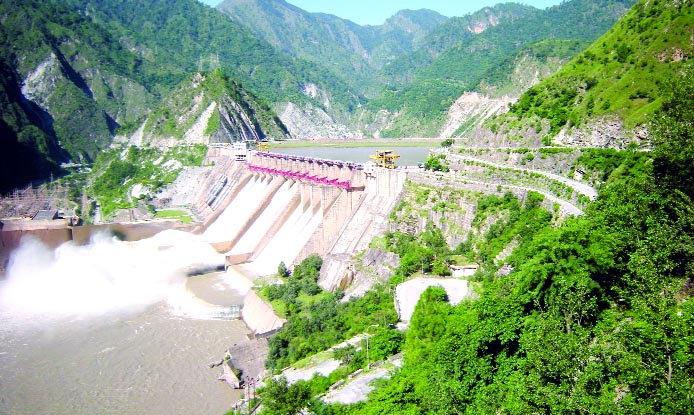
A victim of Indus Water Treaty
Vinod Kumar
The Indian sub-continent is bestowed upon by the Mother Nature with natural water resources in every fence and corner. The Himalayas are the backbone; the snow fed rivers flowing through the fertile planes of Indus and Ganges quench the thirst of millions of creatures in India, Pakistan and Bangladesh, onceknown as a golden bird. The Narmada basin/ Vindhyachal/ Satpura ranges quenching the thirst of Malwa or the central India; the Sahayadary/ Brahamgiri on the west coast, the basins of Godavari, Krishna and the Kaveri in the southern peninsula. And the mighty Brahamputra, Bagmati, Kosi, Teesta, Damodar and Mahanadi etc. meet the water demand of everyone in the east.
The water availability was a key factor for the settlement of the people in any region to create dwellings. Even the hill stations were mostly founded near the water source since ancient times. The water from the wells, ponds, rivulets and rains used to be sufficient for human consumption and for the live stocks. Nevertheless using the river waters for irrigation, commenced as early as 200 years BC; the evidence of the which is available from Chola Dynasty in south where small diversion structures (head works) and canal systems were built to irrigate the fields from the water of river Kaveri. These head works were improved upon time to time and amazingly in use even today. Similar canals were built in the princely state of Jammu & Kashmir too,many centuries ago and are still functioning.
INFRASTRUCTURE DEVELOPMENT TILL 1947
Incredible scientific development of water resources was carried out by the British Govt.to meet the water demand in each part of the sub-continent from 1830 onwards. A few canals pending since the Mughal period of Shahjahan were completed and are in operation even now. Many irrigation projects were built in the sub-continent despite Portland cement, the RCC (reinforced cement concrete) and the explosives not even invented.The largest project undertaken was the construction of Upper Ganges Canal from Hardwar/western UP. Also founding the THOMSON COLLEGE OF CIVIL ENGINEERING in 1847; first of its kind in the sub-continent, which became University of Roorkee in 1949 and now known as IIT Roorkee. It is also a fact that the atmosphere those days used to be not conducive for the independence movement. Still the British engineers moving through the thick forests on the ponies, carrying out surveys, excavating large canals using the donkeys was a phenomenal activity performed in the Indian sub-continent to serve their commercial interests. Besides amazing development was done in the field of education, rail-road communications, health, mining, power generation, sugar, textiles and for other industrialization processes too.
CHALLENGES BEFORE & AFTER THE PARTITION
The scientifically developed waterresources were the assets of the sub-continent. It couldn’t have been divided easily on the political lines or at the obstinacy of Jinnah or by the Radcliff linesbut required much more due diligence. Nevertheless two decisions favourable to India were made before drawing the final lines of the partition.
The first being the Hussaini wala head works placed under India’s control by merging Dist.Ferozpur on Indian side from where Gang Canal was originating and supplying water to Ganganagar/Bikaner regions of Rajasthan. Similar was the case of Pathankot tehsil in Dist.Gurdaspur from where Madhopur head works were supplying water to Doaba region of Punjab. These head works continued water supply to Pakistan even after 1965 war.
The second decision was to exchange the Dist. Rajshahi (now in Bangladesh) with Malda region of West Bengal, supposed to be the part of the then east Pakistan. It was done to facilitate the construction of mighty Farakka Barrage which was meant to augment the supply of water in the river Hooghly or to maintain navigation for Kolkata port.
INDUS WATER TREATY OF 1960
A treaty was signed for the distribution of the water resources between India & Pakistan involving the World Bank. The water rights of three western rivers; INDUS, JHELUM & CHENAB were given to Pakistan which constitutes about 70% water of Indus basin. The water rights of three eastern rivers; RAVI, BEAS and SUTLEJ were retained by India with 30% water only.The status of the three rivers assigned to Pakistan was to remain unaltered after 1947. After signing the treaty Pakistan has built two major multipurpose projects; TARBELA across Indus and Mangla across Jhelum which is their life line as on date. Contemporarily BHAKRA & PONG multipurpose projects were built by India across river Sutlej and Beas; the life line of a few Indian states since 1966. Thereafter continuous development of available resources in the Indus basin is going on in both the countries.As per the treaty Indian side was forbidden to consume any water of three western rivers except building hydro-power projects but that too with Pakistani concurrence.
The treaty was operational since September 1960 till 23-04-2025 when it has been put in abeyance for the terrorist attack in Pahalgam in J&K. Earlier also India had requested Pakistan for a review of this treaty as it was discriminative.
FIRST VICTIM OF INDUS WATER TREATY
The construction of Salal Power Project near Reasi began around 1970. Dr K L Rao the then Union Minister of Irrigation & Power was instrumental along with Dr Karan Singh erstwhile rulers of J&K in pushing the project; its headquarter was established at a new township JYOTIPURAM, matching with the name of the daughter of Dr Karan Singh. The responsibility to build it was entrusted to the Central Water Commission but the Pakistani side objected the construction until A B Vajpayee visited Pakistan in 1978 as Foreign Minister of India. The issue was deliberated; an agreement was signed to facilitate the construction though it proved to be very harmful for India and even for Pakistan which they haven’t realized till date. This article is basically to highlight those technical reasons which continue to make us bleeding even today in operation and maintenance of the project.
The maximum probable flood in the river Chenab was envisaged around one laccum/sec. at site and accordingly the spillway is designed. Besides spillway gates, there was a provision of six under-sluices to facilitate construction & operational requirements. Nevertheless Pakistan wanted the under-sluices to be permanently plugged before commissioning the project which was complied. Their concern was that the quantum of flood water will be doubled if under-sluices are simultaneously opened coinciding with maximum flood in the river thereby inundating them.
Every dam has a dead storage or”filled up silt” at the upstream of the dam, starting from the zero point at the under-sluices till few kilometres away in the reservoir. Also there is a Water Dead Storage which acts as a SILT EXCLUDER for the water entering the Power House through penstocks. Unfortunately there was no provision of SILT EXCLUDING SYSTEM in this dam since it had a large reservoir.
For permanently closing the under-sluices of the dam, the space occupied by the Water Dead Storage is also filled with the silt permanently and forever. Consequently silted water enters the turbines of the Power House causing extensive wear and tear to its blades/RUNNER. The live water available to generate the power is also silted water.
Had the Under-sluices of the dam were not permanently plugged; silt excluding facility would have been available to the project. The flushing of the dam reservoir could have been intermittently done and there would have been minimum wear and tear problems in the Powerhouse including penstocks and controlling valves.
It is a point to understand by all the politicians and the people of both the countries that the water as occupied in the water dead storage space would have been available to Pakistan which is in the range of billions of cubic meter.
EFFECT OF SALAL AGREEMENT ON OTHER PROJECTS
Consequent upon the Salal agreement, no provision of under-sluices was made in other projects as mentioned above and the similar problems as experienced at Salal must be persisting there too. In fact the Baglihar Project would have been built 3 to 4 years earlier if the provision of under-sluices was available in this project.
FUTURE GUIDELINES AND THE ADVICE
Since the Indus Water Treaty is under suspension, the design of the on-going projects in the Chenab valley like Pakal Dul (1000 MW), KIRU & KWAR (1100 MW), Ratle (850 MW), should be reviewed and also the future projects in the pipeline like 1856 MW SAWALKOT, Bursar (800 MW), Kirthai I & II (1320 MW) etc.should be re-designed like normal projects with provisions of sluice gates etc.
Also the efforts should be made to unplug the six under-sluices of Salal spillway system by NHPC in consultation with the GoI.
Undoubtedly snow glaciers of Himalayas are diminishing very fast for the global warming/climate change etc. India should build large water storage damsas much as possible in the upstream of river Sutlej or Chenab basins to safeguard the water needs of the millions of the people living in the sub-continent. Unfortunately there are no major projects available in the catchments of Beas and Ravi Rivers. Pakistan shall also be benefitted with this stored water and they should be now repenting for the mistake committed by them in 1978.
REVIEW OF INDUS WATER TREATY
Undoubtedly Indus water is the life line for the millions of the people living in Pakistan. India can’t stop or divert water of the five rivers flowing into Pakistan overnight; neither it is technically possible. It will be prudent and appropriate for the Pakistan authorities to understand the global water crisis of the sub-continent (for the population burst after partition in both the countries) and work like the British Engineers who diligently developed the water resources of the sub-continent before the partition. They shall have to stop bullying and cooperate with India if treaty is to be tweaked in future.
(The author has worked at Salal Project in early stages from 1976 to 1980 with HCC Ltd. before joining NHPC at Loktak in Manipur.)
 Follow our WhatsApp channel
