

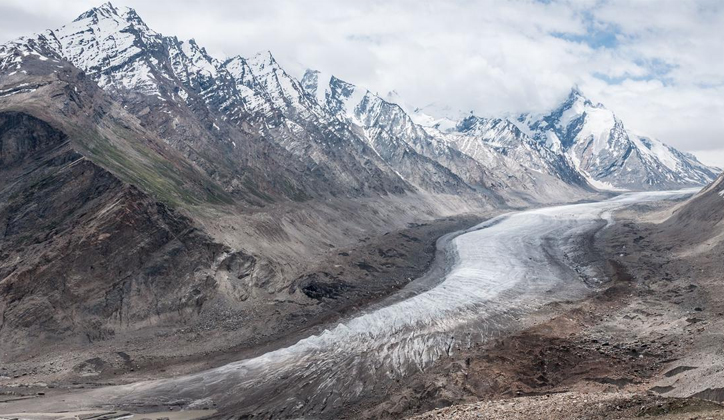
The National Green Tribunal’s suo motu action on Ladakh’s worsening ecological condition is a timely and necessary intervention for one of India’s most fragile and strategic regions. Triggered by a scientific paper detailing rapid climate deterioration, the NGT’s move reflects the urgent need to confront environmental stresses that local communities alone cannot offset. Ladakh, a cold desert with a highly sensitive Himalayan ecosystem, has historically remained stable due to the region’s sparse population and the Ladakhis’ deep cultural respect for nature. Local needs are minimal, and traditional practices are inherently eco-friendly. Yet the ecology is declining at an alarming pace. This raises a fundamental question: if locals are environmentally conscious, why is Ladakh’s ecology deteriorating?
The answer lies in external pressures-unregulated tourism, unplanned urbanisation, insensitive infrastructure expansion and the impacts of climate change. Over the past decade, tourism has exploded beyond the region’s carrying capacity. Urban centres like Leh are witnessing construction booms that ignore the limitations of a cold-desert terrain. Water scarcity, glacier retreat, sudden frost events, flash floods and shrinking agricultural land now threaten the ecological balance. These developments also jeopardise water security far beyond Ladakh. The region’s glaciers feed major river systems crucial for the plains of northern India. Any ecological imbalance in Ladakh will ripple across states dependent on these waters. In this context, the NGT’s intervention becomes essential. It brings legal oversight to a region where multiple ministries and agencies operate without coordination. The research paper cited possible violations of key environmental laws-ranging from the Environment Protection Act to the Water and Air Acts-making judicial scrutiny indispensable. While the Government aims to promote tourism and improve livelihoods, Ladakh cannot afford conventional growth models. Its ecological limits demand responsible tourism, planned urban development, climate-smart agriculture and scientific monitoring of glaciers and water resources. There are sustainable, traditional and modern practices that can boost productivity without harming the environment.
The NGT’s step provides an opportunity to realign Ladakh’s development with ecological realities. If ministries respond with seriousness and the Tribunal issues strong directions, it can be ensured that Ladakh remains a climate-resilient, culturally rich and environmentally secure region. The Tribunal has acted. Time is the most crucial factor. Now, policymakers must ensure Ladakh’s fragile ecology is protected before the damage becomes irreversible.
 Follow our WhatsApp channel
