

Dr. Pallavi Sharma, Dr. Vishal Sharma
pallavisharmajmu@gmail.com
Bowlis are natural water reservoir. In hindi, these reservoirs are known as Bowlis, in dogri called as “Baan” and in English, these are “step-well”. The word ‘Baan’, symbolizes clean mountain water sources that were once integral to community life, ecology and spirituality. This water is not just an element, it too, has spiritual and health significance. As the English name suggests, it has a series of steps which lead down to the ground level where the water is stored. These steps enabled accessibility to reach down to water especially during summers when the water level went down. In India, Bowlis are mainly found in the north-western arid region, where water scarcity is observed frequently. Numerous tanks and Bowlis were commissioned by the ruling clans in such areas in which water was collected mainly during the rainy season and was then used throughout the year by the inhabitants. Different household purposes such as collecting drinking water, bathing, washing in general were the basic routines. Most of the Bowlis were purposefully constructed close to the temples and human settlements. Occasionally, rituals and ceremonies also performed near them. From time to time, daily adorations which include prayers and offerings of water and flowers are also performed. People washed and bathed before daily prayers and made their offerings here.
Chiryai Muttal Bowlis
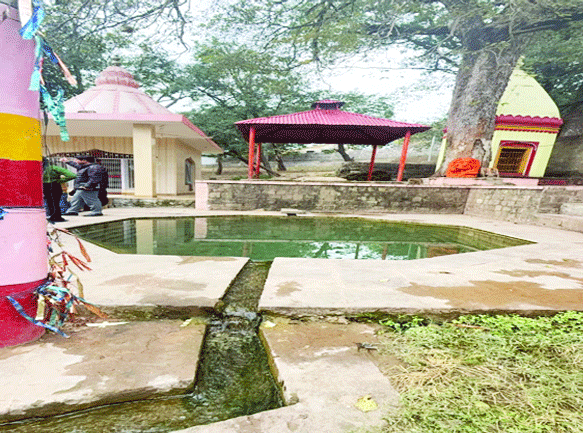
A Bowli complex positioned at a small village namely Chiryai Muttal located at Painthal in Udhampur district, is a matter of concern. Constructed around 300 years ago, it is a complex of four Bowlis. Despite a vessel of water; these structural water reservoirs reflect serenity, traditional architectural marvel, signifying the historical, archaeological and cultural importance. Over a period of time, Chiryai Bowlis are in a state of neglect and despair, withstood the rigorous of weather and time for hundreds of years. Many of them have dried up or fallen into disuse due to changing water systems with the adoption of modern water pipe supply methods. Furthermore, pollution, encroachment, evidence of desecration and misuse of these scared Bowlis is undermining their cultural sanctity. Despite, these Bowlis have immense historical, cultural and architectural implications.
To explore the historical aspect of these Bowlis, very few written literatures are available including the work of Shiv Nirmohi Ji titled “Duggar ki Bawalian-Ek Servekshan” highlighting the social, architectural and cultural magnitude of these ancient structures and few works published in newspaper focusing on the main facets of Bowlis of Jammu, Udhampur, Kathua, Billawar, etc. As far as the Bowlis of Chiryai Muttal are concerned, major content is drawn from the oral traditions available so far in the form of myths and legends among the locals.
Based on local story, in remote past, a garden was cultivated adjoining the Bowli in which two Chinar trees were planted around 250 years ago indicating the life span of Bowli complex. In addition, various folk-lores are associated with these Bowlis. As informed by the local inhabitants and narrated by an eminent author Shiv Nirmohi Ji, the Bowli Complex was built when Rajasthan was struggling with drought. Large number of labourers and artisans moved towards Shiwaliks and some of them stayed in village Chiryai Muttal. During their stay, they built these Bowlis under the patronage of local Rajawada Chief, namely Ghaggar Singh of Jij Rajput clan. After migration, these artisans needed to earn their livelihood. Ghaggar Singh arranged food and settlements for them. As an expression of gratitude and to repay for the kindness of Chief, at the time of their hard need, these artisans laid the construction of these Bowlis to cater the needs of water requirement for the local inhabitants and to avoid any kind of water scarcity in future.
Another folklore credited Maharaja Gulab Singh with the renovation of Chiryai Muttal village. During one of his military campaigns, Maharaja remained missing for more than two months. Then the worried family members including Maharaja’s Queen came to know about a revered Mahatma Purshotam Das Ji known for his divine wisdom, residing in the village Chiryai. The Queen visited Chiryai village, met Mahatma, who assured her that Maharaja Gulab Singh is safe, has achieved victory and will return within two days. True to his words, Maharaja returned as predicted. To acknowledge and show respect, Maharaja Gulab Singh and His Queen again visited Chiryai, paid homage to Mahatma and contributed to the renovation of the village including the whole Bowli site.
Culturally, Bowlis (baan/stepwells) held strong symbolic and spiritual significance. These functioned as community spaces where people gathered for social interaction, observance of religious ceremonies, rituals and feasts. These were purposely constructed near temples, human settlements and important trade routes also. Alongside these roles, Bowlis supported everyday domestic activities such as collecting drinking water, bathing and general washing. Rituals and ceremonies were often performed in their vicinity and regular acts of devotion-such as prayers and offerings of water and flowers-took place around them. Many individuals also washed or bathed at Bowlis as part of their daily worship before making offerings. Even the locals are attracted to build ‘dehris’ (miniature temple shaped memorial structures) of their ancestors at such group of Bowlis. Similarly, the Bowlis of Chiryai Muttal are also associated with various local rituals and ceremonies. An image of naga devta on the cemented slabs lying near the jal kund throw some light on the frequency of naga worship. Also, an image of Shiv Parvati sitting on Nandi and some local deity sitting on donkey or pony like creature lying down to the platform of temple suggest local faith. However, the presence of Raghunath Ji temple and idols of Thakur Ji in the temple reveals the presence of Hindu faith. The temple dedicated to Brahmani Devi and Samadhi of Mahatma Purshotam Das Ji radiating a spiritual aura and indicating the presence of Hindu faith among the natives.
From architectural view point, these Bowlis represents remarkable architectural wonder of their age. The Bowlis, the sculptures and the relief carvings highlight the uniqueness of the skilled artisans. There are five reservoirs in total, first is Jal kund and rest four are Bowlis. Of these, Jal kund is the main source of water to all the Bowlis. It remains filled with water throughout the year and provides water to rest of three Bowlis which are functional and one is non-functional. The first one, located near the temple is in octagonal shape. From here water has been taken through small cemented drain to another two Bowlis that have been constructed at a much lower level on down slope side and are much bigger in sizes. A survey of the site reveals that architects, planners and masons of that era had made water to overflow above specially designed channels built on top of arches from where it was made to fall in Bowlis like a waterfall. While historians, archaeologists, engineers and even locals are unable to solve certain mysteries with regard to the scientific techniques used or structural representation. It apparently describes craftsmanship of artisans of that era who conserved water in such a tranquil manner that it while catering to the needs of local villagers besides animals; also provided a visual delight to heart and soul. Now the question arises- Why all the Bowlis are not in an alignment and tilted at a horizontal angle or why each one of them stands covered with high raised structures from three and not all four sides alone, remain unanswered.
Such a marvellous architectural treasure of Jammu region is facing the wrath of time and management. No doubt, Government under the supervision of Directorate of Archives, Archaeology and Museum is taking initiative for the restoration and conservation of the heritage sites of Jammu region and Bowlis of Chiryai are of prime importance. Moreover, all the other concerning organisations/ institutions/stakeholders/agencies are directed to take necessary measures for the timely preservation and restoration of archeological and cultural heritage of Jammu and hence, develop the site as tourist destination. As it lies in close vicinity of Vaishno Devi Dham, there is a scope of developing this site from economical point of view. But the alarming situation is timely action. Mostly, the organisations are involved in discussions, organising meetings and paper work compilation. If one official formality is completed then another created a hurdle. Adding to this, is the shortage of funds and manpower, resulting in delayed action and thus, day by day destruction of such open-air heritage site. Additionally, there is a need of organising community awareness programs including structured initiative designed to educate, engage and empower local residents to conserve such a priceless heritage. Because, first and the foremost responsibility lies on local community who are 24*7 available there to look after such vulnerable heritages.
Restoring Bowlis not only serve the purpose of heritage conservation, additionally, it will also help to improve the economic condition of people and areas as whole. Reviving these water structures will not only preserve the cultural heritage, furthermore, replenish the natural, sustainable, local water sources, help in rain water harvesting and ground water recharging. Every year enormous amount of rain water got wasted and in this 21st century, when we are aiming the vision of Viksit Bharat @2047 for self-reliant, prosperous India, in this fast-changing technology, still we are facing shortage of water, not able to devise effective technology to make use of rain water. If these Bowlis are maintained properly and effectively, it will propose a way to withstand modern water problems by utilising ancient, proven techniques. There is an urgent need to formulate policies and sponsored scheme to conserve these ancient heritages and also construct new one to make use of natural water sources, recharge groundwater, restore ecological balance and promote traditional structural conservation aligned with sustainable development goals, However, due to protracted neglect and lack of awareness among the locals, the site is losing its significance. Therefore, it is high time to take specific measures to preserve such a heritage site and to revive the cultural and traditional aspects of the site and the village as a whole.
One such initiative for the conservation and restoration of Chiryai Bowlis is taken by the Heritage Club of the Department of History, School of Social Science, Cluster University of Jammu. As a part of Out-Reach Programme, Department has adopted this site and thereby, organised visits to the site to create awareness among the students and encourage them to make their contribution for its preservation. During visits, various activities including cleanliness of the site, enlightening locals about its importance were conducted. During visits, team of experts of the Department of the Directorate of Archives, Archeology and Museum accompanied and informed our students about the richness and the heritage significance of the site. Therefore, it is important to take necessary actions before we are going to lose the ancestral heritage.
(The authors are Faculty at Department of History, SOSS, CLUJ)
 Follow our WhatsApp channel
