

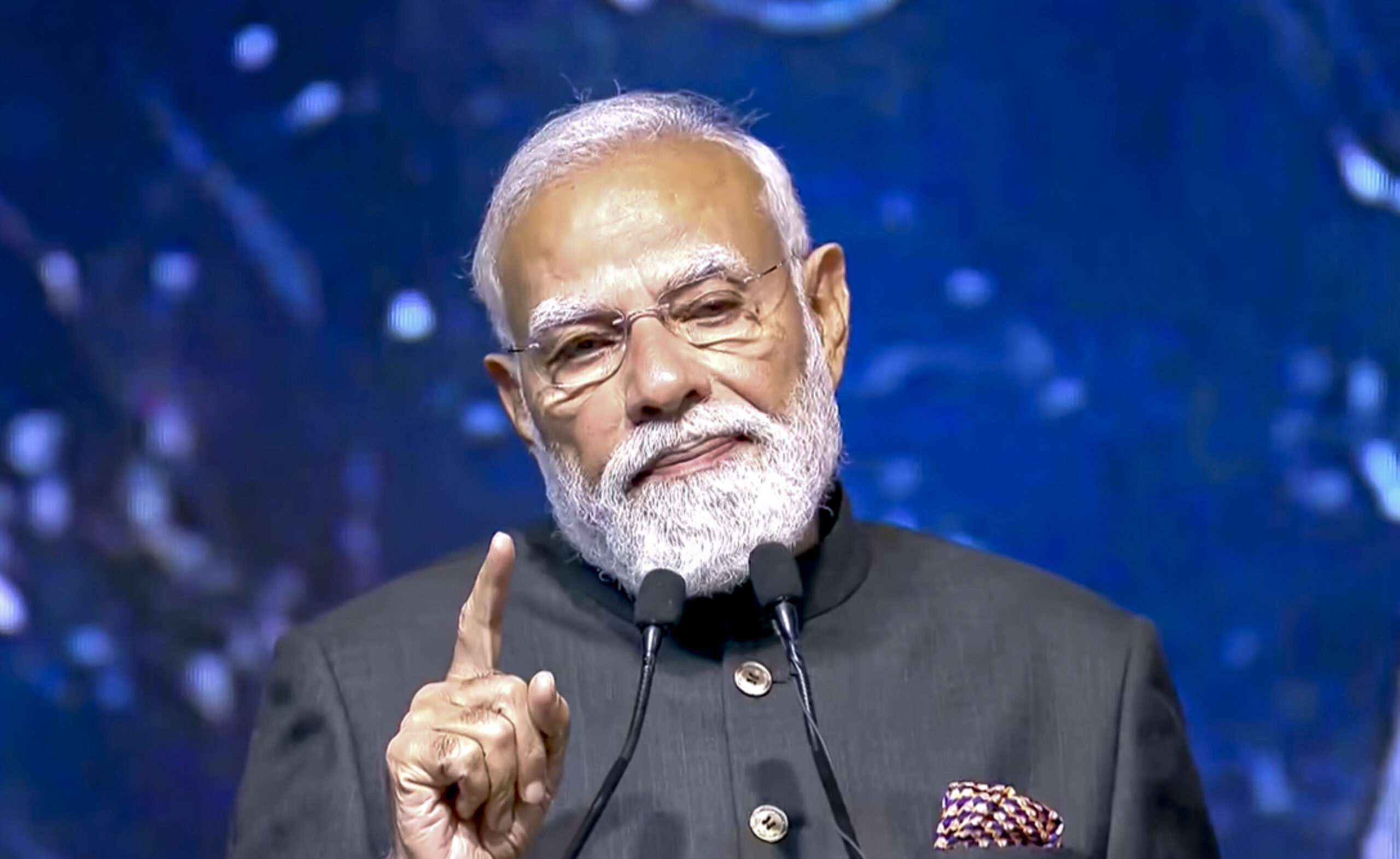
NEW DELHI, Jan 3: Prime Minister Narendra Modi on Saturday inaugurated an exposition of sacred ancient gems and bone fragments linked to the Buddha, asserting that they were not mere artefacts but part of India’s revered heritage.
The prime minister said the sacred Piprahwa Relics travelled to different countries with significant Buddhist populations, including Vietnam, Thailand and Russia, where waves of faith and devotion arose, and people turned up in huge numbers to pay homage.
“This shared heritage of Lord Buddha is proof that India is not connected merely through politics, diplomacy, and economy, but through deeper bonds of emotions, faith and spirituality,” he said.
Modi was speaking at a function to inaugurate the exhibition “The Light and the Lotus: Relics of the Awakened One” at Qila Rai Pithora Cultural Complex in south Delhi.
He recalled that the sacred relics were returning to India after more than 125 years at the intervention of the government and the Godrej Group, which together stopped them from being auctioned off in Hong Kong last May.
“For India, the sacred relics of Bhagwan Buddha are not merely artefacts; they are a part of our revered heritage and an inseparable part of our civilisation,” the prime minister said at the event here in the presence of Buddhist scholars, diplomats and other guests.
“India is not only the custodian of Lord Buddha’s sacred relics but also the living carrier of his tradition,” he said.
Striking a personal note, Modi said his birthplace — Vadnagar in Gujarat — was a major centre of Buddhist studies and Sarnath near Varanasi, where Lord Buddha delivered his first sermon, was his karmabhoomi. The prime minister represents the Varanasi Lok Sabha seat in Parliament.
Modi said before being in government, he travelled as a pilgrim to Buddhist sites, and as Prime Minister, he has had the privilege of visiting Buddhist pilgrimage centres across the world.
He recalled his visits to Lumbini in Nepal, To-ji Temple and Kinkaku-ji in Japan, Giant Wild Goose Pagoda in Xi’an, China, and the Gandan Monastery in Mongolia.
The prime minister said his visit to Jaya Sri Mahabodhi in Anuradhapura, Sri Lanka, was an experience of connecting with the tradition sown by Emperor Ashoka, Bhikkhu Mahinda, and Sanghamitra.
He said that his visits to Wat Pho in Thailand and the Buddha Tooth Relic Temple in Singapore further deepened his understanding of the impact of Lord Buddha’s teachings.
The prime minister said he made a point to carry saplings of the Bodhi tree to places of Buddhist pilgrim centres across the world.
“One can imagine the profound message for humanity when a Bodhi tree stands in the botanical garden of Hiroshima, a city devastated by the atomic bomb,” he said.
The prime minister said that his government was making efforts to ensure that Buddhist heritage reaches the next generations in a natural way and added that the Global Buddhist Summit and international events like Vesak and Ashadha Purnima were driven by this very thought.
The prime minister said that his government had granted classical language status to Pali to make the language in which the Buddha delivered his sermons more accessible to the people.
“This will make it easier to understand and explain the Dhamma in its original essence and also strengthen research connected to the Buddhist tradition,” he said.
The Piprahwa Relics hold a central place in the archaeological study of early Buddhism.
The relics are among the earliest and most historically significant deposits directly connected to Bhagwan Buddha, according to an official statement.
Archaeological evidence associates the Piprahwa site with ancient Kapilavastu, widely identified as the place where Bhagwan Buddha spent his early life before renunciation. (Agencies)
 Follow our WhatsApp channel
