

Govt to develop ‘Viksit village’ in each Assembly segment
* Investors’ need not to worry for deposits: Govt
Gopal Sharma
JAMMU, Feb 17: The Minister for Agriculture Production, Horticulture, Rural Development and Panchayati Raj, Cooperatives, Animal and Sheep Husbandry, Javed Ahmed Dar today said that there is liability worth Rs 184 crores of the SCARD Bank and the deposits of the investors are safe, while the Government has earmarked Rs 770 crores for seven milk plants in the Jammu and Kashmir.
Follow the Daily Excelsior channel on WhatsApp
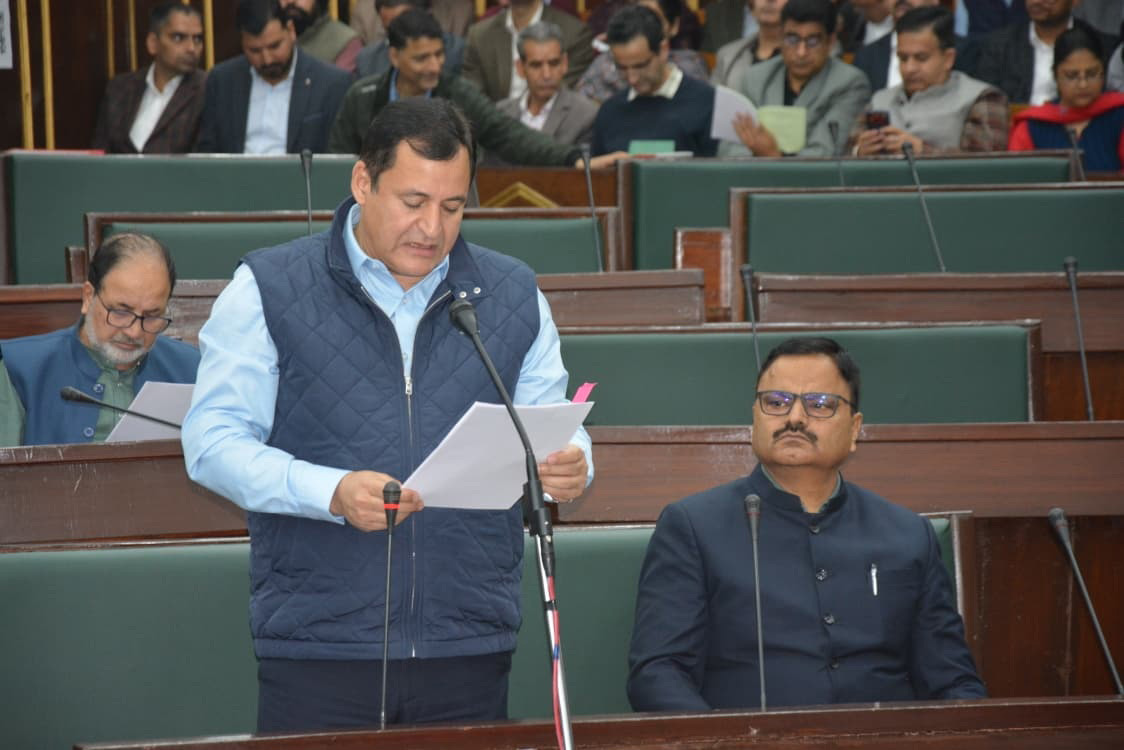
While speaking on the grants of his departments and also replying to the demands raised by Members in the J&K Legislative Assembly today, the Minister said SCARD Bank was established in 1962 in the Jammu and Kashmir for promotion of Agriculture and farmers’ welfare. It started public deposits activity during 2009. The bank has now turned insolvent and has the liability of over Rs 184 crores. There is no scope of its revival. This bank is in the winding up process. However, the money of the depositors is safe. They need not to worry. Their interests will be safeguarded by the Government, Dar said.
The Minister, however, remained non-committal on the future of its employees and said a joint committee of experts from NABARD and Finance department of J&K has been constituted. This panel is thoroughly investigating the matter, irregularities/ embezzlement and fix the responsibility on the people responsible for it. The committee will also suggest for the future of its employees, he added.
In a major push to dairy economy, the Minister proposed establishment of seven Milk Processing Plants of one lakh litre per day capacity, with an investment of approximately Rs 770 crore through UT Capex and Government of India support.
“The J&K Government will be among the first UTs and States to invest in milk value addition sector in addition to the grants from Govt. This initiative will benefit 9 lakh dairy farmers and act as a robust step to increase milk processing capacity of J&K from the current 4 percent to 25 percent in the coming years”, he said.
In aromatic and medicinal plants sector, the Government has planned an investment of Rs 150 crores. He said with this investment, the rural farmers will be able to increase their economic condition by planting such plants on their lands.
Dar announced that the Jammu and Kashmir Government will launch a ‘Viksit village project’ aimed at holistic development of rural areas across all assembly constituencies in the Union Territory, with a substantial allocation under the 2026-27 Capex budget.
“I am happy to announce that in this budget we are introducing a Viksit village project fund, which will be given to all MLAs. We are announcing one ‘Viksit Village’ in every constituency,” Javed said.
The Minister said the project is aligned with the Model village framework. “We propose to establish one model village in each Legislative constituency in rural areas of Jammu and Kashmir, equipped with modern infrastructure, quality education facilities, healthcare services, and sustainable livelihood opportunities to ensure holistic upliftment of rural communities.”
Dar said the initiative builds on the earlier model village concept of the previous government, under which every constituency had received a model village fund through the concerned MLA, with additional components added over time.
The minister said a dedicated financial allocation has been made for the establishment of one model village in each constituency.
“An outlay of Rs 1,800 lakh has been proposed under the Urban Development (UD) Capex 2026-27 for the flagship initiative,” he said adding that of this, Rs 90 crore has been earmarked under the community development programme, while Rs 38.50 crore will be routed through infrastructure of Block Development Councils and district development councils.
Dar further said the development of one model village under the scheme would entail an estimated expenditure of around Rs 2 crore. “MLAs have been advised to identify suitable villages within their constituencies and implement development works based on components prepared at the Gram Panchayat level,” he added.
Highlighting the economic significance of Agriculture sector, the Minister said agriculture and allied activities contribute Rs 41,273 crore to Jammu and Kashmir’s economy, accounting for 19 percent of the SGDP. Of this, horticulture contributes 41 percent, reaffirming Jammu & Kashmir’s leadership in high value fruit production. Livestock contributes 33 percent, while core agriculture accounts for 25 percent ensuring food security and sustaining traditional cropping systems, he said.
The Minister added that government’s push towards vertical farming and protected cultivation has yielded remarkable results, with establishment of 332 hi-tech greenhouses and 848 polyhouses covering an area of 30 hectare. He said that this infrastructure has boosted cropping intensity to 250 percent while significantly safeguarding the crop yields from climate volatility.
“Our focused and strategic push towards oilseed promotion has yielded significant results. The area under oilseeds has expanded from 1.4 lakh hectare to 2.1 lakh hectare, leading to a near doubling of production”, he said.
The Minister further said that the expansion in area under oilseeds, particularly the large scale cultivation of mustard helped in 77 percent growth of apiculture.
“Honey production has crossed 3,895 MTs, supported by distribution of over one lakh bee colonies and establishment of 11 honey processing units under Honey project of HADP, creating new income opportunities for the farmers and rural youth”, he said.
The Minister said that the Mushroom cultivation has increased by 31 percent over the past three years, with production rising from 2,100 MT to 2,742 MT through establishment of 227 units and distribution of 1.18 lakh compost bags.
The Agriculture Minister further said that the Horticulture sector remains top priority of the government, adding that the strength of our rural economy is closely tied to the strength of our orchards.
“To achieve our ambitious target of expanding High-Density plantations across 5,500 hectare, we are developing robust rootstock banks and mother orchards under Project 21 of HADP, laying a strong foundation for self-reliance and long-term orchard sustainability”, he said.
The Minister also said that the Fruit production has increased from 26.43 lakh MT to 26.92 lakh MT and the government is firmly committed to achieve 29.72 lakh MT production by 2029-30. He added that during 2026-27 alone, an additional 1,455 hectare will be brought under high and medium-density plantations, further accelerating growth.
The Minister said that 15,000 metric tonne of new CA capacity will be added during the current financial year recognising the critical importance of Controlled Atmosphere (CA) storage for our fruit economy.
“Jammu and Kashmir currently has 37 mandis, with 24 fully operational and the remaining 13 in various stages of development. Significantly, of the 19 wholesale mandis, 17 have already been integrated with the e-NAM platform while integration of the remaining two is underway. Since inception, over 55,000 stakeholders have registered and a cumulative trade worth Rs 1,721 crore has been conducted up to December 2025”, he said.
The Minister further said that under the Integrated Dairy Development Scheme, 937 dairy units were established during 2025-26, generating employment for nearly 2000 individuals and significantly strengthening the dairy ecosystem across the Union Territory.
He said that under Integrated Sheep Development Scheme, 2018 units were set up in 2025-26, enhancing breed improvement, meat production and sustainable livelihood opportunities for shepherd families and rural youth.
“For the first time in the history of Jammu & Kashmir, 900 elite mutton-purpose sheep of the Texel and Dorper breeds have been imported from Australia, marking a major milestone in strengthening our livestock sector”, he said.
The Minister also announced the launch of an Aromatic and Medicinal Plants Mission with a total financial outlay of Rs 150 crore, for which Rs 10 crore have been allocated in the coming financial year. He added that this mission will harness the vast natural potential of Jammu & Kashmir, promote cultivation of high-value aromatic and medicinal crops, and create significant livelihood and income generation opportunities for our farmers and rural youth.
For support of horticulturalists and safeguard them against weather-related uncertainties, the Minister also announced implementation of the Restructured Weather Based Insurance Scheme (RWBIS) in Jammu & Kashmir, adding that the scheme will cover Apple (both traditional and high-density plantations) and Saffron in the Kashmir Division and Mango, Litchi and Saffron in the Jammu Division, with a total sum insured of Rs 6,594.93 crore.
He said that the government will provide a 25 percent top-up subsidy to promote micro and sprinkler irrigation systems and for this purpose, the government has earmarked Rs 116.86 crore in the current financial year. He added that this initiative is expected to improve water-use efficiency by 60% to 80%.
The Minister said that his Ministry aims to establish 38000 MT CA capacity in 2026-27, adding that to promote balanced regional development, the government will prioritize top-up subsidy for Controlled Atmosphere (CA) storage units in districts other than Pulwama and Shopian, where capacity has already saturated. “To achieve this, 40 new CA stores with an estimated investment of Rs 1,400 crore will be established, of which, the Government will provide Rs 600 crore as subsidy, with top-up support available from 2026-27 onwards”, he said.
On Rural Development Dar said during previous year the government has strengthened wage security and rural asset creation at an unprecedented scale under Mahatma Gandhi National Rural Employment Guarantee Act (MGNREGA). During 2025-26, Rs387.37 lakh person-days have been generated, directly boosting the rural incomes.
He added that under Pradhan Mantri Awas Yojana-Gramim (PMAY-G), 15,093 houses have been completed during the current financial year, taking the cumulative number of houses completed to 3.23 lakh, achieving 97 percent of the overall target, thereby reinforcing housing security and improving the quality of life for rural households.
Under Swachh Bharat Mission (Gramin), the Minister said that 27,775 Individual Household Latrines have been completed and 1,954 Community Sanitary Complexes have been constructed while 553 are under progress and would be completed by March 2026.
Under Rashtriya Gram Swaraj Abhiyan, he said that 214 Panchayat Ghars have been constructed, along with 249 additional rooms for co-location of Common Service Centres. He added that 19 Panchayat Learning Centres have been completed while the remaining 41 are targeted for completion by the end of the current financial year.
The Minister informed that department has achieved remarkable scale and impact across all 285 blocks, mobilizing 7.9 lakh rural women into over 95,000 Self Help Groups (SHGs). He added that SHG women have leveraged Rs. 531.67 crore as capitalization support and accessed Rs. 3,020 crore in bank credit linkage, significantly advancing financial inclusion and economic empowerment.
He further informed that under Lal Ded, 3,169 individual entrepreneurs have been sponsored for credit with an amount of Rs. 32.36 crore, of which, 994 beneficiaries have been sanctioned Rs 10.53 crore while 886 individuals have benefited under Mission Yuva with support of Rs. 4,530 lakh.
“Under Pradhan Mantri Awas Yojana-Gramin (PMAY-G), we aim to construct 50,000 houses with an outlay of Rs 65,000 lakh, accelerating the vision of ‘Housing for All’ while under JKRLM-UMEED, the department aims to develop 600 Cluster Level Federations (CLFs) into Model CLFs (MCLFs) at an estimated cost of Rs 26,070.66 lakh. Besides, the department also intends to establish 1 Lakh additional Lakhpati Didis in 2026-27.
Later, the Assembly passed grants totalling Rs. 4,56,569.56 lakh for Rural Development and PR, Rs 2,42,386.40 lakh for Agriculture, Rs. 1,16,040.98 lakh for Animal and Sheep Husbandry, Rs. 69,648.23 lakh for Horticulture, Rs. 20,620.56 lakh for Fisheries, Rs. 26,611.42 lakh for Cooperatives and Rs. 36,126.71 lakh for the Election department.
The grants were passed through a voice vote after day long deliberations by the Legislators in the House.
 Follow our WhatsApp channel
