

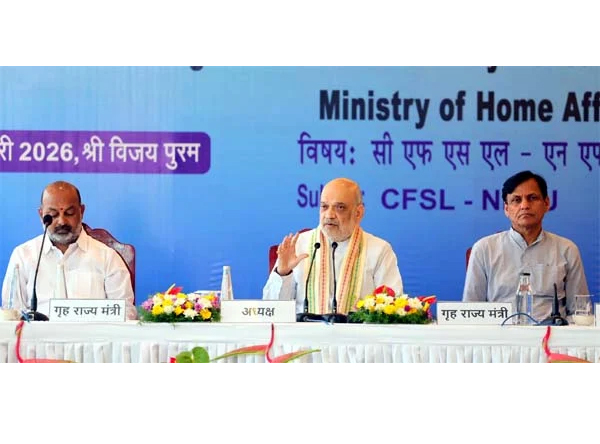
NEW DELHI, Jan 3 : Union Home Minister Amit Shah on Saturday said the government will create such a system by 2029 wherein the entire judicial process, starting from an FIR, going to the Supreme Court, can be completed within three years.
Shah, who chaired a meeting of the Parliamentary Consultative Committee of the Ministry of Home Affairs at Vijaya Puram in Andaman and Nicobar Islands on Saturday over Central Forensic Science Laboratory (CFSL) and National Forensic Sciences University (NFSU), said the MHA has already held 12 meetings of the panel from 2019 until now, which have yielded good results.
Shah said that currently there are seven CFSLs (Central Forensic Science Laboratories) in the country, while eight new are being established.
He said that there will be no state or UT left without either an NFSU or a CFSL.
According to Shah, to strengthen the states’ FSLs, forensic vans, and regional laboratories, th government has provided a grant of approximately Rs. 1,000 crore, while guidelines have been issued for the standardization of forensic science departments.
The IT platform for e-Forensics has also been launched, and 143 laboratories across the country, including CFSLs, have already been connected to it.
Shah said that the centre and state governments are going to invest 30 thousand crore rupees over the next five years to build a network of forensic laboratories pan India.
Union Home Minister and Minister of Cooperation said that by 2029, 35 thousand students will be studying forensics at NFSU, and within 3-4 years we will reach saturation level.
He said that NFSU has 100 percent placement, adding that so far, 14 campuses of NFSU have been established, and this university is currently running more than 100 training programs.
Shah stated that NFSU has so far registered 46 patents, out of which 30 were registered just in 2024.
He said that 96 countries have signed 103 MoUs with the NFSU, and additionally, 117 organizations from the central and state governments have also entered into agreements with it.
According to Shah, in the times to come, good work will be done forensic intelligence, along with AI-based analysis of forensic results and the continuous updating of software.
The Home Minister said that after the implementation of the three new criminal laws, good initial results are being witnessed from the efforts to deliver quick outcomes.
Shah mentioned that the reforms undertaken since 2022 have been efforts in this very direction, adding that to turn the vision of completing the entire process from FIR to SC justice within three years into reality, the MHA is monitoring the efforts 360 degrees, to address every shortfall.
HM said that the centre has its focus, and is working on forensics since 2020 to enhance and expand capabilities in the domain to bolster the justice delivery process.
Shah mentioned that in West Bengal, the accused in the rape of a minor girl was sentenced to death in just 62 days, and in a triple murder case of Bihar’s Siwan, two accused were sentenced within 50 days.
However, HM said that there is a need to further strengthen the system.
Shah said that earlier there were five challenges, including major technology gap in forensic investigations, the limited quality of evidence, chain of custody issues, instances where police did not submit forensic investigation reports to the courts, a shortage of skilled professionals and forensic laboratories, and the lack of nationwide standards.
However, now with new law provisions, forensic laboratories will directly send reports to the court, and provide a copy to cops.
Shah also said that concrete steps have been taken to store data electronically, enable data interoperability among them, and conduct continuous analysis based on Artifical Intelligence (AI),by completely modernizing police, courts, prisons, forensics, and prosecution.
Forensic visits are made mandatory in all criminal cases where the punishment is seven years or more, HM added.
(UNI)
 Follow our WhatsApp channel
