

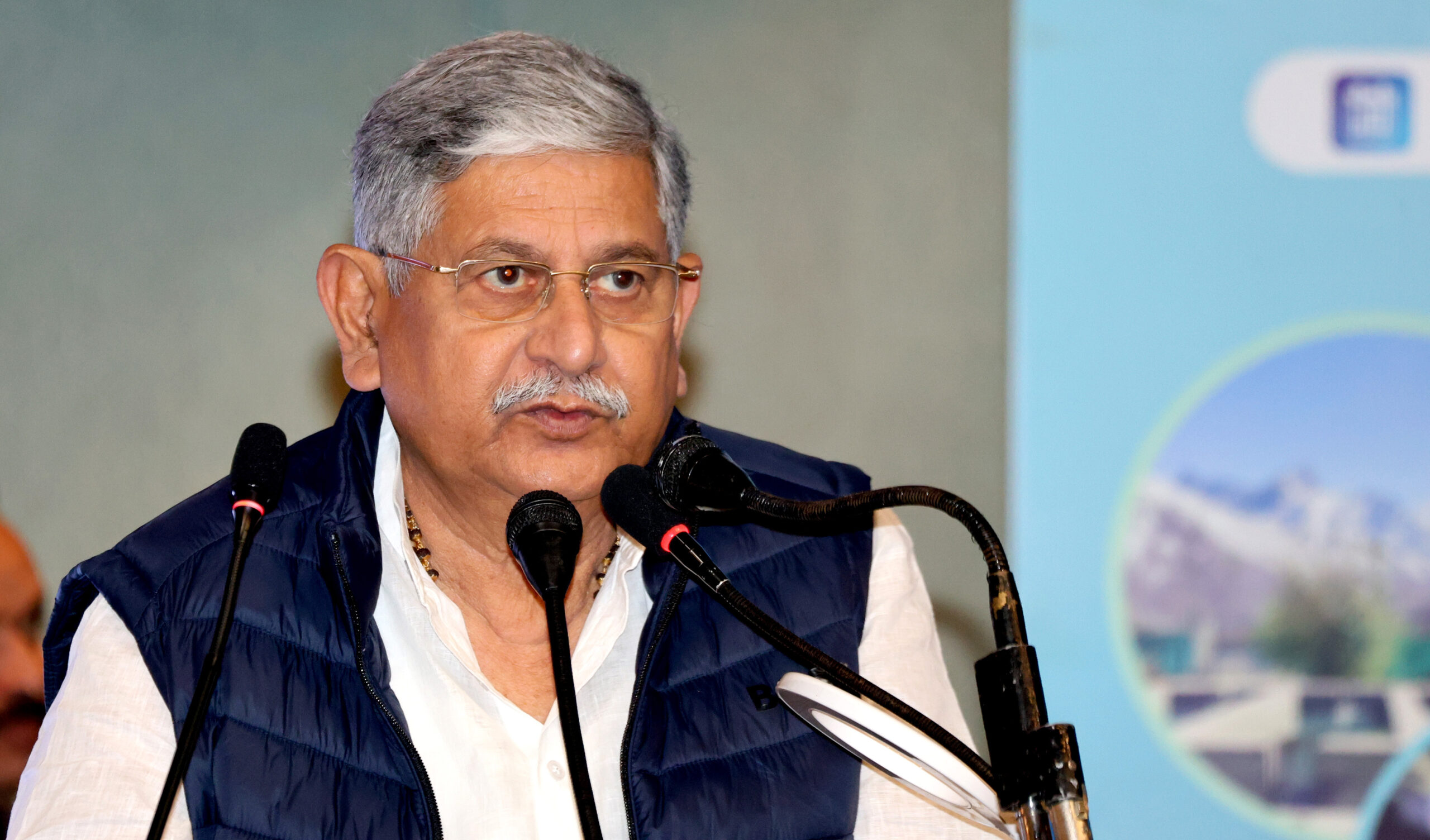
Govt investment has strengthened infra: Baghel
Irfan Tramboo
SRINAGAR, Mar 14: Union Minister for Fisheries, Animal Husbandry and Dairying and Panchayati Raj Rajiv Ranjan Singh today announced the sanction of a Rs 100-crore Integrated Aqua Park to be established in Anantnag district, aimed at strengthening aquaculture infrastructure, boosting fish production and creating employment opportunities.
The announcement was made while addressing the National Conference on Cold Water Fisheries at the Sher-e-Kashmir International Conference Centre (SKICC) here.
The Union Minister said that the project would promote cold-water fisheries development and strengthen the fisheries value chain in J&K.
Follow the Daily Excelsior channel on WhatsApp
He also urged the organisation of fish farmers into cooperatives and Fisheries Farmer Producer Organisations (FFPOs) to improve their access to Government schemes, infrastructure and institutional credit.
Click here to watch video
Singh called upon States and Union Territories to actively support fish farmers by facilitating access to modern infrastructure and financial support.
He said organising farmers into cooperatives and producer organisations would enhance collective capacity, improve market access and ensure better financial and technical assistance.
Emphasising the need to strengthen the entire fisheries value chain, the minister said cold-water regions possess significant potential for trout production and export.
Increasing productivity, expanding value addition and improving market linkages, he said, are key to strengthening the incomes of cold-water fish farmers.
On the occasion, the dignitaries jointly released the Model Guidelines for Reservoir Fisheries and Aquaculture Management, a comprehensive framework covering scientific seed stocking, cage- and pen-based aquaculture, leasing and governance mechanisms, biodiversity conservation, value-chain linkages and monitoring systems.
The Union Minister, the Lieutenant Governor and the Chief Minister also presented awards to fisheries cooperative societies, progressive fish farmers, Kisan Credit Card (KCC) beneficiaries and fisheries start-ups from across Jammu and Kashmir in recognition of their contributions to the sector.
Under the Best Fisheries Cooperative Society category, awards were presented to Jehlum Fisherman Cooperative Ltd, Mahrajpora Sopore (Baramulla), Affarwat Trout Fish Farmers Cooperative Ltd, Tangmarg (Baramulla) and Bandi Trout Fish Cooperative Limited (Kupwara) for their role in strengthening collective fish farming and the fisheries value chain.
In the Progressive Cold-water Fish Farmers category, Shakeel Mohammad Teeli of Anantnag, Mehjoor Sultan Mir of Kupwara, Umer Akbar Dar of Pulwama, Zaid-ul-Ahad of Srinagar and Sara Bano of Srinagar were honoured for their contributions to sustainable trout farming.
In the Kisan Credit Card category, Nusrat Jan, wife of Shabir Ahmad Ganie, Abdul Rashid Ganie, son of Late Gul Ganie, Abdul Rashid Ganie, son of Habib Ullah Ganie, Bilal Ahmad Malik, son of Ali Mohammad Malik, and Asif Ahmad Malik, son of Hafizullah Malik, all associated with aquaculture units in Srinagar, were honoured.
Under the Fisheries Start-ups category, recognitions were given to M/s Sheeshang Trouts represented by Manzoor Ahmad Bhat (Live Fish Vending Centre, Anantnag), M/s Springvalley Feed Mill represented by Gowhar Rasool Reshi (Feed Mill, Srinagar), M/s Fisheries Paradise represented by Neha Atri (Carp Unit, Samba), M/s Rakesh Biofloc represented by Rakesh Kumar (Biofloc Unit, Jammu), M/s Kashmir Trout (Cold Storage Unit, Srinagar) and M/s Raina Trout Farm represented by Reyaz Ahmad Raina (Trout Unit, Ganderbal) for their enterprise leadership in feed production, farming, processing and value addition.
Sara Bano of Srinagar also received approval for establishing a new Recirculating Aquaculture System (RAS) unit under the Fisheries and Aquaculture Infrastructure Development Fund (FIDF) scheme.
To strengthen post-harvest handling and transportation, refrigerated vehicles were distributed to Arsalan Ali of Pulwama, Muzafar Ahmad Dar of Baramulla, Mohammad Iqbal Malik of Kulgam, Shakir Ahmad Mir of Shopian and Umar Akbar Dar of Pulwama. Three-wheeler vehicles were also provided to Farooq Ahmad Akhoon, Ghulam Nabi Kaloo of Budgam, Umar Farooq Dar of Baramulla, Irshad Ahmad Khuroo of Anantnag and Muddasir Ahmad Khanday of Kupwara to improve last-mile transport and local market access.
Speaking on the occasion, S. P. Singh Baghel highlighted the vast potential of India’s cold-water fisheries sector and said sustained government investment has strengthened infrastructure and created new opportunities for innovation, training and processing. He said the sector also plays an important role in employment generation and community development, particularly in remote and high-altitude regions.
Union Fisheries Secretary Dr Abhilaksh Likhi said cold-water fisheries play a vital role in preserving India’s indigenous fish germplasm, noting that more than 278 species contribute to national production, eco-tourism and niche markets. He said targeted interventions have strengthened scientific stocking, climate-suitable culture practices, improved cold-chain connectivity and market linkages for start-ups, women-led groups and FFPOs.
Joint Secretary in the Department of Fisheries Sagar Mehra said investments of Rs 230 crore in the cold-water fisheries segment have improved productivity and value-chain efficiency. He stressed the need to strengthen the entire value chain from pre-production to post-harvest through improved seed availability, brood banks, hatcheries and grow-out farms supported by modern logistics.
He also emphasised scaling advanced production systems such as recirculating aquaculture systems (RAS), raceways and cage culture, along with IoT-enabled monitoring, genetic improvement and modernised cold-chain infrastructure.
A short film showcasing the growth story and sustainable initiatives in the cold-water fisheries sector was also screened during the conference.
The conference witnessed participation of more than 10,000 attendees in hybrid mode, including senior officials, scientists, industry representatives, fisheries cooperatives, entrepreneurs and progressive fish farmers from across the country.
 Follow our WhatsApp channel
