

How Jammu and Kashmir Became a Gateway for Buddhism
Kanwal Singh
singhkanwaljeet1008@gmail.com
For centuries, present day Jammu and Kashmir and north western Indian subcontinent has been described as a region at the edge of empires, religions and civilisations. New archaeological evidence from Kashmir, however, suggests a very different story. Far from being Buddhism’s last stop before the mountains, the present day J&K, functioned as one of the gateways through which Buddhist ideas were shaped, refined and carried onward to Central Asia and beyond.?
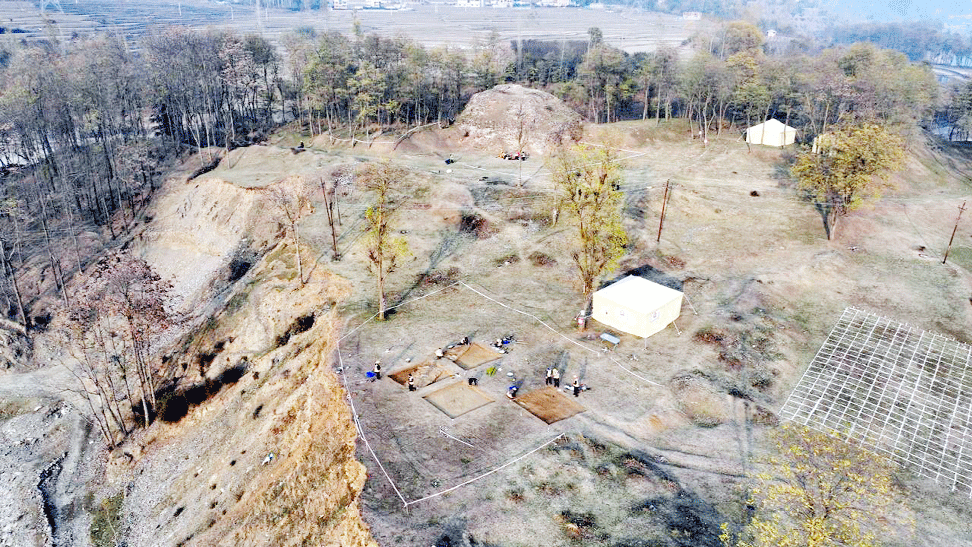
The recent excavation of a large Buddhist complex at Zehenpora in north Kashmir is more than a local archaeological discovery. It reopens a global historical question: how did Buddhism travel from the Indian subcontinent to Gandhara, Bactria, and eventually China? Increasingly, the answer points to Jammu and Kashmir not as a passive recipient of ideas but as an active intellectual hub within trans-Asian networks of learning and
as a crossroads of thought, belief and cultural exchange, where scholars, saints, monks, artisans and travellers helped shape one of the world’s great philosophical traditions.
Until now, the dominant scholarly understanding of Buddhism’s movement beyond the Indian subcontinent has largely framed Jammu and Kashmir as a peripheral or transitional zone within a Silk Route narrative centred on Gandhara and Central Asia. This view relied primarily on Chinese, Tibetan, and Indian textual sources, with limited archaeological evidence from Jammu and Kashmir itself. Excavations at Harwan in the 1920s and Ambaran first placed the region materially within the Kushan Buddhist world. The ongoing excavation at Zehenpora has the potential to recalibrate this understanding by foregrounding Kashmir as an active monastic and intellectual hub embedded in trans-regional Buddhist networks.
A Discovery That Began Far From the Valley
The story of Zehenpora’s Buddhist site began not in the Valley but with an archival photograph preserved in a French museum. The image showed three ancient stupas standing in Baramulla, suggesting that the unassuming mounds at Zehenpora might conceal something far more significant. This clue eventually led to a collaborative excavation in 2025 by the Jammu and Kashmir Department of Archives and Kashmir University, facilitated by India’s Ministry of Culture.
Preliminary evidence indicates that the Zehenpora Buddhist complex dates to the Kushan period, between the first and third centuries CE. Archaeologists have identified the remains of a large stupa, structural foundations, pottery, copper artefacts, and other relics, pointing to a well-organised monastic settlement embedded in wider Buddhist networks linking Kashmir to Gandhara.
Dr. Ajmal Shah, Assistant Professor of Archaeology at the University of Kashmir and Director of the Zehenpora excavation, situates the site within these broader historical routes.
“The location of Zehenpora site on one of the ancient corridors connecting Kashmir region with Taxila and other parts of the subcontinent is itself an indicator that the site was on the crossroads. Infact the whole region of Baramulla has previously thrown light on the connections with many parts of neighbouring world. Given that the Xuan Zang has visited Baramulla, I am hopeful that the Zehenpora site will shed a fresh light on such contacts if the excavation continues.”
At the same time, Dr Ajmal Shah cautions against premature conclusions while underscoring the site’s significance. “It would be too early to say anything with certainty about the diffusion of Buddhism and the role of Zehenpora. However, I am sure that given the huge area of the site and the amount of evidence we have already excavated, the site will prove to be one the richest archaeological sites in Kashmir valley and will for sure refine an understanding of Buddhism in Kashmir after a long time. The site is significant having large above ground intact mounds and the excavated apsidal stupa structure with many artefacts pointing towards major cultural phase of the ancient Kashmir.”
Reflecting on earlier interpretations, he further adds: “Kashmir’s role in spread of Buddhism is generally understood through textual references from Chinese, Tibetan and Indian sources. Harwan excavations in 1920s brought the material culture within the Kushan period in Kashmir into context for the first time… Zehenpora site situated on the ancient route linking Kashmir with Gandhara and Central Asia would have naturally acted as one of the major hubs for transmission of Buddhism outside the geographical boundaries of Kashmir.”
Jammu and Kashmir was not merely absorbing ideas; it was helping transmit and refine them. Its role as a civilisational conduit stretches back millennia. At Burzahom near present-day Srinagar, Neolithic pit dwellings reveal carefully designed settlements adapted to harsh climatic conditions, underscoring that civilisation in Kashmir accumulated gradually through adaptation and exchange.
By the Mauryan period, Kashmir had become a thriving centre of Buddhist learning. Monasteries and stupas attributed to Emperor Ashoka dotted the valley, while textual sources describe Kashmir as a land of scholarship, sometimes referred to as Sharada Pitha. During the Kushan period, royal patronage intensified. Tradition and documented evidence suggests that Emperor Kanishka convened the Fourth Buddhist Council in Harwan, Kashmir, where Mahayana Buddhism was systematised under scholars such as Vasumitra and Ashvaghosha.
From Kashmir, these ideas travelled onward to Gandhara, Kabul, and Bactria. Material evidence, including the Gilgit manuscripts-among the oldest surviving Buddhist texts, further attests to the region’s role as a custodian of Buddhist knowledge.
Buddhist Sites in Jammu
This layered history extends beyond the Valley. Further south, in Akhnoor on the banks of the Chenab, sites such as Ambaran expand the picture. Dr Rajesh Sharma, Assistant Professor, Department of Buddhist Studies at the University of Jammu situates the spread of Buddhism in the region within a much longer historical arc. His assessment draws on early Buddhist texts and Chinese pilgrim accounts, including works such as Early History of the Spread of Buddhism and the Buddhist Schools by N. Dutt and Thomas Watters’ On Yuan Chwang’s Travels in India, alongside Archaeological Survey of India excavation reports.
During an interview to Daily Excelsior, He stated , that “Buddhism took inroad in the land of Madra which included Jammu and its neighbourhood. According to Theragatha and Therigatha three prominent disciples of the Buddha hailed from the Madra desa. Later on the task of propagating Buddhism was introduced in the Kashmir region through the Jammu region during the Mauryan ruler Ashoka in 3rd Century BCE Majjhantika Thera and his team reached Kashmir.”
Archaeological evidence corroborates this continuity.
“Buddhism was introduced in Jammu in Pre-Kushana period. A Buddhist site has been discovered at Ambaran in Akhnoor. Excavations have revealed the brick foundations of a large stupa, monastery walls, terracotta figures, pottery and Kushan coins.”
Dr. Sharma also highlights how Buddhism extended into the mountainous interiors of Kishtwar and Paddar, where it remains a living faith shaped by caravans trade routes and monastic mobility. It seems to be in flourishing state in Jammu. From the account of 7th century Chinese pilgrim Yunchwang, he found that several monasteries were constructed in Poonch and Rajauri. About Buddhism in Poonch, Yunchwang writes “they (people of Punch) were sincere believers in Buddhism. He further notes encountering a Crown Buddha statue placed within a Hindu temple in Rehi village of Ghagwal tehsil in Samba district, suggesting that the area may have come under Buddhist influence during the Kusana age, centuries before Tibetan Buddhism spread from the northeast and Brahmanical traditions from the Indian mainland, highlighting how Buddhist material culture survived within shared sacred landscapes.
Intersections of Earlier and Later Traditions:
What makes Jammu and Kashmir’s past resistant to simplification is how older traditions intersected with later ones. Near Ambaran Buddhists site stands the Sui Simbli temple, whose beautiful wall murals depict Hindu epics alongside Sikh Gurus and the Bhakti saint Kabir. Alongside these stand Kashmir’s Sufi shrines and temples, from Sheikh Noor-ud-din’s dargah at Charar-e-Sharief to other centres where poetry, devotion, and everyday life flowed together. Taken together, these sites tell a consistent story: this region functioned as a crossroads of belief systems where Shaivite, Buddhist, Vaishnavite, Bhakti, Sikh and Sufi traditions intersected.?
Today, Jammu and Kashmir is often viewed narrowly through the lens of political conflict. Archaeology offers a corrective. Beneath the soil lies a history that resists modern simplifications, reminding us that pluralism and intellectual vitality are inherited legacies embedded in the region’s foundations.
Read alongside Burzahom, Harwan, Ambaran, and Sui Simbli, Zehenpora tells the story of a land where scholars and saints, monks, Sufis, Gurus, and artisans, traders and mystics shaped ideas that travelled far beyond the valley.
As Professor Kashab Sharma of the Department of History observes:
“Chinese pilgrims odysseys, Sanskrit paeans, and Greco-Roman chronicles portray Buddhism’s majestic exodus to Central Asia as a Silk Road symphony, positioning Jammu and Kashmir as its periphery. The Zehenpora stupas revelation magnificently rewrite this: J&K emerges as an exalted civilizational crossroads.
Recognising this layered past is not an exercise in romanticisation. It is an act of historical honesty. Jammu and Kashmir was never marginal to the currents of civilisation; it was a place where Buddhist thought was received, reshaped, and transmitted onward to Central Asia and China.
 Follow our WhatsApp channel
