

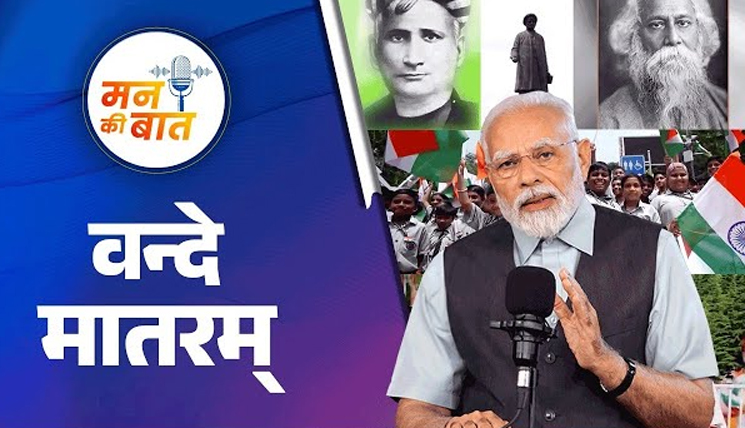
Prime Minister Narendra Modi’s latest Mann Ki Baat address was not just another routine communication with citizens-it was a clarion call to reconnect with India’s soul, its cultural roots, and the self-reliant spirit that once fuelled the nation’s freedom struggle. By urging citizens to celebrate 150 years of Vande Mataram, the Prime Minister rekindled the emotional and patriotic fervour that inspired millions during the Independence movement. The national song, penned by Bankim Chandra Chattopadhyay and first sung by Rabindranath Tagore, symbolises India’s unity, pride, and civilised grandeur. In an age dominated by technology and social media, where instant gratification often overshadows deep reflection, the PM’s appeal is a timely reminder. Remembering Vande Mataram is not merely about celebrating a song-it is about reviving the values it represents: sacrifice, resilience, and love for the motherland. This initiative, marking 150 years of the song, serves as an opportunity for citizens, especially the younger generation, to relive the spirit of patriotism that guided our ancestors. It encourages us to look back not just with nostalgia but with a renewed commitment to protect and promote India’s cultural and moral legacy.
Equally significant in the PM’s address was his emphasis on the swadeshi spirit-a concept that defined India’s independence struggle and continues to hold immense relevance today. From the revival of indigenous dog breeds like the Mudhol and Rampur Hounds by the BSF and CRPF to the cultivation of coffee by women in Odisha’s Koraput, these examples underline India’s ability to thrive through local resources, skills, and enterprise. The Prime Minister’s praise for these grassroots initiatives is a reaffirmation of his belief that India’s strength lies in its villages, its traditions, and its people’s creativity. The cultivation of coffee in regions like Koraput, where women have taken the lead, is particularly inspiring. This illustrates the synergy between economic empowerment and cultural revival. India’s coffee diversity-from Chikmagalur to Wayanad-is a testament to the country’s vast potential when innovation meets dedication. When citizens turn to indigenous production, they do not just create livelihoods-they uphold the spirit of self-reliance, the very foundation of the Atmanirbhar Bharat vision.
Moreover, the Prime Minister’s reflections on the role of social media in promoting Sanskrit showcased how ancient traditions can adapt to modern tools. The growing popularity of Sanskrit among young content creators, as highlighted in his address, indicates that India’s cultural heritage is not fading but evolving. The integration of tradition with technology is shaping a new narrative – one that respects the past while embracing the future. Festivals too, as the PM rightly emphasised, are much more than moments of celebration. They embody social unity, economic rejuvenation, and cultural continuity. The Prime Minister beautifully captured how these occasions strengthen the bonds of community life. They also stimulate local economies, from artisans to small vendors- reviving commerce at the grassroots level. In a nation as diverse as India, such festivities become crucial instruments of social harmony and inclusive growth.
This month’s Mann Ki Baat was thus a profound reflection of India’s journey-from the struggles of the past to the aspirations of a self-reliant future. The Prime Minister once again demonstrated how leadership rooted in history can illuminate the path ahead. His message carried an implicit call: development must not come at the cost of cultural amnesia. Economic growth, technological progress, and social reform must coexist with reverence for heritage, nature, and community. As India marches toward the goal of Viksit Bharat by 2047, the Prime Minister’s words serve as both a reminder and a roadmap. The story of India’s rise is not written merely in GDP figures but in preserving its values, languages, and traditions. The spirit of Vande Mataram continues to guide the nation – urging every citizen to rise with pride, act with purpose, and build a future worthy of the sacrifices of those who came before. The PM has shown the path; it’s for people to follow it. True progress lies in blending modern aspiration with ancient wisdom, economic self-reliance with cultural pride, and national development with spiritual awakening.
 Follow our WhatsApp channel
