

Fayaz Bukhari
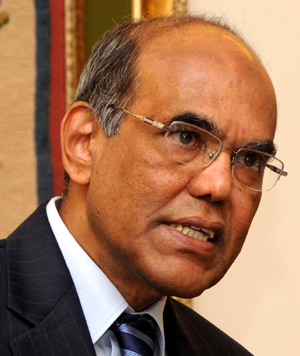 Srinagar, May 9: Reserve Bank of India (RBI) has asked banks in State to increase the credit-deposit ratio to 40 per cent from present 36.5 per cent by the end of current financial year to make sufficient credit available to the people of the State.
While addressing a press conference, RBI Governor Dr D. Subbarao, said that enough credit avenues are not available to the people in the State. He asked the banks to increase the credit Deposit ratio from 36.5 percent to 40 per cent by the end of the current fiscal year.
The RBI Governor said that the SARFAESI (Securitization and Reconstruction of Financial Assets and Enforcement of Security Interest) Act is not applicable in the State and Chief Minister Omar Abdullah has assured that all the DICs would be used to generate credit avenues for the banks.
The RBI Governor said that as far as the SARFAESI act is concerned it is not applicable to Jammu and Kashmir State due to Article 370. “But the Chief Minister has said it will be enacted shortly in the State either in the Assembly or through an ordinance”, he added
The SARFAESI Act empowers banks to dispose of assets of defaulting borrowers to recover loans from them without having to go through the time-consuming process of invoking such securities through a court of law.
The RBI Governor said proposals of flow of credit from District Industries Centres should be prompt and regular and that banks should be actively involved in skills development programme launched by the State Government.
The RBI Governor said that it was reiterated that no collateral security by way of mortgage should be taken by the banks up to loans of Rs.10 lakh.
Dr Subbarao said that till the end of the last fiscal year, 786 villages in Jammu and Kashmir with population above 2,000 have been covered in the financial inclusion policy by providing the people living in these villages with the banking facility. “Banks have been asked to cover all the 5,800 villages with population less than 2,000 in the State through financial inclusion by the end of this fiscal,” he said.
Replying to a question about Islamic banking being allowed in the country, Dr Subbarao said: “The proposal for Islamic banking has come to us from some Parliament members. It is being studied and examined by us. What needs to be seen is how Islamic banking would be allowed which does not allow taking and charging of interest on which our banking system operates.”
“We got to see that Islamic Banking which does not allow charging interest or taking of interest is inconsistent with our existing laws. All that I am saying is Islamic banking is not consistent with current banking laws,” RBI Governor said.
Charging of interest is necessary to conduct banking operation in India because banks have to borrow on which it has to pay interest rate, the RBI Governor said. “We only allow banks to take a credit risk under law,” he said.
“If an institution or bank is under Islamic banking, it will have to come under perview of Shariah regulation. It is not clear that there can be two regulatory agencies over the same institutions. RBI as the banking regulator and Shariah court as regulator for Islamic banking,” RBI Governor said.
The RBI Governor said that it is the Government which have to determine whether they want to permit Islamic Banking and if so they have to enact a law that is consistent with Islamic Banking.
Dr Subbarao said that RBI has completed investigations against banks after the expose by web portal Cobrapost for violating prudential banking norms and will take action if they are found guilty.
“We have done investigations, we have prepared an internal report. There are processes to be followed to take investigations to its logical closure. The first is action against individual institutions who are involved in practices which are not consistent with the banking regulation and prudential banking,” said the RBI Governor.
Cobrapost in its expose has alleged money laundering and other wrong doings by several public and sector financial institutions, including the country’s largest bank State Bank of India and the Life Insurance Corporation.
The RBI Governor also said it was a “misnomer” to call the West Bengal financial scam a chit fund scam, as chit funds are legal operations controlled by the central bank.
“What has been blown up in West Bengal is a collective investments scam which is regulated by SEBI (Securities and Exchange Board of India) and the SEBI is taking action in that.”
Dr Subbarao said it will inject liquidity through Open Market Operations (OMOs) to deal with any shortage of cash in the system. “As and when necessary, we will do OMOs to manage liquidity,” he added.
“The RBI does not use foreign exchange to manage the liquidity situation. We don’t use forex intervention as a measure of managing liquidity. Liquidity gets affected as a result of forex intervention,” Dr Subbarao said.
Trending Now
E-Paper
 Follow our WhatsApp channel