

Maj Gen SK Sharma
shiv_k_sharma@yahoo.co.in
In Kashirah village of Udhampur district, the temple of Raja Mandleek is very popular. On every Sunday, one can see hundreds of Hindus and Muslims gathering there to pay obeisance and get blessings of the lord, depicting a pleasant scene of Hindu-Muslim brotherhood. This temple serves as a center of social and religious unity.
History of Raja Mandleek
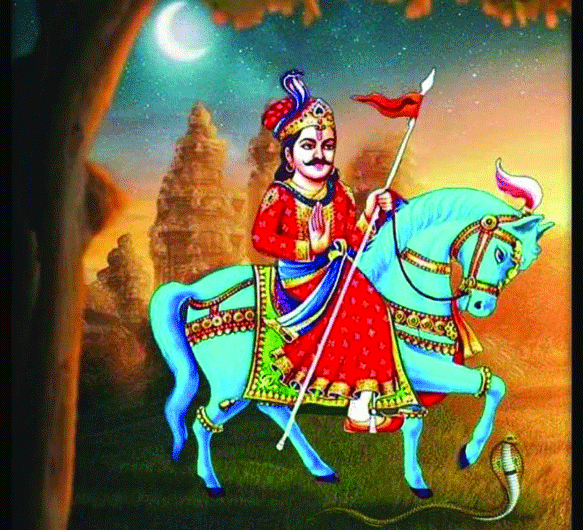
Raja Mandleek, the family deity (kul devta) of many communities in northern states of India is known by various names like Goga Devta, Gugga Devta, Gogga Veer, snake-God etc. Muslims refer Him as Goga Peer, Jahar Peer, whereas Kaimkhani Muslims claim that they are descent from him and that is why they regard him as a peer (saint). In J&K, he is the family deity of Samnotra baradari, Padyal brahmins and many others. Tens of his devasthans could be seen at various locations in Jammu province where lungars (community lunches) are organized on the day of Gugga Navmi and other occasions. Rituals start with holding of Pooja and Havan followed by Bhandara.
There are many folklores about the birth of Raja Mandleek. However, the most common belief is that, he took birth, in Vikram Samvat 1003 (approximately 946 AD or 10th century AD) in the family of Chauhan Rajputs of Dadreva village in the Churu district of Rajasthan. His father, king Jevar, was ruler of that area. Their spiritual guru Gorakh Nath gave a special fruit Gugal (Commiphora wightii) to his mother Rani Bachhal which made her pregnant, giving birth to Mandleek who later became king and was known as Raja Mandleek. Locals also started calling him Gugga ji, or Gogga ji.
Raja Mandleek was a warrior king and protector of cows of the region. He had tremendous spiritual powers and could save all those who were bitten by snakes. Many of his devotees call him as Snake-God.
He took samadhi (eternal rest) along with his blue horse at Goga Medi, around 120 KM from Hanumangarh, thus becoming a guardian for pastoral communities and snakes. His miraculous activities people started realizing even after he took samadhi. As this area was Muslim-dominated that time so, his temple was constructed in a mixed visible Hindu-Muslim architecture. Local Muslims worship him like a Peer and call him as Jahar Peer.
Kashirah Link
During around 17th century, the village of Kashirah and areas around used to suffer from frequent draughts. Besides, many farmers used to lose their lives due to bites of venomous snakes. It was believed that someone in the village had committed a grave crime which has annoyed the Almighty who has given shraap (curse) to the complete village. Poor public was fed up and started migrating to others better places.
A Samnotra Brahmin who was a farmer as well as a pundit (spiritual guide) in the village prayed to the Almighty for excusing the locals of the blunder they have committed inadvertently and relieve them of the shraap. In the night, he got a dream in which Raja Mandleek, riding on a blue horse, gave him darshans and showed him the path of getting relief from the shraap. In the morning, when he got up, he explained about Raja Mandleek to all the residents. Immediately, he prepared a photo of Raja Mandleek, kept in his house and started worshipping every day. He also declared Raja Mandleek as the Kuldevta (family deity) of all the residents of Kashirah and the areas around.
That year, the villagers saw miraculous events happening. The area got ample rainfall, good crops and no farmer in the area lost life due to snake bite. Since that time, all the villagers started paying their obesiance to Raja Mandleek and celebrating His birthday, which falls on Navmi day in the month of Bhadhrapad (a month in Hindu calendar) with pomp and show. This day in Northern India is also celebrated as Gugga Navmi.
Beliefs and Rituals Performed
Worshipping of the deity continued for centuries with more residents becoming strong believers of Raja Mandleek. To educate themselves about the deity, during 18th century, the Samnotra pundits went to Goga Medi village in Rajasthan where original temple of Raja Mandleek is there. They stayed there, learnt about the miraculous acts of the deity, the daily ritual details etc. so that they also get blessings from the lord in a proper way. After this they started the same customs in Kashirah temple also, some of which are:
* Wood ash (Doone ki rakh) is given to devotees as prasad along with a three-strand cotton for tying on their wrist which will save them from all evils.
* A few devotees undertake Jatter (spiritual shivering) which signifies entry of the spirit of the deity in them for their purity. A few devotees also go in for self-flagellation during Jatter, by hitting their body with sangals (special iron chains).
* Goat bali (sacrifice) is offered to the deity on special occasions. However, on a request from a Sardali brahmin in 1960s, this custom was stopped.
* If any individual bitten by snake bite is brought to the temple, a three-strand cotton thread is wrapped around his/her wrist for his/her safety. Till date, all such individuals have survived.
* A tied bunch of peacock feathers is used to perform Phanda to give relief to those suffering from some chronic disease.
* At the time of harvesting of any new crop, pratham bhog (first offering) is always offered to the deity before use by themselves.
* Biggest function in the temple is on Gugga Navmi, the day following Shri Krishan Janam Ashtami, when in addition to elaborate puja, elaborate bhandara is done feeding thousand of devotees.
As per the customs, the puja is performed by the male members only. However, during satkale period (at the time of birth or death in the family), they are not permitted to enter the temple and someone else is to be deputed for performing daily puja.
Kashirah history
Village Kashirah is situated on Dhar-Udhampur road and is just a few kilometers from Udhampur city. This city is strategically very important and Indian Army has established its prestigious Northern Command headquarters here. Even the Indian Air Force has used some land of Kashirah village and constructed an airport for their use.
Exact details of Kashirah are not well documented, however, as per the folklore, two jagirdars Murli and Mukat were controlling the complete area during 1140 AD. Farming was the main occupation of the residents. Their ancestors kept moving out of the village in search of better avenues. During 17th and 18th centuries, the influential personalities were Assa, Jassa, Govind and Billa. Billa was a Samnotra brahmin who used to perform religious functions too.
During 19th century, the six prominent descendants of Samnotra brahmins including Billa, Tilk Raj, Chooya, Dyaloo, Thakur Das were performing puja every day. However, another family of Sadotras was coopted and permitted to perform puja on special occasions.
The spiritual and magical popularity of these brahmins spread throughout the State of Jammu and Kashmir. During initial years of 20th century, Maharaja Pratap Singh, the then ruler of the State of Jammu and Kashmir took Nil Kanth, one of the descents of Billa, to his palace at Jammu for performing religious functions. The responsibility of puja, since then, was taken over by five Samnotra and a Sadhotra families, who now, are known as patedars (temple owners).
Till 2025, the responsibilities of daily puja in the temple were taken by rotation, one family at a time for one year. Hence the turn of that family used to come again in the seventh year. On the Goga Navmi day of 2025, all the six families decided to take services of expert pundits for puja instead of they doing it. This experiment will last for six years after which again it would be reviewed.
For readers
To get rid of any physical problem and experience solace, readers can visit this temple, especially on Sundays or Gugga Navmi day, get a sacred 3-strand cotton thread and dhoone ki rakh as prasad. Also enjoy the beauty of the village.
(The author is Former Board Member, Shri Mata Vaishno Devi Shrine Board and Advisor to J&K Dharmarth Trust Council)
 Follow our WhatsApp channel
