

Dr Sanjeev Puri
purisanjeev1@yahoo.co.in
This is the story of 57 years’ of modern transport in late 19th to mid 20th century in the Princely State of Jammu and Kashmir in the Dogra Maharajas’ rule under Partap Singh and Hari Singh, when the state was connected to the British India by rail. It was a dream project of Partap Singh costing a sum of Rs 9.60 Lakh lent by the Dharmarth Trust and this amount was recovered from revenue collected from Railway and Octroi. Jammu & Kashmir Railways owned and managed the 16miles(26km) standard gauge line (4ft8.5in) from Suchetgarh to Jammu Tawi while North-Western Railway (NWR) of India made 9mi/15km line connecting Sialkot Junction(Punjab) to Kashmir frontier(J&K border) with creation of Sialkot Cantt. station in between, total track being 25miles(41km).
Maharaja Ranbir Singh had proposed to fund its construction to the Governor General of India, for which an agreement was signed on July 4, 1888 during his son Maharaja Partap Singh’s rule. Maj Gen Raoul de Bourbel, a retired Colonel from British Indian army was made in-charge of J&K Public Works Department to lay this project. Work started in Oct 1888 and was completed on Mar 13, 1890. A steam engine train entered the state for the first time on March 15, 1890, Saturday at the Suchetgarh border from Sialkot for reaching Jammu, the winter capital, within 90 minutes. Maharaja dedicated it to his people and made its first 2 days’ run free for everyone.
The train passed through various stations: Suchetgarh named after Raja Suchet Singh, brother of Maharaja Gulab Singh, Ranbir Singh Pora, commonly spoken as Nawan Shahar, named after Maharaja Ranbir Singh, and a big business centre till independence, Miran Saheb a flag station, Jammu Cantt. a small station in army cantonment at Satwari, finally terminating at Jammu Tawi. All these stations were single story brick structures, and so were two major bridges. Initially the train halted at a temporary terminal in Jammu, 1/4mile from the left bank of Tawi River to be replaced by a full fledged terminal station established in 1897 with all the facilities including an octroi post and a Railway Chowni for housing the Railway staff. A floating bridge of old boats existed on Tawi with tongas running for Jammu city, it was later replaced by a suspension bridge, financed and managed by the Dharmarth trust again which recovered the cost from toll collection for using the bridge. Hoot of the train would give an idea about time as it could be heard in the whole town.
Suchetgarh Stn housed border octroi post as check point for people entering from Punjab by train, tongas/buggies, bullock carts, horses, and even on foot; it had a Sarai for night shelter and Raghunath temple made by Maharaja Gulab Singh in1837. There was no pucca road from Sialkot. Other sarais were presnt at Deewana Mandir in Nawan Shahar and Radha Krishan temple in Miran Saheb. Ranbir Singh Pora Stn had a crossing facility for trains with a platform, station masters’ office, ticket counter and quarters for guards with main wing comprising of three dome shaped entries for the platform.
Sialkot Junction was a busy station with trains coming from Lahore and Gurdaspur. The Jammu bound trains originated from Sialkot as well as Wazirabad thereby connecting Jammu with Lahore, Amritsar and Delhi. Passengers from these cities would arrive in Jammu for onward journey to Kashmir to escape hot summers. From Jammu Tawi Stn motorcars, buses, tongas, horse caravans and trucks would take them to Kashmir via Banihal Cart Road which was opened for public in 1922. Previous to this, the road was used only for the royal family. Similarly traffic coming from Srinagar would now halt at Jammu Tawi Stn for onward journey back by train. Jammu had transport agencies namely ND Radhakrishan, Allied Chirag Din and Sons and Nanda Bus Service operating buses and trucks for Srinagar.
1891 census shows population of Jammu 36000 and Sialkot 55000: twin cities closely linked with intimate relationship with Dogri speaking people, and the train providing a crucial connection for trade, travel, and cultural exchange with a hassel free passengers’ transport with restricted trade. This train made travel easy and became the lifeline for people of both the cities. Fare between Jammu/Sialkot was 4 annas whereas bus used to charge 5 annas, and rail fare between RS Pora/Sialkot was 1 anna. Goods imported from Punjab to J&K faced custom duty. Passengers had to undergo screening of luggage with payment of duty on even house hold goods. This was a major source of revenue for the state. Many people would travel daily for their jobs. Sports, a major industry in Sialkot, employed a large number of workers from Nawan Shahar villages. Cricket bats were made in “Kashmir Willows Factory” at Miran Sahib from the willows’ wood procured from Kashmir to be exported to Sialkot. This factory had skilled workers from Sialkot. RS Pura’s “Karan Sugar Mills” named after Yuvraj Karan Singh, would get sugarcane supply from Sialkot villages. During hot summers, people from Sialkot would take a dip in icy cool waters of Ranbir Canal in Jammu while enjoying chilled mangoes and milk bottles and return back in the evening. They would also buy kites and strings from Pacca Danga during Rakhi and Janamashtmi festivals. Jammu people would visit Sialkot to watch new movies in cinemas, much before they were shown in Uttam and Hari talkies of Jammu. Hockey matches at Sialkot between Murray College Sialkot and Prince of Wales College Jammu attracted a number of people from Jammu.
Besides passengers and goods, this train also carried letters and parcels between India and J&K under the Postal Treaty of 1st Jan 1890. Imperial Post Offices at Jammu and Nawan Shahar sold Indian and J&K stamps along the railway line as the posts crossing the border required both stamps.
The trains had 1st, 2nd, Inter and 3rd classes.1927 time table shows 3 pairs of trains between Wazirabad and Jammu via Sialkot, starting from Wazirabad (Up) at 6.05 am, 12.58 pm and 6.55 pm, reaching Sialkot at 7.44 am, 3.00 pm and 8.25 pm to reach Jammu Tawi at 9.15 am, 4.40 pm and 10 pm respectively. Last train took halt at Jammu Tawi Station for early morning departure. These trains left Jammu (Down) at 6.50 am 11.05am 8.29pm and reaching Sialkot at 8.49 am 1.09 pm, 10.30 pm and finally Wazirabad at 10.05 am 2.28 pm and 11.42 pm respectively. 1931, 1932 and 1935 time tables show introduction of a pair of Sialkot-Jammu Tawi trains starting (Up) from Sialkot Cantt. at 9.45 am reaching Jammu at 11.23 am to return (Down) from Jammu at 2.00pm reaching Sialkot Cantt. at 3.26 pm. It is said that this local train had one big couch carrying 200 people in each sortie, some sat on benches and others squat on the floor. However, only 2 pairs of trains in 1944 and 3 pairs in 1946 chugged between Jammu Tawi and Wazirabad via Sialkot with no train between Jammu and Sialkot as per the time table.
Prince of Wales, Edward on his visit to Jammu on Mar 2, 1922 was received by Maharaja Partap Singh and Raja Hari Singh at Jammu Tawi Stn from where he was taken to Satwari Cantonment as Jammu was gripped with plague. Mahatma Gandhi’s visit from Muzafrabad to J&K from 1 to 5th Aug 1947 just before Independence consisted of stay in Srinagar as Maharaja’s guest. He left on 3rd in a car for Jammu and stayed night in a bungalow, a summer residence at Sketar, Kud, the owner being Govind Ram, a contractor with wood business in Jammu. Gandhi arrived Jammu on 4th and stayed in the house of JL Sharma (Superintendant Ranbir Press) at Panjtirthi. He rode the train to Sialkot on way back. During the freedom movement against the British, Jammu Stn platform saw national leaders like Aruna Asaf Ali and Jai Prakash Narain addressing their supporters defying Maharaja Hari Singh’s forces.
Post 1947
J&K state remained independent even after India gained independence on Aug15, 1947 with creation of Pakistan. The state had Standstill Agreement with India and Pakistan with status quo in administrative, economic and security arrangements including communication and rail service. Communal tension built up in June 1947 in Jammu with Hindu/Sikh refugees migrating from areas of Punjab which would become Pakistan and Muslims from the rural areas coming to Jammu of which many migrated to Pakistan. This train service was suspended by the newly created Pakistan which inherited the North Westren Railways from British India. The last train coming from Sialkot on 18th September brought a larger number of Hindu/Sikh refugees, remained stationed at JammuTawi station while the last train from Wazirabad with hundred of refugees never reached Jammu as it was derailed 2-3 kms of Sialkot. Later Jammu lost its connection with Sialkot and it got connected with Gurdaspur of Indian Punjab by road improvement undertaken by Indian army engineers with a pontoon bridge over Ravi river in late September and early October 1947.
Post-Independence & Present
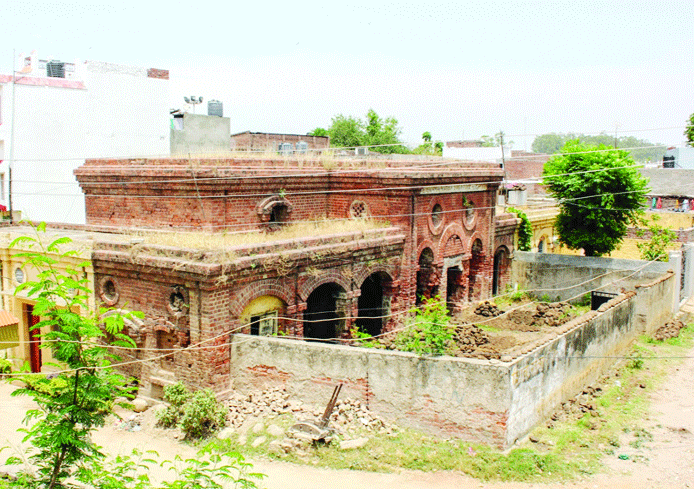
Hindu/Sikh refugees from Pak Occupied Jammu and Kashmir were settled on the property of J&K Railways with locality being called Patri and Nai Basti. Gradually the Railway infra-structure started getting vanished. BSF has set up its offices and control room in the old station building and octroi post at Suchetgarh border. BSF is now conducting Retreat parade regularly like Atari border. Ranbir Singh Pura station still stands tall with its name in Gurumukhi, English and Urdu in Ward 3 in a congested narrow lane surrounded by residential houses. Although in shambles, it has a platform, station masters’ office, ticket counter and quarters for guards. Inside there is a gigantic iron hose that fed water in the trains. There is no sign of the railway track on the platform, one can still find an iron lever to change the rail lines. Two portions of the station i.e. Station Masters’ office and Staff Quarters were occupied by the people who had renovated the old structure with new construction. Now this station has been vacated and is being renovated to its original form under the “Scheme for Revival, Restoration, Preservation and Maintenance of Architecture and Heritage”, the project has been approved at an estimated cost of Rs 1.05 crore and is being implemented by the Department of Archives, Archaeology and Museums. Flag station of Miran Sahab does not exist today, whereas Satwari station buildings are with Army and Air Force. Station at Jammu was transferred in 1954 to the Transport Department, converted into yard and workshop of J&K State Road Transport Corporation and the platform was demolished to widen the main road outside. A huge cultural complex, Kala Kendra, with Archives Department’s building has been constructed in a portion and and a major chunk of land on which a revolving platform stood for reversing the rail engine has been converted into a PWD store. One can see the Station master room and other buildings, and also few meters of uprooted rail lines and 1889 gigantic iron water hose imported from Birmingham that fed the steam engine and bogies along with a banyan tree. Railway staff quarters in the present warehouse are in shambles. Two Petrol Stations have come up along the road on the station land. The administration took the decision in 2021 for makeover of the Heritage Railway structures Jammu Smart City Ltd and Tourism Department, but no such development is visible on ground. These heritage buildings are decaying because of neglect and early attention is needed to preserve the history. Shops have come up in the Octroi Complex at Vikram Chowk adjacent to Amar Singh Club opposite the site of station. Bridges on the railway track are being used as a part of the roadway connecting RS Pura with Jammu. Similarly Sialkot Cantt. station remains abandoned on Pakistan side as only Jammu bound train used to pass through it.
(The author is a renowned Ophthalmologist)
 Follow our WhatsApp channel
