

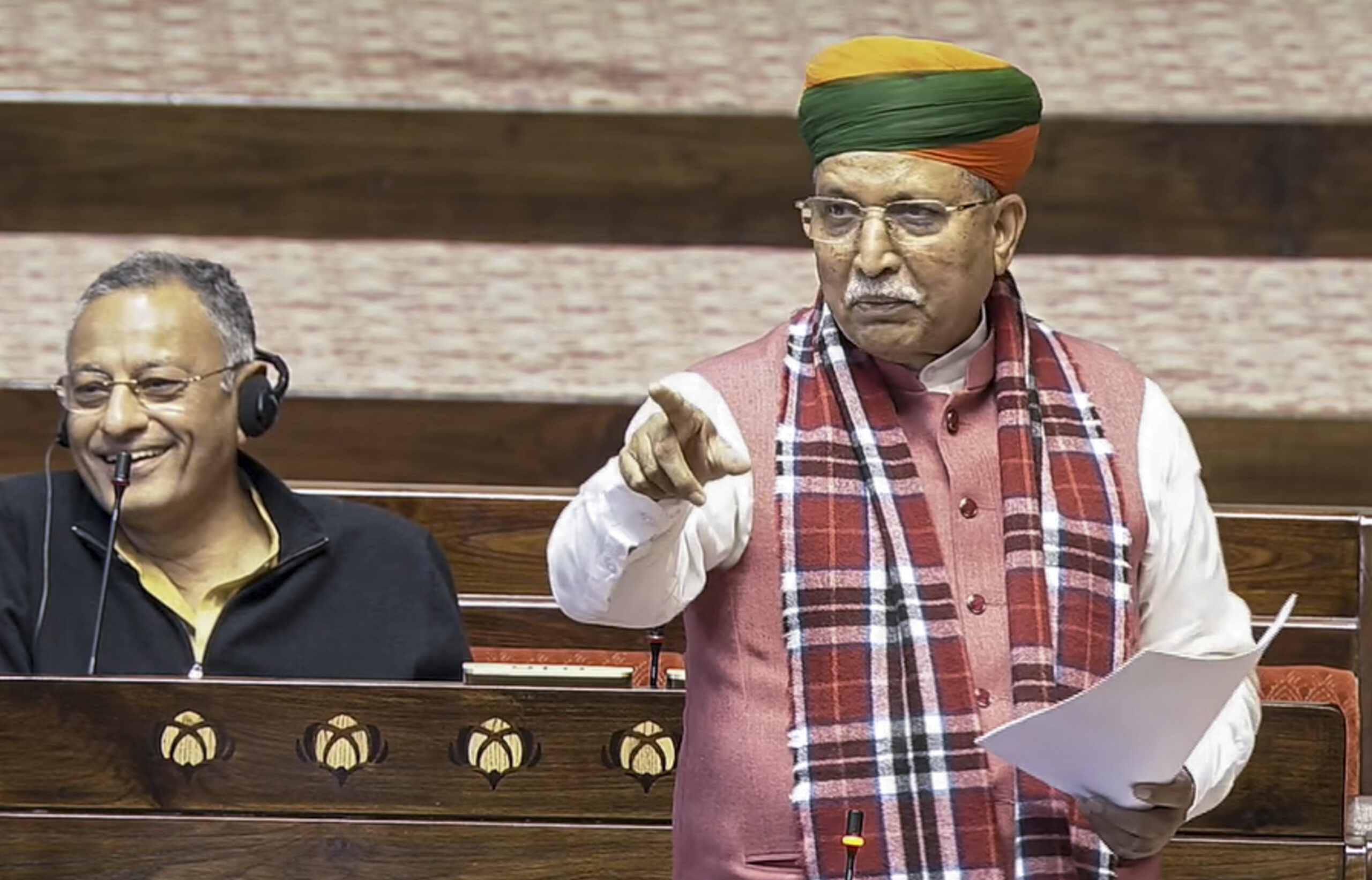
New Delhi, Feb 5: The government on Thursday informed the Rajya Sabha that the process to revise the Memorandum of Procedure (MOP) for appointment of judges in higher judiciary is under consideration and further steps in this regard will be taken only after it is complete.
Replying to supplementaries during the Question Hour, Minister of State for Law and Justice Arjun Ram Meghwal said consultations are underway on setting up the All-India judicial service and in what form it should be brought in.
Replying to Congress MP Rajeev Shukla’s query on whether the government was bringing in judicial reforms and whether the NJAC would be brought in again, the minister said all know that the National Judicial Appointments Commission Bill was passed by Parliament and the Act was later challenged in the Supreme Court and was struck down.
“After that, a procedure to revise the MoP (Memorandum of Procedure) is under consideration and the next step will be taken up after that process is complete,” Meghwal informed the House.
To another query on whether a national judicial service would be introduced in the country, the minister said, “Article 312 in our Constitution has a provision for the All-India judicial service and this issue has been discussed several times even during conferences of judges.” “This is an issue which is pending before the Supreme Court. Consultations on this are underway as to in what form this should be brought in. This matter is pending,” Meghwal said.
The law minister said in our democracy, judiciary is an independent organ of the governance system and is competent to handle all issues.
“Our government is also committed to ensuring the independence of the judiciary.
“We are ensuring that jointly with the judiciary, judges get a conducive environment to help provide justice to people,” he said.
The minister also said clearing pending cases is the right of the judiciary. He, however, said the government has helped increase the strength of the lower judiciary.
“In 2014, total strength of the judges in district and sessions courts was 19,518 and we have added 6,376 posts after that. The present strength of the lower judiciary has been increased to 25,894 by our government,” Meghwal told the house.
To another query by AIADMK MP M Thambidurai on what the government was doing to change the name of Madras High Court, the minister said, “There are several High Courts in the country which have old names. All these issues are under consideration.” In his written reply to the question on pendency of cases, the Law Minister said, “Pendency of cases in courts arise due to several factors, which inter alia, include complexity of the facts involved, nature of evidence, co-operation of stakeholders, viz., bar, investigation agencies, witness and litigants, the availability of physical infrastructure, supporting court staff, etc. besides the shortage of judges.” “The disposal of cases is within the exclusive domain of the judiciary. However, the Central Government is committed for speedy disposal of cases and reducing pendency as mandated under Article 21 of the Constitution and has taken several initiatives to provide an ecosystem for faster disposal of cases by the judiciary…
“The Government has been filling up vacancies of Judges in the Supreme Court of India and the High Courts from time to time. From 01.05.2014 to 19.01.2026, 72 Judges have been appointed in the Supreme Court. 1162 new Judges were appointed and 820 Additional Judges were made permanent in the High Courts during the same period,” he said.
He said the sanctioned strength of judges of high courts has increased from 906 in May 2014 to 1122 to date.
Further, filling up of vacant positions of the judicial officers in district and subordinate courts is the responsibility of the high courts and state governments concerned, the minister said.
As per the constitutional framework, in exercise of powers conferred under the proviso to Article 309 read with Articles 233 and 234 of the Constitution, the respective state government, in consultation with the high court, frames the rules and regulations regarding the appointment and recruitment of judicial officers, Meghwal said. (Agencies)
 Follow our WhatsApp channel
