

Dhurjati Mukherjee
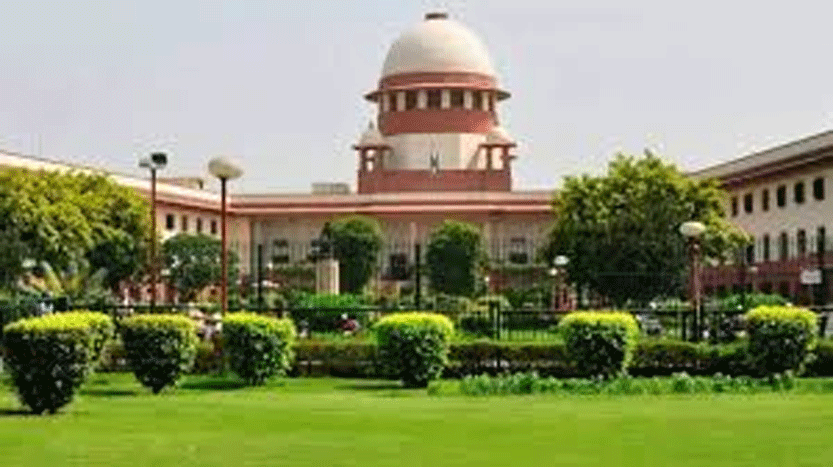
Just at the end of the year, the Supre Court gave a landmark judgment whereby it has ordered nationwide audit of all private and deemed universities, transforming a student’s grievance into a deep scrutiny of India’s sprawling education sector. In a sweeping directive, the apex court asked the Centre, all states and UTs and the UGC to submit personally sworn affidavits disclosing how these institutions were set up, who governs them, what regulatory approvals they hold and whether they truly function on a not-for-profit basis. While this should have been investigated long ago, it remains to be seen that in the year ahead there would be a drastic review of private universities to highlight their shortcomings.
The question that is being alleged by a large section of scholars, and quite rightly, is whether education has steadily become totally profit-oriented. Undeniably, this is a fact and the reason why business houses are setting up universities and academic institutions across the country. But the point here is why should a business enterprise enjoy various types of facilities when it gives very little to society? This has never been questioned by the government or even by civil society in the right manner.
It is a well-known fact that private universities charge exorbitant rates and are profit oriented. Most business houses find education a safe business to invest where risk involved is virtually mil. Moreover, in the name of being not-for-profit, they get land from state governments at highly subsidized rates. Recall, in 2017, a Supreme Court verdict invalidated engineering degrees awarded via unapproved distance mode to deemed universities and barred them from conducting such courses without clear regulatory approval.
The current order is far-reaching as it questions how private universities acquire land, appoint leadership, handle finances and whether they have credible grievance redressal mechanism. The demand for personal accountability – from chief secretaries to the UGC chairperson – signals judicial impatience with the status quo. It may further be pointed out that private universities, many of which operate under different and central laws, are rattled.
A question to be raised is what role the government has in the matter?Prime Minister Modi has been criticising Macaulay for anglicising the Indian way of thinking but the spread of quality education happened due to the efforts of the British. The Centre and the states have not invested adequately to ensure spread of education to all parts of the country, particularly rural and backward districts and allowed private parties to take over the business of education. There is no monitoring of fees being charged, whether seats are reserved for poor and marginalised sections and whether these institutions confirm to guidelines of the authorities, either by the Centre or the states.
Education being on the concurrent list both are liable to ensure the right of every individual to education. But if we are to assume that private and deemed universities give quality education, why can a farmer’s son not get the facility? These institutions are set up on huge land which now the new apex court order has asked the authorities to investigate. But it’s feared that vested interests will find a way out to protect them as these institutions are expanding rapidly and making enormous profits.
It would have been better if the court had found out a civil society organisation or an academic association in each state and asked them to file a report, simultaneously with that of the state governments. It would not be impertinent to say that most political parties and bureaucrats are seen as allegedly being dishonest and end up protecting owners of private and deemed universities. Or else how can they manage so much land near metros and big towns, which surround the educational complexes?
Has there been any investigation of the process of admissions to these institutions by any of the state governments? If there is any such a report, why has it not been made public? The undersigned, who was travelling to Delhi a few years back, was told by a family that they were asked to pay Rs 80 lakh extra (apart from usual fees) for their son’s admission in a private medical college in Kolkata. There would be similar examples and hardly a very few private medical colleges admit students strictly on merit without any underhand charges.
While most engineering colleges have been set up by private parties the question remains about the quality of teaching. The chief of KMDA (Kolkata Metropolitan Development Authority), a veteran civil engineer and guest faculty of many institutes, had once told me that when he asked one of his relatives why she had not gone to college (engineering), the young student replied that classes are not held every day. Moreover, when my friend asked how the vast syllabus is completed and how they give their exams, she replied that questions are given and students can go to the libraries and consult books in writing the answers. She also said that some students take the question papers home and submit the written answers the next day. This college happens to be part of a very renowned group of private colleges and one deemed university of Bengal.
This very well reveals the standard of teaching of most engineering colleges. The pay structure of most of these institutes is much below their government counterparts. As such, it has been found that retired professors and those who would retire within six months or so leave government institutions to join deemed universities. As in most other sectors, there is absolutely no monitoring and control as these institutions are owned by powerful people who are hand-in-glove with the ruling party and are only interested in making money.
How and why business houses with no academic background can be allowed to set up educational institutions? Why can’t educationists, doctors and engineers be motivated and financially supported to set up educational institutions, medical colleges, engineering colleges and the likes? There could be much talk about public-private participation in setting up engineering colleges with the help and support of organizations such as Coal India, MECON, NTPC etc and medical colleges with help from AIIMS, NIMHANS etc.
At a time when there is a dire necessity to upgrade standards of education and bring transparency and fairness in admission, the implementation of the Supreme Court order is a direct necessity and timely intervention by the apex court, though it should have come much earlier. It remains to be seen whether the state governments will fall prey to manipulations or be honest in putting forth before the court the real situation.—INFA
 Follow our WhatsApp channel
