

Verender Bangroo
virendrabangroo@gmail.com
Jammu, a region replete with historical significance and cultural richness, has long been a treasure trove of art, architecture, and heritage. As an individual immersed in the art scene of Jammu for over three decades, I have had the privilege of witnessing firsthand the unwavering dedication of collectors, enthusiasts, and artists who have tirelessly worked towards preserving the region’s rich cultural legacy. My involvement in the Jammu and Kashmir Festival in Delhi, where I extended an invitation to art aficionados from Jammu, served as a testament to their devotion to collecting and celebrating the region’s heritage.
It was during this period that I came across Anil Paba from Udhampur, a scholar, heritage enthusiast, and collector of artifacts whose work has been instrumental in highlighting the cultural richness of Jammu. Although I had heard about Anil ji’s endeavors for over 35 years, it was not until the COVID-19 pandemic, while serving as the Regional Director of the Indira Gandhi Centre for the Arts in Katra, that our paths converged online. I organized a series of webinars aimed at showcasing Jammu’s heritage, and Anil ji’s participation sparked a conversation that revealed his profound involvement in sociocultural and ecological issues pertinent to Jammu.
Anil Paba’s academic background is as fascinating as his professional trajectory. A banker by profession, he pursued his true passion, history and archaeology, by earning a Master’s degree in these subjects. His academic pursuits are reflected in his meticulous work, which includes extensive explorations of archaeological sites in Jammu and the mapping of ancient temples, particularly in Udhampur. His profound knowledge of prehistoric settlements, tools, caves, and temples is impressive, as he has not only focused on prominent sites like Manwal and Kirmichi but also shed light on obscure shrines tucked away in villages, often overlooked by many.
What distinguishes Anil ji’s work is his dedication to disseminating knowledge about Jammu’s heritage. He has regularly contributed to local newspapers, enlightening readers about Dugarland’s art, culture, literature, and language. Our interactions were always enriching, and he would share his writings with me, enabling me to gain a deeper understanding of Jammu’s heritage. It was a pleasure to learn alongside him, and our bond grew stronger over time.
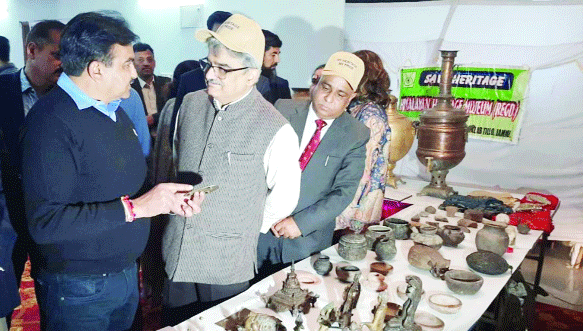
Anil Paba ji’s collection is a testament to his unwavering commitment to preserving Jammu’s heritage, comprising books, manuscripts, coins, and artifacts that narrate the story of this region. I had the opportunity to view his collection when he invited me to exhibit it for the visit of Minister of State for Culture, Arun Meghwal ji. The sheer diversity of his collection left me awestruck – paintings on cloth, manuscripts in Sharda, Devnagri, and Nastalik scripts, a remarkable coin collection, and artifacts crafted from bronze, brass, and wood. He meticulously organized the exhibition in a school hall in Udhampur, which was a grand success.
Meghwal ji was impressed by Anil ji’s collection and assured him of all possible assistance in preserving and promoting it. Anil Paba ji is, indeed, one of Jammu’s cultural jewels, passionately dedicated to preserving the region’s rich cultural legacy. Now, it is imperative for the government to provide him with the necessary support. Allocating land and infrastructure in Udhampur for showcasing his collection would not only honor his endeavors but also promote Jammu’s cultural heritage.
One of Anil Paba’s major contributions is promoting the restoration of the Devak River, an important water body in Udhampur, which holds significant socio-cultural and socio-religious importance in the overall ecology of the region. The Devak River is mentioned in the Puranas, and its maintenance and restoration are crucial for the region. There are many religious beliefs and practices associated with it. Paba left no stone unturned in advocating for its cause, writing to concerned authorities at the state and central levels to raise awareness about this important river.
His efforts paid off, and the central authorities took notice, initiating restoration work. The government acknowledged to his concern and guided the concerned department to expedite activities and developmental work related to this important river project. This is one of the significant contributions of Anil Paba, highlighting the importance of our water bodies – be it tanks, streams, rivers, or other water bodies.
In the Shivalik region of Jammu, there are many such water bodies that have been used for harvesting water since ages. However, they are often ignored and need conservation measures. These water bodies are not just relics of the past but are very much a part of our living and existential heritage. We need to take care of them, restore them, and make them alive and functional.
Another significant contribution of Anil Paba is through his writings. He is a prolific writer who has continuously highlighted the importance of heritage preservation and propagation, particularly among the youth of this region. His writings in print and non-print media emphasize that cultural heritage is an integral part of our eco-cultural heritage.
As a proud Dogra, Anil Paba writes with passion and interest, reflecting his commitment to preserving and promoting the region’s cultural heritage. His articles have been prominently featured in local media, including Jammu’s local print media, for over three decades. He continues to inspire and educate people about the importance of preserving our cultural heritage, and his efforts are a testament to his dedication to this cause.
Anil Paba’s work serves as a reminder of the importance of preserving our cultural heritage and the role we can play in promoting it. His contributions will undoubtedly have a lasting impact on the region and its people.
His contributions have been recognized, as evidenced by the Union Territory Award conferred upon him by Jammu and Kashmir. This acknowledgment underscores the government’s interest in promoting his work. However, the question remains: what’s next for his lifelong collection? It is imperative for the union territory government to provide him with the requisite space and infrastructure to showcase his artifacts. Imagine a dedicated space where visitors can immerse themselves in Jammu’s rich heritage through his collection – it could become a thriving hub for cultural enthusiasts!
His endeavors exemplify the importance of preserving cultural heritage. His work serves as a model for others, and it is essential for the government to support him in this endeavor. Providing a dedicated space for his collection would not only honor his contributions but also promote Jammu’s cultural legacy, inspiring future generations to appreciate and preserve their heritage.
Recommendations
The Union Territory Government should allocate land and provide infrastructure in Udhampur for showcasing Anil Paba ji’s collection.
The Government should establish a dedicated museum or cultural center to promote Jammu’s heritage.
His work should be recognized and supported through national and international collaborations to promote cultural exchange and preservation.
By supporting Anil Paba’ endeavors, we can ensure the preservation of Jammu’s rich cultural heritage for posterity.
 Follow our WhatsApp channel
