

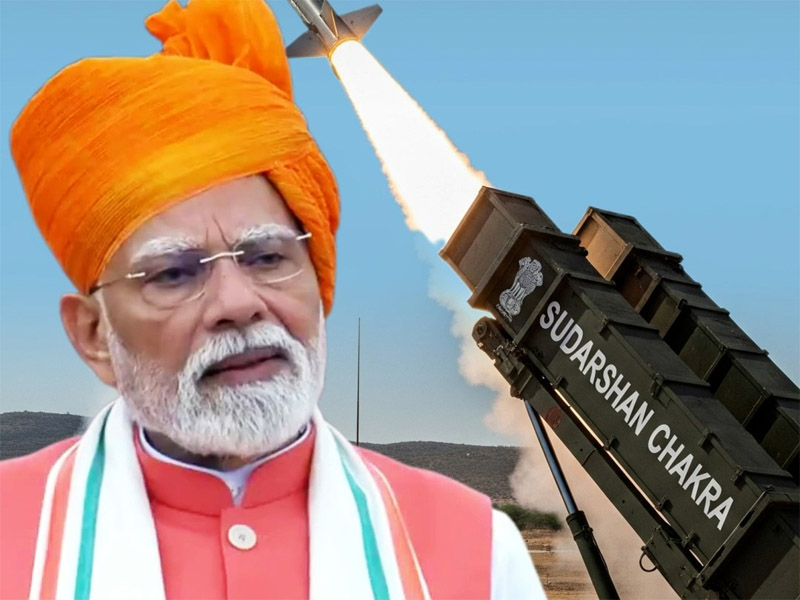
3-fold goals of Sudarshan Chakra Mission
5 red lines define India’s approach in dealing with Pak
Sanjeev Pargal
JAMMU, Aug 20: The Central Government is preparing for long-term threats beyond immediate responses to the terror attacks which is evident from ‘Sudarshan Chakra Mission’, announced by Prime Minister Narendra Modi during his August 15 Independence Day speech from Red Fort in New Delhi, a futuristic defence programme.
Follow the Daily Excelsior channel on WhatsApp
An official document released by the PIB titled ‘Transformation of India’s Defence and Internal Security Posture’ today said the goals of Sudarshan Chakra Mission are three fold which include to ensure that entire system is researched, developed and manufactured in India; to anticipate future warfare scenarios through predictive technologies and to create precise, targeted systems for counter-action.
“By 2035, the aim is to provide comprehensive national security shield for both strategic and civilian assets,’’ it said.
As per the document, the Prime Minister has laid down clear boundaries in dealing with Pakistan and five red lines now define India’s approach.
“Any attack on India will be met with a decisive reply, no tolerance for nuclear blackmail and nuclear threats will not prevent India from striking terrorist bases, no distinction between terrorists and their sponsors and both will be held equally accountable, terrorism first in any talks which means engagement with Pakistan, if it happens, will focus only on terrorism or Pakistan occupied Jammu Kashmir (PoJK) and zero compromise on sovereignty i.e. terror and talks can’t go together, terror and trade cannot go together, and blood and water cannot flow together,’’ the official document said.
It said more than 100 terrorists were eliminated including individuals linked to the IC-814 hijacking and Pulwama attack. Pakistan attempted retaliatory strikes through drones and missiles but the Indian counter-drone systems neutralized them.
“India’s defence and internal security posture under the Modi Government reflects a decisive shift towards strength, clarity and self-reliance with record investments in defence, rapid growth in indigenous production, bold reforms and the adoption of emerging technologies.
“India has transitioned from being a major importer to a rising global exporter of defence equipment. Firm responses to terrorism, the clear articulation of new normal with Pakistan, and futuristic initiatives like the Sudarshan Chakra Mission underscore a forward-looking security doctrine,’’ the document said.
It said India has adopted a firm and clear approach towards cross-border terrorism and pattern of action over the last decade reflects this policy.
“After Uri attack in 2016, India carried out surgical strikes across the Line of Control (LoC). Following Pulwama attack in 2019, India launched precision air strikes on a terrorist camp in Balakote. And the most recent and defining operation came in May 2025 with Operation Sindoor which was launched in response to the killing of civilians in Pahalgam. India gave its armed forces full freedom of action,’’ the document read.
Asserting that India’s journey of self-reliance has expanded beyond defence into food, health, energy, technology and financial inclusion, the document said Prime Minister Narendra Modi has emphasized that national security now includes these vital sectors, ensuring that the nation remains resilient against global challenges while steadily moving towards becoming the world’s third-largest economy by 2030.
“At the same time, progress in internal stability, food and energy security, financial inclusion and technology innovation demonstrates that Atmanirbharta is not confined to defence alone but forms the foundation of a resilient and confident India prepared to meet both traditional and non-traditional challenges on its path to becoming a global leader,’’ it said.
In the last 11 years, India’s defence and internal security posture under the government of PM Modi has undergone a “profound transformation”, it says.
The shift has been marked by “greater clarity of purpose, stronger deterrence, and a sustained drive for self-reliance,” the synopsis says.
This Government has consistently underlined that “national security is non-negotiable”, and to ensure this security, India will build its own capacity and preparedness.
This has resulted in a “more confident, modern, and proactive approach to challenges, both external and internal”. it added.
With record investments in defence, rapid growth in indigenous production, bold reforms, and the adoption of emerging technologies, India has transitioned from being a major importer to a rising global exporter of defence equipment, it added.
“India’s defence expenditure has steadily increased under the present government, rising from Rs 2.53 lakh crore in 2013-14 to Rs 6.81 lakh crore in 2025-26,” the PIB synopsis says.
“The focus is no longer only on acquiring weapons but also on building domestic capacity. In 2024-25, defence production touched a record Rs 1.50 lakh crore, more than triple the 2014-15 level,” it adds.
Fighter jets, missile systems, artillery systems, warships, naval vessels, aircraft carriers and a lot more are now being made in India, underlining how strongly “self-reliance and deterrence have become the cornerstone of national security,” the government said.
Defence exports grew thirty-four times over the last decade, reaching Rs 23,622 crore in 2024-25. Indian equipment is now exported to over 100 nations, including the United States, France, and Armenia, it said.
The document also shared data related to indigenisation efforts.
The SRIJAN Portal (2020) enables the industry to locally develop items earlier imported. “To date, over 46,798 items have been listed”.
And, Positive Indigenisation Lists by DPSUs have identified 5,012 items (across five tranches), “signalling a phased ban on imports”, it said.
 Follow our WhatsApp channel
