

Dr Rakesh K Pandit
7pandit77@gmail.com
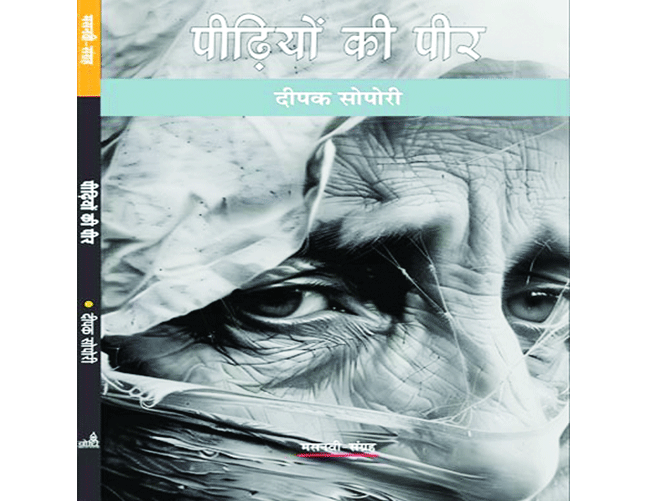
Book Name: Peediyu Ki Peer (Masnavi Poetry)
Author: Deepak Sopori
Pages: 91
Price: Rs. 179
The book titled “Peediyu Ki Peer” presents heartfelt human emotions and brings a depth of understanding and sensitivity of the author Deepak Sopori. This collection, his maiden poetry anthology, explores the themes, including fearless conscience, duty, longing, sorrow, conflict, truth and self-discovery. The themes explored in the book are diverse and wide-ranging. The poems are crafted in simple manner with footnotes making them accessible to readers of all backgrounds. This enhances their impact, allowing the emotions and messages to resonate deeply. Deepak’s poetry is not merely a collection of words but a voice of the soul-meant to be read, recited, and felt on vivid themes. This collection is a treasure of unique crafting in “Masnavi” style, a genre of Persian and Urdu poetry written in rhyming couplets where both halves of each verse rhyme, typically used for long narrative epics, philosophy, spiritual stories, etc.
In the first poem, Zafarname ki nazrr, the poet has been able to do justice to the message and essence of Zafarnama (Written by Guru Gobind Singh Ji in Persian, addressed to the Mughal emperor Aurangzeb after the Battle of Chamkaur). The poet highlighted that despite immense personal loss, how to maintain dignity, moral clarity, fearless conscience, righteous resistance, and the triumph of ethical authority over brute force. The poet has been able to combine the sharp political critique with spiritual wisdom, presenting truth and justice as the ultimate measures of power as mentioned in Zafarnama.
In the second poem, the poet delves deep in the samvada (dialogue) between Bhi?ma Pitamaha and Abhimanyu, as presented in traditional retellings of the Mahabharata. It is a deeply moving poem that brings into sharp focus the complexity of human relations. The poet beautifully crafted the emotions of age-old wisdom face-to-face with youthful heroism in a battle field. The author beautifully underscores the tension between duty and conscience, revealing Bhi?ma’s inner conflict and Abhimanyu’s destined martyrdom. Together, their dialogue in the poem enriches the Mahabharata’s enduring message on dharma, fate, and the cost of righteousness in the times of war.
In the third poem, the poet highlighted through his own experience of pain and agony a hypothetical conversation between a grandfather and his young grandson. This conversation is actually the story of each Kashmiri Pandit, who have been forced to leave Kashmir but their soul is still stuck there and wandering. For Kashmiri Pandits, leaving Kashmir was not like people changing houses but we left like people, whose roots were pulled out of the earth. “In the poem the grandson Neel asked grandfather Ramjoo to move beyond Kashmir in memory and thought. To that grandfather replied, it is like leaving Kashmir a second time and I cannot do that.”
In the fourth poem the poet presents significance of the meeting between Kashmiri Pandit Birbal Dhar and Maharaja Ranjit Singh. The meeting holds great historical and moral significance in the context of early nineteenth-century Kashmir. The poet boldly highlighted the convergence of clarity, moral courage, urgency, dignity and political power in response to oppression and immortal sacrifices by the family of Pandit Birbal Dhar, Qadis Khan and Pandit Bassa Ram for the safety of land of Kashmir, Sanatan culture and the resilience of Hindu civilisation.
In the last poem, the elegance and tradecraft shown by the poet in recounting the story of Raja Harishchandra and Sage Vishwamitra holds deep moral and philosophical significance in the Sanatan tradition, symbolizing the supreme value of truth and unwavering righteousness. The narration of the poem underscores timeless values of integrity, sacrifice, patience, and faith making it a moral compass for both rulers and common people. It affirms the Indian ethical vision that truth is the highest virtue, sustaining both individual character and social order. The flow of the story through the poem is so heart touching and exemplifies that truth ultimately triumphs, purifies the soul, and commands divine grace.
The book Peediyu Ki Peer presents a powerful and emotionally rich poetry anthology that blends history, spirituality, philosophy, and personal pain through the elegant Masnavi style. Through five deeply reflective poems, Deepak Sopori gives voice to themes of conscience, duty, truth, sacrifice, and identity. By drawing from sources like the Zafarnama, the Mahabharata, the history of Kashmir, and the legend of Raja Harishchandra, the poet connects timeless moral struggles with lived human experience. The collection emphasizes that poetry can preserve memory, awaken moral clarity, and inspire readers to reflect on righteousness, resilience, and the enduring strength of the human spirit.
(The book’s reviewer teaches Physics at Government Degree College, Ramnagar)
 Follow our WhatsApp channel
