

By Dr. Gyan Pathak
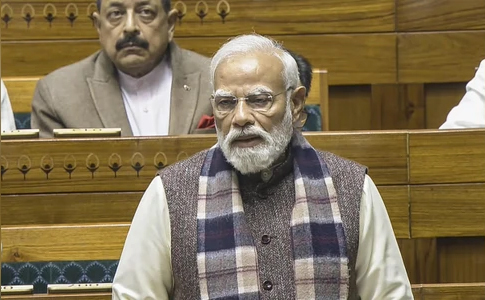
India wanted to celebrate the 150th year of India’s National Song “Vande Mataram” for its admirable role in the Freedom Movement of India, but PM Narendra Modi’s rhetoric in the Parliament of India using the history of its evolution as a national song turned the celebration into an event of utter bitterness.
PM Narendra Modi’s criticism of past Congress leaders on Vande Mataram either lacked understanding of the history or a deliberate attempt to selective rewriting of history of India, that by and large aligns to the Hindu Nationalism of RSS as against Secular Democratic Constitutional Nationalism of the country. Though his narrative is politically powerful, it is historically weak and constitutionally dangerous. He just reduced the history of a plural freedom movement into a communal morality tale, and unfairly used it against the present Congress.
The country has heard his speech and knew how a secular constitution balance was branded as appeasement, religious neutrality was miscast as anti-Hindu bias, a voluntary nationalism was replaced by performative nationalism, and minority rights were reframed as majority humiliation.
PM Modi’s has been repeatedly attacking past Congress leaders alleging them of adopting appeasement policy for Muslims and having anti-Hindi bias, which is not at all neutral understanding of the history of India during the freedom struggle, especially with reference to Vande Mataram. That is why may historians and constitutional scholars consider his speech as unfair and misleading.
How the Congress actually handled Vande Mataram? The Historical reality suggests that the Congress faced a genuine problem. By the 1930s–40s, Muslim leaders raised objections to the stanzas of Vande Mataram beyond the two stanzas, which contained explicit goddess imagery. They feared compulsory singing would blur the line between national loyalty and religious worship. This was not an artificial issue, but had emerged from the trauma of partition politics. There was deep anxieties about majority–minority power in a future independent India.
That is why the Constituent Assembly decided only the first two stanzas (which are purely about the land, rivers, soil) would be the National Song. “Jana Gana Mana” was accepted as the National Anthem. Moreover, it was also decided that no citizen would be forced to sing either. The Constitutional compromise was surely not “appeasement”. It was actually a constitutional accommodation done to prevent religious conflict. The decision was consistent with secular democracy, not appeasement.
Even Rajendra Prasad, Jawaharlal Nehru, and Maulana Azad and many other important leaders endorsed this balanced approach. Now let us see how PM Narendra Modi has been reframing it as “anti-Hindi” and Muslim appeasement for polarisation of Hindu votes in favour of BJP.
PM Modi routinely claims (directly or by implication) that: Congress leaders were “ashamed of Hindu identity”; They downgraded Hindu symbols to appease Muslims; and They weakened Vande Mataram due to “minority pressure”.
This framing works through three distortions: Turning secularism into “Anti-Hinduism”; Portraying Muslim concerns as “Illegitimate”; and Erasing Hindu support for the compromise. What actually Congress did? Two things are worth noting: Treated the state as religiously neutral; and allowed all communities to keep their faith without state coercion.
Making it the basis of his criticism, PM Modi suggested, if the state does not publicly privilege Hindu symbols, it is “anti-Hindu”. This flips secularism on its head: Neutrality is misrepresented as hostility.
In Modi’s rhetoric, Muslim objections are described as “Demands”, “Pressure”, “Vote-bank blackmail”. However, historically these objections were debated openly in the Constituent Assembly. Hindu leaders themselves agreed that a nation cannot be built by forcing a religious act on any citizen. Therefore, it is clear that the consensus reached either in the Congress and in the Constituent Assembly was a “consensus-based constitutionalism” which can’t be termed as “Muslim appeasement”.
The third distortion effected by PM Narendra Modi was erasing Hindu support of the Congress for their compromise. Modi’s narrative suggested that “Congress bent to Muslims against Hindu interests.” However, the historical reality is that Hindu leaders like Rajendra Prasad, Jawaharlal Nehru, Sardar Vallabhbhai Patel, and Radhakrishnan et all accepted limiting Vande Mataram to its non-religious core protecting freedom of conscience. It was a clear evidence that the decision was a not communal bargaining, rather it was national conflict management. PM Modi’s rhetoric is against historic understanding which not manages conflicts but creating new ones for polarisation of Hindu votes.
Nevertheless, PM Narendra Modi’s narrative is politically useful for him, RSS, and BJP. His narrative serves four major political goals: To construct a “Hindu Victimhood” narrative; To rebrand BJP as the “Corrector of Historical Wrongs”; To turn Pluralism into Betrayal: and To Blur the line between Nation and Religion.
By claiming that Congress “suppressed Hindu symbols” and Hindus were made to feel “second-class” he is trying to generate a sense of historical grievance which fuels mobilisation and cultural anger among Hindus against Congress.
Modi presents himself as the leader who will “restore what Congress denied”. Chanting Vande Mataram, temple politics, public display of religiosity of the state are being framed as “national correction,” not ideological change.
Anyone defending “Voluntary patriotism”, “Religious freedom”, “Constitutional limits on religious symbolism” is being branded as “Congress mindset”, “Anti-national”, “Appeaser” and so on. This is dangerous since this shrinks the space for dissent.
Under this narrative Nation seem to mean Hindu cultural expression, and disagreement with this narrative as disloyalty. During the freedom movement and in the Constituent Assembly debates nation meant shared political destiny across faiths and disagreement meant democratic right.
Core unfairness in Modi’s criticism are: portrayal of secular compromise as Muslim appeasement, Protection of conscience as insult to Hinduism; Voluntary patriotism as forced symbolism, Religious neutrality of state as pseudo-secularism, and conflict prevention as weak leadership. His rhetoric is not historical analysis but a political reinterpretation for mass mobilisation of Hindus in favour of BJP.
Congress and Constituent assembly ensured Vande Mataram as a national song, a unifying cultural symbol, and free from legal coercion. Ironically, under the majoritarian politics, Modi has been using it as a weapon against Congress, Muslims, and all the opposition parties that have considerable support among Muslims. Reducing the national celebration as a street level fight is highly deplorable. (IPA Service)
 Follow our WhatsApp channel
