

Rs 4.12 lakh cr projects under constant watch, major gains recorded
*IWT abeyance eases execution of hydropower projects
Mohinder Verma
JAMMU, Jan 5: Direct and continuous monitoring by the Prime Minister through the PRAGATI (Pro-Active Governance and Timely Implementation) platform has led to the completion of six high-impact projects worth Rs 53,000 crore in Jammu and Kashmir, while nine other projects costing Rs 59,000 crore are progressing at an accelerated pace.
Overall, 61 projects involving an investment of Rs 4.12 lakh crore are currently being monitored by the Project Monitoring Group (PMG) under the Cabinet Secretariat. Further, with the Indus Water Treaty (IWT) kept in abeyance, long-standing constraints on strategic hydropower projects such as Pakal Dul and Kishanganga have been removed, enabling faster execution.
CLICK HERE TO WATCH VIDEO
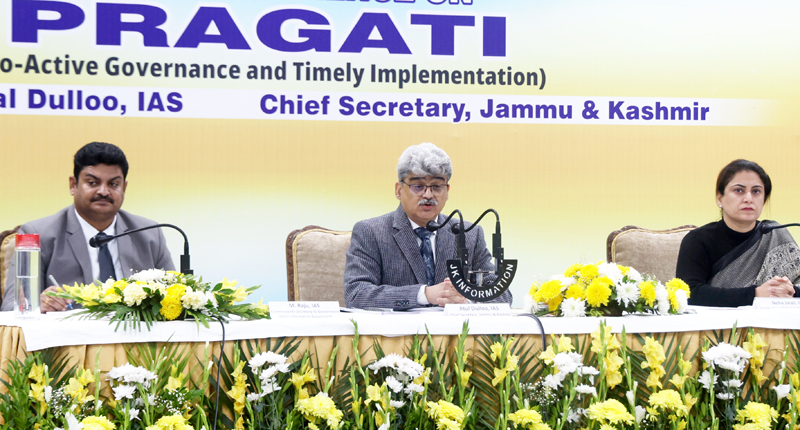
Disclosing this at a press conference organised by the Press Information Bureau (PIB), Ministry of Information and Broadcasting, in close coordination with the Department of Information and Public Relations (DIPR), J&K, Chief Secretary Atal Dulloo said that this technology-driven governance platform has emerged as a decisive tool for resolving inter-departmental bottlenecks, cutting procedural delays and unlocking projects that had remained stalled for decades.
Follow the Daily Excelsior channel on WhatsApp
Highlighting the transformative impact of the PRAGATI platform in expediting major developmental projects across J&K, he said, “this mechanism has emerged as a powerful instrument for resolving long-pending issues and ensuring timely execution of big-ticket initiatives”. He added that the basic aim is to fast-track long-pending projects through close coordination between the Centre and the Union Territory, remove bottlenecks and differences in implementation and expedite clearances involving multiple agencies.
The Chief Secretary informed that a total of 61 projects worth Rs 4.12 lakh crore are currently listed on the PMG portal, covering sectors such as connectivity, energy and social infrastructure. Of these, 15 projects worth Rs 69,000 crore have been completed, while the remaining 46 projects involving Rs 3.43 lakh crore are under execution.
He specifically pointed out that 15 high-priority projects worth Rs 1.12 lakh crore in J&K are being directly monitored by the Prime Minister through the PRAGATI platform, enabling swift resolution of issues related to land acquisition, financial and physical constraints, and ensuring timely and fair compensation to affected families.
So far, 59 major issues related to these projects have been taken up, of which 57-nearly 96 per cent-have been resolved. These issues primarily pertained to land acquisition, forest and environmental clearances, agriculture-related concerns, utility shifting and construction bottlenecks. Their resolution has placed the Union Territory among the top performers nationally, supplemented by robust district-level follow-up by the administration.
Highlighting PRAGATI’s tangible impact, the Chief Secretary said that six high-priority projects worth Rs 53,000 crore have been completed in J&K under constant monitoring through this platform. He cited the Jammu-Udhampur-Srinagar-Baramulla Rail Link (USBRL) project, launched in 1995 but delayed for nearly 25 years, which gained momentum and was completed after being brought under PRAGATI’s constant review.
Similarly, long-pending land acquisition and transmission-related issues of the Kishanganga Hydroelectric Project were resolved, enabling its completion. Problems affecting the Kishanganga transmission system, AIIMS Jammu (utility shifting), the Srinagar-Banihal stretch of National Highway-44, and the Alsteng-Kargil-Khaltse-Leh transmission line were also addressed, with the latter handed over to the Ladakh Union Territory.
Dulloo said that nine high-value projects, currently under PRAGATI supervision, are progressing at a satisfactory pace. These include the Delhi-Amritsar-Katra Expressway, AIIMS Awantipora, Pakal Dul Hydroelectric Project, 4G coverage under the Universal Service Obligation Fund (USOF) and several other energy and connectivity projects across different parts of the Union Territory.
He informed that apart from large infrastructure projects, PRAGATI also reviews social sector schemes and public grievances, reinforcing its role as a people-centric governance platform.
“At present, 56 schemes and programmes across the country, including those in Jammu and Kashmir, are being reviewed through PRAGATI, with the overarching objective of ensuring timely, efficient and outcome-oriented implementation of development initiatives,” he further said.
Replying to a question on hydropower projects in the context of the Indus Water Treaty (IWT), the Chief Secretary said that the treaty being kept in abeyance has fundamentally changed the situation. “Obviously, there are no restrictions now. All those restrictions have gone,” he said, adding that this would help fast-track projects like Pakal Dul and Kishanganga, which had earlier faced repeated objections, delays and cost escalations”.
He said it is now expected that the pace of execution of hydropower projects will further improve, ensuring timely completion and preventing them from turning economically unviable.
On delays in projects such as the Delhi-Amritsar-Katra Expressway and AIIMS Kashmir, the Chief Secretary said delays generally arise due to coordination bottlenecks or execution challenges. He clarified that AIIMS Kashmir is facing execution-related issues, not coordination problems, with delays caused by factors such as floods, adverse weather conditions and labour disruptions. He expressed confidence that AIIMS Kashmir would be completed by the end of the year, while delays in the expressway project were also attributed to flood-related disruptions.
On labour safety and welfare, Dulloo said responsibility rests with executing agencies, district administrations and the police, though he refrained from sharing operational details during the press conference.
Earlier, in her opening remarks, Director, PIB, Neha Jalali, described PRAGATI as a powerful illustration of how digital governance can effectively translate intent into tangible and visible outcomes. She said PRAGATI is not merely a review platform, but a transformative governance mechanism aimed at breaking bureaucratic inertia, strengthening the Team India approach through enhanced coordination between the Centre and the States, and fostering a culture of time-bound decision-making, accountability and outcome-based monitoring.
Citing the Jammu-Udhampur-Srinagar-Baramulla rail link as a key example, she noted that work on the project began in 1995 but witnessed limited progress for nearly 25 years due to multiple challenges, including difficult terrain, land acquisition issues, forest clearances and security-related constraints. She explained that after the project was reviewed under PRAGATI, critical approvals and statutory clearances were expedited and long-pending bottlenecks were resolved through sustained inter-ministerial and inter-agency coordination.
This coordinated and proactive approach ultimately resulted in the completion of the project, enabling operational rail connectivity in the Kashmir Valley and marking a major milestone in the region’s infrastructure development.
Commissioner/Secretary, Information Department, M Raju; Director, DIPR, Nitish Rajora; Joint Director Information Headquarters, Zahoor Ahmad Raina and Joint Director Information Jammu, Deepak Dubey were present in the press conference.
 Follow our WhatsApp channel
