

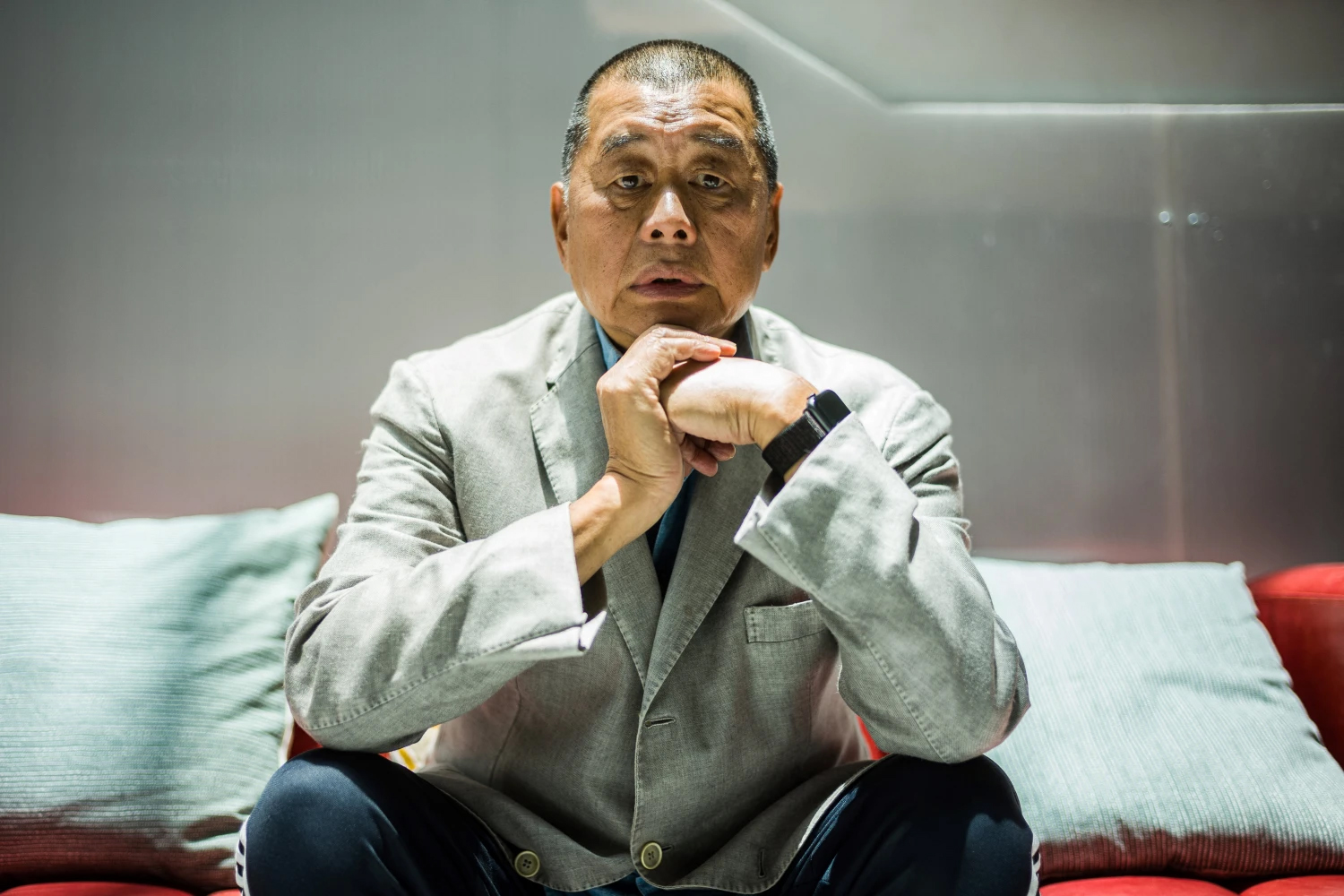
HONG KONG, Feb 10: Nearly five years after Hong Kong’s pro-democracy Apple Daily shut down, its founder, Jimmy Lai, is jailed, the newspaper’s former staff and readers are lamenting the loss of the city’s press freedoms.
Lai, 78, was sentenced Monday under a Beijing-imposed national security law to 20 years in prison, the longest such sentence so far. His co-defendants, six other former Apple Daily journalists, received jail terms ranging between six years and nine months and 10 years.
Officials in both Hong Kong and Beijing defended the case against Lai, with the city’s leader, John Lee, accusing the newspaper of inciting violence and poisoning young minds. The government insisted his case had nothing to do with press freedom, saying the defendants used journalism as a guise to commit acts that harmed Hong Kong and China.
There’s no question that things are different in Hong Kong without the Apple Daily. Since it folded, the city’s once freewheeling press scene has changed drastically; its voice was one of many that have been silenced in the former British colony.
“We’ve lost a newspaper that spoke for the people, and there’s no going back,” said William Wong, 66, who had been reading Apple Daily since its founding in 1995. He liked its sharp, to-the-point reporting and critical coverage of current affairs and politics.
Former Apple Daily journalists recall their work with pride
——————————————————————
Lai’s newspaper stood at one end of the media spectrum, openly supporting democracy, while at the other end, China-backed media outlets pushed a pro-Beijing stance. The Apple Daily’s position helped expand the space for other media outlets to operate, said Francis Lee, a journalism professor at the Chinese University of Hong Kong.
“When the one at the front has disappeared, the effect is that the whole spectrum and operating space will become narrow,” Lee said.
After 1997, when Britain handed control of Hong Kong to China, the semi-autonomous territory was promised 50 years of Western-style civil liberties, including freedom of the press. Some former Apple Daily journalists recalled those who were jailed as leaders who built a newsroom allowing them freedom and vast resources to report fearlessly and innovatively.
Resources provided to reporters seemed “endless,” said one former Apple Daily reporter, Kwok, who agreed to speak to The Associated Press on the condition of not using his full name to avoid trouble with his current job.
Lai introduced QR codes in the newspaper before they were commonly used, he said. Helicopters were used for aerial coverage of pro-democracy marches on July 1, the anniversary of the territory’s handover to China.
Reporters could report without fear, said Kwok, who was proud to work for a newspaper that he said stood with citizens.
The experimental media culture shaped Apple Daily’s digital offerings. Edward Li, a former chief news editor for its online news, developed animated video reports with satirical narration that were popular with residents, though they sparked debate over objectivity.
Li said he stayed for over a decade partly because the paper, with its “trial and error” culture, let him explore new formats. Li brought the same approach to Pulse HK, an online news outlet for Hong Kong readers that he co-founded after moving to Taiwan, a self-governed island democracy.
“If you never take that step, nothing will actually succeed,” Li said. “This is something that (Lai) inspired in me,”
In an industry where low salaries are the norm, both Li and Kwok were impressed by how the company rewarded employees with parent company shares.
Apple Daily runs into trouble
———————————–
Kwok said he sometimes felt uncomfortable when Apple Daily’s coverage glorified pro-democracy figures while being extra critical of their political rivals.
He was unhappy when Lai launched a campaign in May 2020, encouraging readers to petition US President Donald Trump, during his first term, to “save Hong Kong.”
Soon after the national security law imposed by Beijing to quell the 2019 massive pro-democracy demonstrations took effect in June 2020, police arrested Lai. They also arrested senior Apple Daily journalists, freezing USD 2.3 million of the paper’s assets in 2021. That forced the paper to shut down.
Kwok said he wept after editors he had worked with had been arrested. He also considered leaving Hong Kong, but could not for family reasons.
Lai, who pleaded not guilty, was convicted in December of conspiracy to collude with foreign forces to endanger national security and conspiring with others to publish seditious articles. The six others entered guilty pleas in 2022, admitting to the collusion-related charge accusing Lai and others of requesting foreign sanctions or blockades or engaging in other hostile activities against Hong Kong or China.
In his verdict on Lai’s case, the judges wrote that Apple Daily had turned into a newspaper that opposed the city and the Chinese government after an earlier pro-democracy movement in 2014.
Seeing their former colleagues in custody has been painful. “It’s like seeing your family members in prison,” said Li before the sentencing.
Some former Apple Daily reporters cried after Monday’s sentencing.
Hong Kong’s changes extend far beyond Apple Daily
————————————————————
A 2025 survey by the Hong Kong Journalists’ Association found that the city’s journalists view media self-censorship as widespread. The association has raised concerns about journalists facing harassment through anonymous messages. Some in the city have grown reluctant to talk to reporters.
The gap between freedom of speech and the press in Hong Kong and mainland China, where the ruling Communist Party bans public dissent, has grown much smaller. Dozens of civil society groups were disbanded. The city’s decades-old vigil remembering the 1989 crackdown on demonstrations in Beijing’s Tiananmen Square has vanished: its organisers are on trial under the security law.
News reports monitoring the government have dwindled, and officials now face less pressure over accountability, said William Wong, the former Apple Daily reader.
Ordinary residents have grown more cautious, and some avoid talking about politics, he said.
Simon Ng, also a longtime Apple Daily reader, said he believes media outlets are more restrained in their coverage.
“As transparency has weakened, it’s relatively more difficult to pursue the truth in news,” Ng said. (AP)
 Follow our WhatsApp channel
