

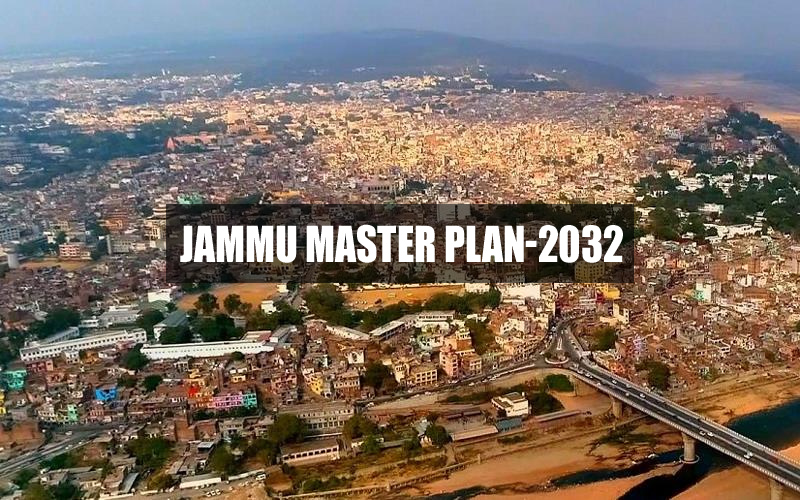
The unfolding delay in finalising the statutory framework for urban growth in Jammu has become a defining governance failure with long-term consequences for the region’s economic, ecological and social stability. A Master Plan is not merely a cartographic exercise. It is the scientific and legal backbone that determines how a city grows, how resources are allocated, and how future crises are prevented. The continued pendency of Master Plan 2032, despite statutory processes, public consultations, and technical groundwork, reflects a dangerous mismatch between urban realities and policy responses.
Historically, Jammu’s urban planning journey has been uneven. The first formal Master Plan, covering the period from 1974 to 1994, operated in a vastly different socio-political and demographic environment. The 1989-90 migration from Kashmir fundamentally altered Jammu’s urban trajectory, pushing population growth and land demand far beyond projections. Ironically, while work on the next plan began around 1989 with stakeholders and consultants, the process stalled into years of silence. What followed was a fractured continuation of the outdated 1974-1994 planning base, allowing unregulated expansion to take root. The subsequent plan for 2001-2021 attempted a course correction but suffered from glaring discrepancies-particularly in land-use zoning, slope conservation, forest protection, and safeguarding of nullahs and riverbanks. The consequences are visible today: small residential plots have been converted into congested multi-storey structures, encroachments have become normalised under the perception of future regularisation, and fragile ecological zones have been pushed to the brink. This legacy of weak enforcement and flawed planning continues to haunt present urban management.
The latest revision exercise involved multiple technical layers. Public consultations were completed, objections addressed, and inquiry mechanisms established. Yet, despite these milestones, the plan remains stuck in procedural limbo, with pending inputs from the Revenue and Forest Departments. In an era defined by digital governance and real-time data integration, such delays appear not only outdated but also catastrophic in planning terms. Unlike other cities, Jammu’s growth dynamics are uniquely volatile. The city has witnessed exponential population pressure driven by migration, climate-driven seasonal shifts, and the socio-economic pattern where families from Kashmir and Ladakh maintain secondary residences in Jammu. Every winter, the city functions far beyond its designed capacity. Housing demand spikes, water and power networks stretch to breaking point, and civic infrastructure struggles to cope with temporary yet predictable demographic surges. The absence of a revised Master Plan has direct, measurable consequences. Summers bring severe water and electricity shortages. Monsoons and flash floods repeatedly expose weak drainage planning. Traffic congestion has reached chronic levels, with every major road and chowk facing saturation. Markets are overwhelmed by pedestrian spillover, while parking and public space deficits continue to grow. Hospitals, schools, and public utilities operate under sustained pressure. These are not isolated infrastructure failures-they are symptoms of systemic planning paralysis.
Equally alarming is the stalled inclusion of nearly 350 villages into the expanded planning boundary. Without formal notification, these areas exist in regulatory ambiguity-neither fully rural nor properly urban. This creates fertile ground for illegal constructions, speculative land conversion, and infrastructure neglect. Investment hesitates, civic services remain inconsistent, and local populations remain trapped between administrative jurisdictions. The delay also undermines strategic urban restructuring. The proposed relocation of Government offices from the old city core was meant to free space for essential civic amenities such as public toilets, parking zones, green spaces and pedestrian infrastructure. Instead, additional structures have reportedly emerged in those same zones over the past five years, directly contradicting long-term planning objectives. Such contradictions deepen urban chaos and increase future demolition and rehabilitation costs.
Urban planning delays are not neutral-they are destructive. Every year of delay multiplies correction costs exponentially. Illegal constructions become politically and socially difficult to reverse. Ecological damage reaches irreversible thresholds. Infrastructure retrofitting becomes financially unsustainable. In planning science, delayed regulation almost always results in permanent disorder. For a rapidly growing city like Jammu, the stakes are existential. The Government must recognise that urban planning is not a file-based exercise but a time-sensitive intervention. Pending inter-departmental inputs cannot be allowed to paralyse statutory planning. Each passing month compounds risk. Jammu’s future depends on decisive, immediate notification and implementation of the Master Plan framework.
 Follow our WhatsApp channel
