

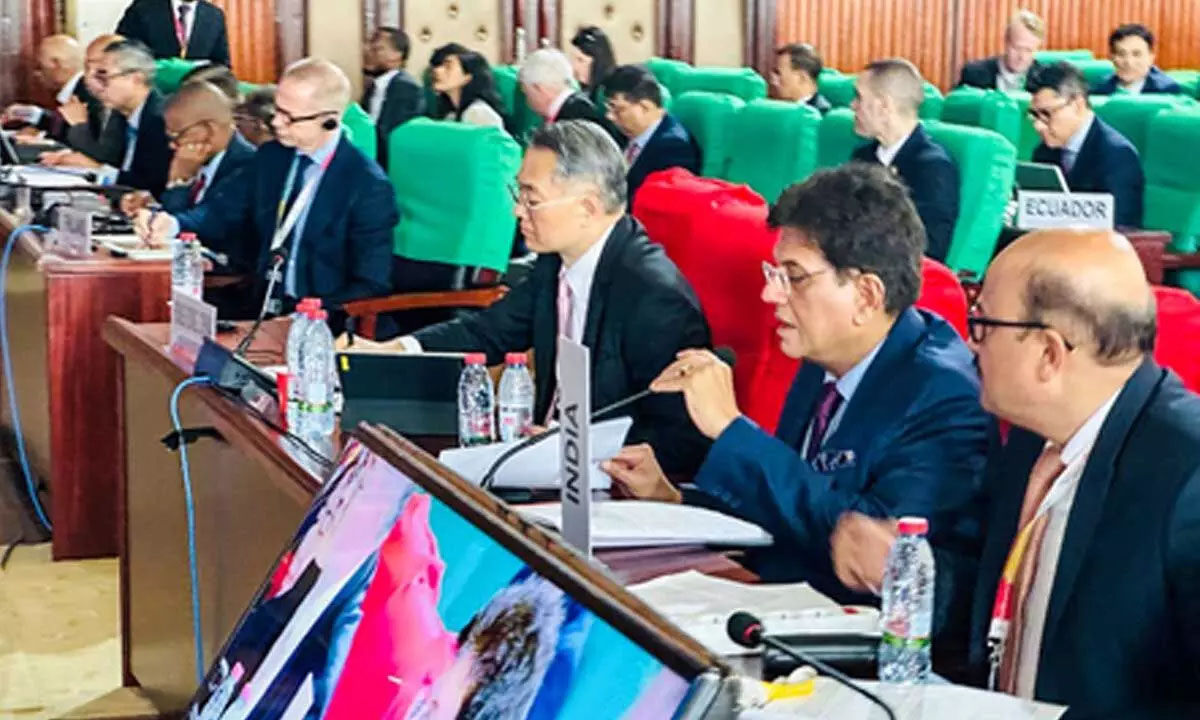
NEW DELHI, Mar 28: Commerce and Industry Minister Piyush Goyal on Saturday said that consensus-based decision-making is the bedrock of the WTO’s legitimacy highlighting the need to provide fair opportunity for member countries to participate meaningfully in global trade.
Speaking on ‘Decision making including past mandates’ on the second day of the WTO Ministerial Conference (MC) 14 in Yaounde, Cameroon, Goyal said that it is important for the WTO not to ignore the sovereign right of each member to not bind itself to rules which they do not agree to.
India stressed the importance of the WTO to undertake a careful stock-taking of the current impasse and the underlying causes, while ensuring discussions remain transparent, inclusive, and member-driven, the Commerce Ministry statement said.
India also highlighted that an integrated multilateral trading system cannot thrive alongside fragmentation within its own institutional framework.
On “Level playing field issues,” the minister said that discussions must take into account the asymmetries from the ‘Uruguay Round.’
The ‘Uruguay Round’ (1986-1994) was the eighth and most ambitious round of multilateral trade negotiations conducted under the General Agreement on Trade and Tariffs (GATT) involving 123 countries.
India emphasised that without effective adjudication, rules lose their enforceability which affect smaller economies.
India also cautioned against weaponising transparency to justify trade retaliation or challenge legitimate domestic policies. Instead, it should be accompanied by meaningful and sustained capacity-building support, ensuring that all members can meet obligations fairly and effectively.
India also stressed that all members have a fair opportunity to build productive capacity, create employment, and participate meaningfully in global trade.
On the sidelines of the second day meeting at WTO, the Minister also held bilateral talks with his counterparts from the US, China, Korea, Switzerland, New Zealand, Canada, Morocco, and Oman.
Discussions were mainly focused on matters related to deepening bilateral ties.
Commerce Secretary Rajesh Agrawal extended India’s support for a time-bound restart of reform efforts with milestones, based on a more robust evidentiary analysis and through engagement with submissions and ministerial decisions.
(UNI)
 Follow our WhatsApp channel
