

Veena Naravane
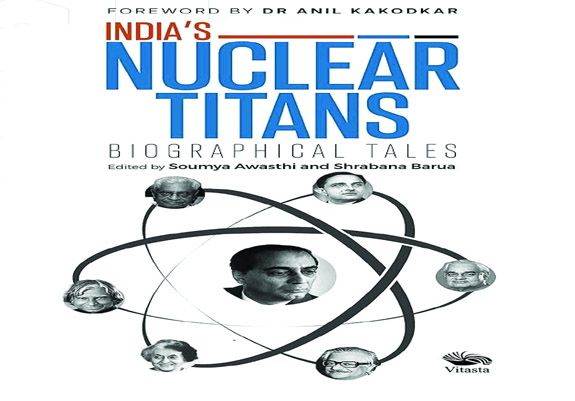
Name of Book : India’s Nuclear Titans: Biographical Tales (Vitasta Publishers, 2023)
Authors: Soumya Awasthi and Shrabana Baruah
India’s nuclear history is a tale of evolution through the past seven decades since independence. This evolution has been spurred on by a number of people: Scientists, Statesmen, Diplomats and Strategists. It is the result of the labour of many unsung heroes as well. In their book ‘India’s Nuclear Titans’, Soumya Awasthi and Shrabana Baruah have curated an anthology of biographical tales of ten eminent persons associated with India’s Nuclear programme. There is a total of eleven contributors to this anthology.
The book starts with a preface where the two curators of the book, Soumya and Shrabana, endearingly stand up for their alma mater, Jawaharlal Nehru University, and urge the readers not to give in to narrow-mindedness by believing in the bad press that JNU has received in the recent past. They go on to remind us of the great pool of talent that the university has provided to the nation. It is no surprise, then, that many of the contributors to this anthology are associated with JNU.
The book has ten stories in all, divided into four sections. Section A is titled ‘Scientists’ under which we read of Homi Bhabha, Vikram Sarabhai, Raja Ramanna and APJ Abdul Kalam. Section B is called ‘Statesmen’ and deals with Indira Gandhi and Atal Bihari Vajpayee. Section C is entitled ‘Thinker/Strategists’ and contains stories on K Subrahmanyam, Jasjit Singh and C Raja Mohan. Lastly, Section D, called ‘Diplomats’, deals with Arundhati Ghose. In addition to this, there is a very comprehensive introduction by Shrabana Baruah and a conclusion by Soumya Awasthi. In addition, there are brief write-ups on the contributors and an all-important list of abbreviations used in the book.
I recommend that all readers not skip the introduction in a hurry to get to the main content. The introduction encapsulates India’s journey in the field of nuclear science and its uses mainly in the field of renewable energy and strategic weapons. The introduction adds more context to the biographical stories that follow. It also sheds light on some debates that have become obscure over time but have not disappeared completely from our minds. One such question that always troubled me was how the early statesmen of independent India, whose thought processes were deeply entrenched in Gandhian principles, reconciled with the idea of the need for a nuclear programme for India when the only visible use of this science had been to destroy Hiroshima and Nagasaki!
There has seemingly been a dichotomy in India’s stance, where on the one hand, it supports disarmament and non-proliferation of nuclear weapons,yet on the other hand, it has not been a signatory to any non-proliferation or arms limitation treaty. Look into this book for an answer, dear reader!
One of the most exciting times in post-independent India was when it became openly nuclear with the 1998 Pokhran tests. This and the 2005 India-US Civil Nuclear deal put India firmly in the nuclear saddle, ending years of ambiguity and speculation regarding its intentions. The introduction throws light on this period as well, explaining very briefly the basics of Nuclear Science for the uninitiated.
As you dive into the book, the first story is of Homi Bhabha, the colossus who led India’s world of atomic research. This story, while highlighting his contributions, had some interesting vignettes on how Bhaba was considered to be a ‘colonial scientist’ unlikely to come up with any seminal work, as against the brilliantly original ‘western scientist’. We also learn of his struggles with fellow scientist Meghnad Saha and his lasting friendship with Nehru. The stories on the other three scientists, Vikram Sarabhai, Raja Ramanna and APJ Abdul Kalam, are equally absorbing. In their prolific and multi-dimensional careers, they applied their skills. Their thought processes shaped not only the nuclear programme but also set an entire nation on the path of modernity. The small insights into their foibles, like Ramanna’s love for the piano and green chillies, Sarabhai’s style of leadership, and Kalam’s doggedness, all make these icons more human for the reader.The stories do justice to their stature as the institution-builders of modern India.
The beauty of the book lies in the fact that each chapter comprises of several anecdotes on each personality which is gathered from the author’s interactions with their friends and family members, for example in the case of Sarabhai, his daughter was more than happy to interact, similarly, for K. Subrahmanyam his wife, grandchildren’s and colleagues from early days were interviewed, likewise, for Arundhati Ghosh, Vajpayee and others.
In the subsequent sections, we read about the eminent strategists, statesmen and diplomats who played equally essential roles in India’s nuclear trajectory. The punctilious K Subrahmanyam decoded India’s complicated relationship with the US. Ever pragmatic, he supported India’s alignment withthe USSR in 1971 and in 2005, the civil nuclear deal with the US. He explained the difference between non-nuclear deterrence and nuclear deterrence, leaving no room for ambiguity.
The diplomat Arundhati Ghose made no bones about the double standards and hypocrisy of the West regarding Pakistan’s proliferation of its nuclear arsenal. Atal Bihari Vajpayee was the Prime Minister when the Pokhran tests were accomplished. He went ahead with them despite the looming spectre of US sanctions, which many felt would come down as a sledgehammer the moment the tests came to light. After the successful testing, Vajpayee, in his characteristic gentlemanly way, did not claim the credit for it and was magnanimous enough to acknowledge the contributions of previous governments.
Another attractive aspect of the book is the compilation of images for each personality from childhood to adulthood, and also the interesting chronological flow of the timeline to explain the journey of India’s Nuclear program. The concluding chapter by Soumya is a perfect culmination of the book, which summarises for the readers how India’s growth in the field of nuclear has been from being ambiguous to being more assertive.
The aim of the book, we are told right at the beginning, is to analyse ‘the role of the people…who have contributed in catapulting India into the nuclear map of the world’. The book stays true to its intent. However, since it is autobiographical, it would have done better if it were a graphic timeline of India’s nuclear trajectory, indicating the contributions and timespan of each of the ten eminent persons, which would add to its overall appeal, making it more readable for the layperson, as well as the young readers. Another way of making it readable would be to follow an anecdotal pattern.The book reads like an academic work, which is inspiring and explains the tough and turbulent journey for India from meek to mighty!
 Follow our WhatsApp channel
