

Excelsior Correspondent
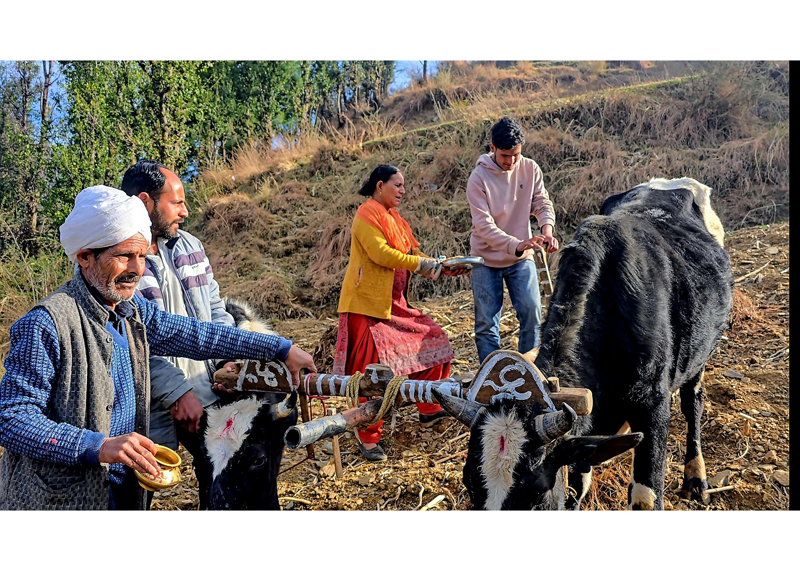
BHADERWAH, Mar 14: Primarily celebrated as the departure of the winter season and start of new agricultural season, Dharamdes festival, also known as Brahni and Soont was today celebrated with traditional gaiety and fervor across Bhaderwah Valley.
The festival is celebrated across the hilly Chenab valley since ancient times as the new year, especially by the farming community as agricultural practice still remain the primary occupation of 80 percent of the population.
“After prolonged harsh climatic conditions, from October to March due to which both cattle and humans remain indoors, Agricultural activities begin on first of Chet every year when earth becomes clear of snow,” said Puran Chand Bhagat, head Chaila (main Priest) of Village upper Bheja.
He said, “Locals here irrespective of their creed and caste take their oxen to the nearby field, perform their pooja by putting a ’tilak’ on their fore-heads and ‘gur'(jaggery) in their mouth and plough the land.”
The ritual is done by every male of the family including small children. Women folk dig the land with ‘kudali’. The day is called Dharamdees (Pious day).
As per tradition, In the preceding night, a large ‘Thali’ filled with rice, coin and gur is placed at the feet of the family deity.
Next day, before dawn someone from the family goes to the nearby ‘bowli'(natural fountain) to fetch fresh water. It is supposed that one who fetches the water first of all is blessed by the almighty.
The pot of fresh water is then placed near the ‘Thali ‘ called Kamrath and some jaggery eaten from it. This is done by every one from the family one by one.
During the festival, people avoid going to each other’s house believing that their going there would caste good or bad effect on the family for the whole year.
Not only elders but young generation also enjoys the festival and want to carry on with their culture.
 Follow our WhatsApp channel
