

Excelsior Correspondent
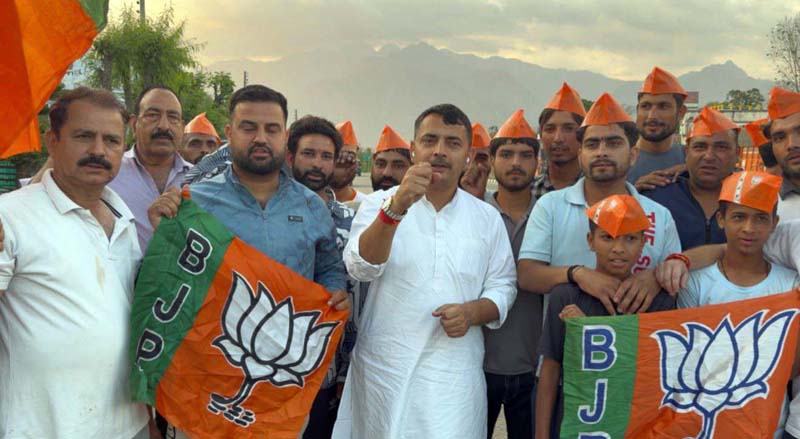
UDHAMPUR, Apr 12: Raising concerns over financial management in Jammu & Kashmir, MLA R S Pathania today cited findings of the Comptroller and Auditor General (CAG) of India to allege serious lapses in utilization of public funds.
Addressing people and party cadres across far-flung areas of Udhampur, he said nearly Rs 34,000 crore remains unspent, pointing to major shortcomings in fiscal planning and execution.
Quoting the audit observations, Pathania said around 160 centrally sponsored schemes, intended for direct public benefit, have witnessed negligible or zero expenditure. He termed the situation not just administrative inefficiency but a denial of development, asserting that funds released by the Centre are failing to translate into tangible outcomes on the ground.
Highlighting key concerns, he referred to the large volume of idle funds, poor implementation of schemes, and weak financial governance marked by delays, lack of monitoring and absence of accountability. He said these issues have compounded developmental challenges across sectors.
Drawing attention to ground realities, the MLA said several rural and semi-urban areas continue to face drinking water shortages, erratic power supply and poor road connectivity, leading to inconvenience and safety risks. He added that unemployment remains a major concern as employment-linked schemes have not been effectively implemented.
Pathania also flagged what he described as disproportionate neglect of Udhampur, citing a decline in district plan allocation and alleging that the district has been sidelined in developmental priorities.
He further stated that despite significant financial support from the Central Government, including substantial budgetary allocations, timely flood relief and additional assistance for infrastructure, the UT administration has not been able to utilize funds effectively. He attributed this to lack of coordination among stakeholders, resulting in policy paralysis.
Calling for corrective measures, he stressed the need for time-bound fund utilization, stricter monitoring of schemes, independent audits, transparency in performance and accountability for lapses.
 Follow our WhatsApp channel
