

Dr Mrinalini Atrey
Heritage is not only about the past-it is about shaping inclusive futures through memory, place, and participation. “Francesca Giliberto
This global vision finds intimate expression in the narrow, stone-paved lanes of Pakki Dhakki. This is not heritage in abstraction, it is lived, layered, and quietly eloquent. Tucked into a steep hillside overlooking the Tawi River, PakkiDhakki once carried the social magnetism that localities like Trikuta Nagar and Gandhi Nagar command today. It was a coveted address, humming with intellectual, ritual, and culinary vibrancy.
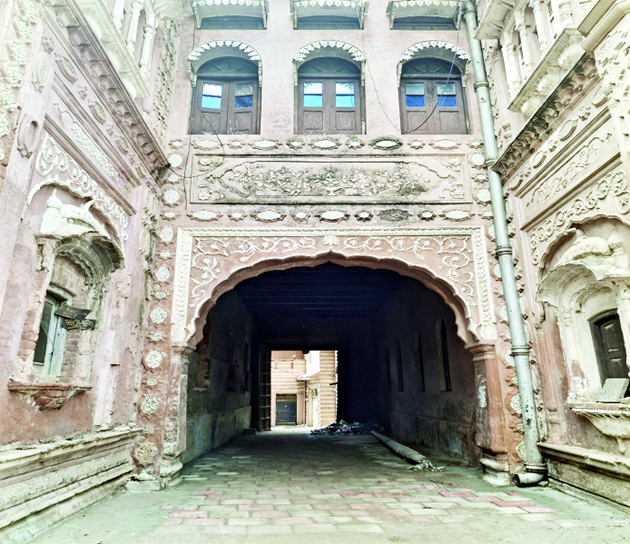
During my fieldwork, I walked through this storied terrain alongside Vaibhav Sharma and Nidhi Verma, residents whose memories thread lineage and locality with striking clarity. Here, ancestral homes speak through weathered facades and hand-carved doorways; temples emerge at turns, both unexpected and tender. Each pathway recalls the footsteps of poets like Dinu Bhai Pant, astrologer like Anant Ram Sharma, and royal chefs whose craft once nourished the Dogra court. Every silence echoes with the presence of palace women who trekked the incline for ritual ablutions at the river and worship at the RadhaRukimini temple.Pakki Dhakki is not just a place;it is a spatial archive, where memory and architecture remain entwined, waiting to be re-read.
The name Pakki Dhakki-meaning “paved slope”-derives from its distinctive stone-laid stairways connecting Mubarak Mandi, the royal palace complex, with the sacred banks of the Tawi River. Unlike other dhakkis (slopes) in old Jammu, which remained earthen or loosely paved, this was the only properly laid stone route used daily by palace staff and royal women. Its strategic location and durable construction made it a prized settlement for those serving the Dogra court: astrologers, water carriers (bishtis), chefs, artisans, and ritual specialists. Over time, it became an aspirational address-where proximity to power met the dignity of labour.
Along with important addresses, Pakki Dhakki is stitched with a sacred geography of temples, rituals, and intergenerational belief. At its heart lies the Radha-Rukmini temple, nearly 200 years old and the only known temple in North India where Rukmini is venerated alongside Radha and Krishna. Pilgrims once bathed in the Tawi before ascending the dhakki to offer rituals here. Abandoned after the monarchy’s end, it was revived by residents and is now managed by the Dharmarth Trust.
Across from it stands a modest Radha-Krishna temple nestled into the hillside. Below, where the slope flattens near the river, begins a cluster of shrines linked by a tiled walkway connecting Pakki Dhakki to DhounthlyDhakki. Steep stairs descend to the Narsingh Ji temple, which houses a shaligram with an open mouth signifying the Narsingh avatar. Though rebuilt, its sanctity remains.
A little ahead stands the remarkable Savitri temple-possibly one of Jammu’s oldest-built entirely of stone blocks with a pyramidal shikhar. Its interiors glow with miniature-style murals depicting the Ramayana and Krishna Lila. The Dharmarth Trust oversees its care. Nearby, the Dakshineshwari Kalika temple, though a recent structure, enshrines a Kali Mata idol believed to be five centuries old and visually akin to Bahu Fort’s icon. Adjacent Shiva temples, a black Shivalinga beneath a canopy, and a weathered one recovered from the Tawi, complete this sacred complex.
These temples do more than mark devotion;they map the spiritual choreography of palace women and pilgrims. Oral histories speak of a now-lost staircase, descending vertically from Mubarak Mandi to the riverbank near Savitri temple. Elders even recall a pulley-powered lift system once used by royal women, testimony to a kingdom’s entangled ritual and architectural intelligence.
Despite its rich historical fabric, Pakki Dhakki stands today in quiet decline. Its tiled lanes, laid only after persistent persuasion from residents, remain fractured and uneven. Many ancestral homes lie in disrepair as families have migrated to newer neighbourhoods, and with reduced patronage, the temples that once anchored daily life have begun to crumble. These are not just physical signs of neglect;they mark a deeper erosion of memory, identity, and civic responsibility.
Though drains have been installed, the air is thick with stench due to poor maintenance. The tiled trek, once envisioned as a heritage walk, is now choked with overgrown grass and scattered garbage. Ironically, this stretch remains one of the few open spaces amidst the dense cluster of built-up areas, offering a potentially picturesque morning walkbut it lies unused and unloved. A troubling apathy hangs heavy in the air. Residents, who no longer see themselves as stewards of their heritage, often forget that this is their inheritance to safeguard and pass on. Heritage must be lived to be preserved, and right now, Pakki Dhakki is being lived through silence, a silence laden with erased rituals, crumbling shrines, and fading identities.
This neglect is not merely local-it is mirrored and magnified by institutional oversight. The Smart City Mission, despite its stated commitment to inclusive urban renewal, has failed to recognise Pakki Dhakki as a heritage asset worthy of investment and visibility. Its plans focus on infrastructural upgrades and marquee projects, often privileging spectacle over substance. Pakki Dhakki, with its layered history and living sacred geographies, has been left off the map, literally and figuratively.
Similarly, the Mubarak Mandi Heritage Society, tasked with conserving the palace complex and its surrounding precincts, has yet to embrace Pakki Dhakki as an integral extension of the royal urban landscape. Despite its proximity and historical entwinement with Mubarak Mandi, the locality remains excluded from conservation dialogues, tourism circuits, and interpretive frameworks. This omission reflects a narrow understanding of heritage that isolates monuments from the communities, rituals, and everyday spaces that gave them meaning.
What is needed is a shift from monument-centric preservation to landscape-based stewardship, as advocated by UNESCO’s Historic Urban Landscape approach. Pakki Dhakki is not a peripheral zone but a connective tissue of memory, movement, and meaning. Its exclusion from revitalisation plans is not just a planning failure; it is a missed opportunity to foster cultural continuity, civic pride, and inclusive urban futures.
Technically speaking, the issue of local communities and their well-being has gained increasing attention in heritage conservation discourse, especially since 2005. While the inclusion of local communities in heritage site management was first emphasised in UNESCO’s 1996 Operational Guidelines, highlighting the need for their collaboration and approval in site nominations, the theme of community well-being is a more recent concern, formally emerging in the 2019 revisions. Scholars such as Chiara Bortolotto have argued that “protecting intangible cultural heritage is inseparable from the concerns of local communities” (2020), while William Logan has framed cultural practices as a form of human rights that must be recognised and safeguarded (2007). These perspectives underscore that heritage conservation cannot be divorced from the lived realities of those who inhabit and sustain these landscapes.
In the case of Pakki Dhakki, the disconnect between institutional planning and community stewardship reflects a broader global tension: between top-down revitalisation and bottom-up resilience. The Smart City Mission and the Mubarak Mandi Heritage Society have overlooked Pakki Dhakki’s cultural significance, failing to integrate it meaningfully into their revitalisation plans. Their omission reflects a narrow understanding of heritage, one that isolates monuments from the communities, rituals, and everyday spaces that gave them meaning. As global frameworks remind us, heritage must be conserved not only as a cultural asset, but as a dynamic resource for social cohesion, ecological sustainability, and community well-being.
We can transform passive neglect into participatory renewal by launching citizen-led heritage walks, reclaiming memory through interpretive signage, and petitioning for inclusive policy action. Pakki Dhakki’s legacy deserves to be lived again-through footsteps, stories, and care.
To reclaim Pakki Dhakki as a vital cultural landscape, it is essential to adopt a holistic and participatory approach that echoes the ethos of UNESCO’s 2011 Historic Urban Landscape recommendations, aligns with Sustainable Development Goal 11.4, and reflects the priorities of the New Urban Agenda. Restoring the pedestrian corridor between Mubarak Mandi and the Radha-Rukmini temple can create a curated heritage trail, layered with mnemonic and architectural memory. Expanding tourism circuits through interpretive signage and digital storytelling archives will enhance visibility and engagement. Establishing community-led heritage cells to collect oral histories and maintain shrines fosters grassroots stewardship and civic agency, while formally recognising Pakki Dhakki as a “Historic Urban Enclave” ensures access to preservation funding and policy inclusion.
These efforts must be mirrored in education and outreach, embedding the neighbourhood’s legacy into curricula, field visits, and intergenerational storytelling to support cultural literacy. Such integrated actions not only safeguard physical spaces but restore the emotional and narrative textures of the city. Preserving Pakki Dhakki is not just an act of remembrance-it is a shared responsibility and a promise to future generations. Its stones speak not of obstacles, but of enduring verses in the city’s sacred text, waiting to be reread through care, imagination, and collective will.
(The author is Secretary-General, ICICH-ICOMOS Co-Counselor, ICOMOS- India)
 Follow our WhatsApp channel
